If x > 0, what is the value of the following expression? 1 / [1 + x(b − a) +…
2023

If x > 0, what is the value of the following expression?
1 / [1 + x(b − a) + x(c − a)] + 1 / [1 + x(a − b) + x(c − b)] + 1 / [1 + x(b − c) + x(a − c)] = ?
Answer: B. 1 — Concept: Whenever a sum has three cyclic terms of the form 1/(1 + x^(m−n) + x^(p−n)), multiplying each term's numerator and denominator by the appropriate…
- A.
0
- B.
1
- C.
3
- D.
5
Attempted by 2 students.
Show answer & explanation
Correct answer: B
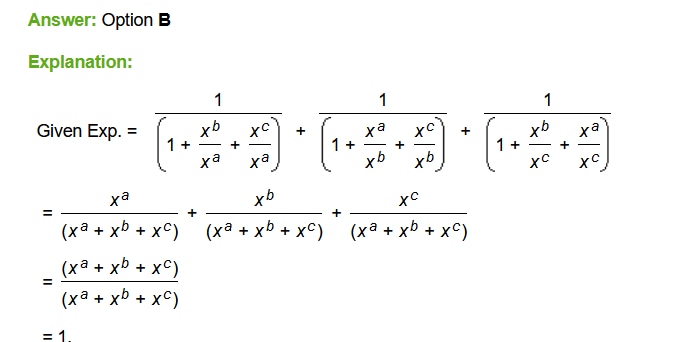
Concept: Whenever a sum has three cyclic terms of the form 1/(1 + x^(m−n) + x^(p−n)), multiplying each term's numerator and denominator by the appropriate power of x removes the negative/relative exponents and rewrites every term as a fraction over one common denominator x^a + x^b + x^c. Because the resulting numerators turn out to be exactly x^a, x^b, and x^c, they must add up to that same denominator, so the whole sum collapses to 1 — independent of the specific values of a, b, c, or x (for x > 0).
Working:
Multiply the numerator and denominator of the first term by x^a: since x^a · x^(b−a) = x^b and x^a · x^(c−a) = x^c, the term becomes x^a / (x^a + x^b + x^c).
Multiply the numerator and denominator of the second term by x^b: since x^b · x^(a−b) = x^a and x^b · x^(c−b) = x^c, the term becomes x^b / (x^a + x^b + x^c).
Multiply the numerator and denominator of the third term by x^c: since x^c · x^(b−c) = x^b and x^c · x^(a−c) = x^a, the term becomes x^c / (x^a + x^b + x^c).
All three terms now share the same denominator (x^a + x^b + x^c), so adding them gives (x^a + x^b + x^c) / (x^a + x^b + x^c) = 1.
Cross-check: Cross-check with a = 2, b = 1, c = 0, x = 2: the three terms evaluate numerically to about 0.5714, 0.2857, and 0.1429, which add up to exactly 1, confirming the result.
Answer: The expression simplifies to 1.