In an examination, 10 questions are to be answered, choosing at least 4 from…
2025
In an examination, 10 questions are to be answered, choosing at least 4 from each of Part A and Part B. If Part A and Part B each contain 6 questions, in how many ways can these 10 questions be answered?
Answer: C. 66 — Concept When choosing items from two separate groups under a split constraint, sum the combination counts over every valid split of the required total between…
- A.
44
- B.
55
- C.
66
- D.
None of these
Attempted by 2 students.
Show answer & explanation
Correct answer: C
Concept
When choosing items from two separate groups under a split constraint, sum the combination counts over every valid split of the required total between the groups — within a split the two group-choices are independent (multiply, by the multiplication principle), and across splits the cases are mutually exclusive (add, by the addition principle).
Application
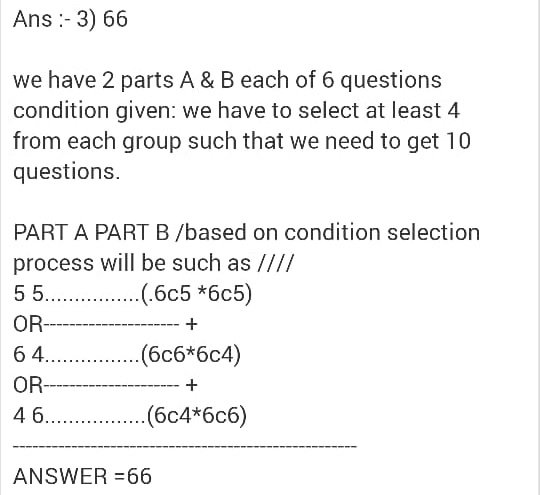
Let a = number of questions answered from Part A (out of 6) and b = number answered from Part B (out of 6), with a + b = 10, a ≥ 4, b ≥ 4, a ≤ 6, b ≤ 6.
Since b = 10 − a must be at most 6, a must be at least 4; combined with a being at most 6, the valid values are a = 4, 5, 6.
Split a = 4, b = 6: 6C4 × 6C6 = 15 × 1 = 15 ways.
Split a = 5, b = 5: 6C5 × 6C5 = 6 × 6 = 36 ways.
Split a = 6, b = 4: 6C6 × 6C4 = 1 × 15 = 15 ways.
Total = 15 + 36 + 15 = 66.
Cross-check
Only 12 − 10 = 2 of the 12 total questions are skipped, so no single part can lose more than 2 — meaning at least 4 from each part is answered automatically for any choice of 10 out of 12. So the count also equals the unconstrained selection 12C10 = 12C2 = 66, confirming the split-wise sum.
The correct answer is 66.