At an election, there are five candidates among which three members are to be…
2024
At an election, there are five candidates among which three members are to be elected, and a voter may vote for any number of candidates not less than 1 and not greater than the number to be elected. Then the number of ways in which a voter may vote is:
Answer: A. 25 — Concept: When a selection may include anywhere from 1 up to k items chosen independently from a set of n distinct items, the total number of ways is the sum…
- A.
25
- B.
30
- C.
32
- D.
None
Attempted by 4 students.
Show answer & explanation
Correct answer: A
Concept: When a selection may include anywhere from 1 up to k items chosen independently from a set of n distinct items, the total number of ways is the sum of combinations for each allowed size, because voting for exactly 1, exactly 2, ..., exactly k candidates are mutually exclusive cases: total = nC1 + nC2 + ... + nCk.
Application: Here n = 5 candidates, and the voter may vote for any number of candidates from 1 up to 3 (the number of seats to be elected).
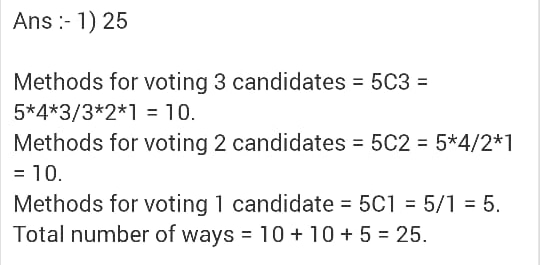
Number of ways to vote for exactly 1 candidate = 5C1 = 5.
Number of ways to vote for exactly 2 candidates = 5C2 = 5!/(2!×3!) = 10.
Number of ways to vote for exactly 3 candidates = 5C3 = 5!/(3!×2!) = 10.
Since these cases are mutually exclusive, add them: 5 + 10 + 10 = 25.
Cross-check: As an independent check, the sum of all subset sizes of a 5-element set is 25 = 32, since every candidate is either voted for or not. Removing the two disallowed cases — voting for none (5C0 = 1) and voting for more than three, i.e. four or five candidates (5C4 + 5C5 = 5 + 1 = 6) — gives 32 − 1 − 6 = 25, confirming the result.
So the number of ways in which a voter may vote is 25.