Solve (approximate each decimal to the nearest whole number): (41.992 −…
2025

Solve (approximate each decimal to the nearest whole number): (41.992 − 18.042) ÷ ? = 13.112 − 138.99
Answer: A. 48 — Concept: Many quantitative-aptitude “solve for ?” items deliberately use decimals that sit very close to whole numbers (here 41.99, 18.04, 13.11, and 138.99)…
- A.
48
- B.
67
- C.
89
- D.
40
Show answer & explanation
Correct answer: A
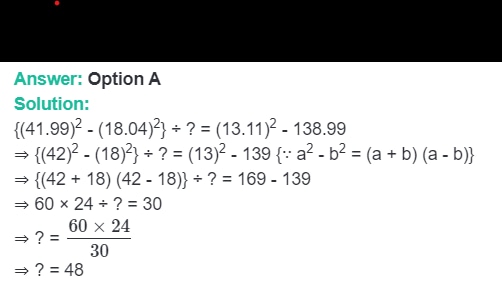
Concept: Many quantitative-aptitude “solve for ?” items deliberately use decimals that sit very close to whole numbers (here 41.99, 18.04, 13.11, and 138.99) as a shorthand for those whole numbers — the intended method is to round each one to the nearest integer first, then work with clean integers. Once rounded, the identity a2 − b2 = (a + b)(a − b) turns the squaring on the left-hand side into a quick product.
Application:
Round each decimal to the nearest whole number: 41.99 → 42, 18.04 → 18, 13.11 → 13, and 138.99 → 139.
Rewrite the left-hand side using the identity a2 − b2 = (a + b)(a − b): (42 + 18)(42 − 18) ÷ ? = 132 − 139.
Simplify the left-hand factors: 42 + 18 = 60 and 42 − 18 = 24, so the numerator becomes 60 × 24 = 1440.
Simplify the right-hand side: 132 = 169, so 169 − 139 = 30.
Solve for the unknown: 1440 ÷ ? = 30, so ? = 1440 ÷ 30 = 48.
Cross-check: Substituting back into the rounded, whole-number version of the equation confirms the result independently — 1440 ÷ 48 = 30, and the right-hand side 132 − 139 also equals 30, so both sides match exactly under the intended rounding convention.
Result: ? = 48.