It is being given that (323 + 1) is completely divisible by a whole number.…
2025
It is being given that (323 + 1) is completely divisible by a whole number. Which of the following numbers is completely divisible by this number?
Answer: B. 369+1 — For any number x, the sum-of-cubes identity gives x3 + 1 = (x + 1)(x2 - x + 1). This means x + 1 always divides x3 + 1 - whatever divisor N a number has of…
- A.
346
- B.
369+1
- C.
369
- D.
7 x 323
Attempted by 9 students.
Show answer & explanation
Correct answer: B
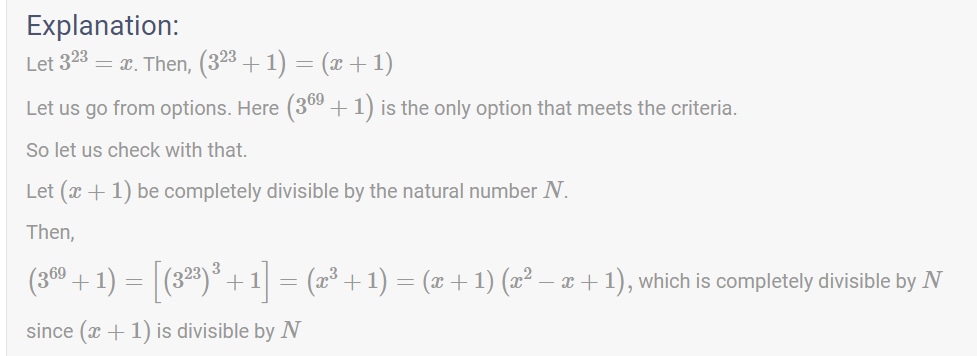
For any number x, the sum-of-cubes identity gives x3 + 1 = (x + 1)(x2 - x + 1). This means x + 1 always divides x3 + 1 - whatever divisor N a number has of the base (x + 1), that same N divides the cubed expression (x3 + 1) too, purely by the chain of divisibility, no matter what N actually is.
Apply this with x = 323, matching the question's number (323 + 1).
Let x = 323. Then x + 1 = 323 + 1 is exactly the whole number described in the question, and let N be any divisor of it.
By the identity above, x3 + 1 = (323)3 + 1 = 369 + 1, and x + 1 = 323 + 1 divides x3 + 1 = 369 + 1.
Since N divides 323 + 1, and 323 + 1 divides 369 + 1, N also divides 369 + 1 (divisibility chains through).
This holds for every possible N, which is what the question needs. As a check: 323 is odd, so 323 + 1 is even - meaning 2 is a valid choice of N. A pure power of 3 (like 346 or 369) is always odd, and 7 x 323 is also odd, so none of those three can be divisible by an even N such as 2. Only 369 + 1 is guaranteed divisible by every divisor of 323 + 1.