The remainder obtained when any prime number greater than 6 is divided by 6…
2025
The remainder obtained when any prime number greater than 6 is divided by 6 must be :
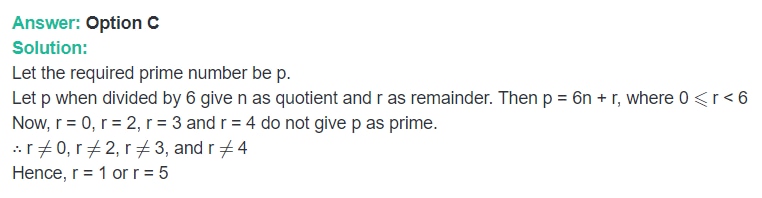
Answer: C. either 1 or 5 — For any integer n, write n = 6q + r, where the remainder r on division by 6 lies in {0, 1, 2, 3, 4, 5}. A prime number greater than 6 is not divisible by 2 or…
- A.
either 1 or 2
- B.
either 1 or 3
- C.
either 1 or 5
- D.
either 3 or 5
Attempted by 3 students.
Show answer & explanation
Correct answer: C
For any integer n, write n = 6q + r, where the remainder r on division by 6 lies in {0, 1, 2, 3, 4, 5}. A prime number greater than 6 is not divisible by 2 or by 3, so the remainder r must not make 6q + r divisible by 2 or 3 either.
r = 0: 6q + 0 = 6q is divisible by 6 (hence by 2 and 3) — not possible for a prime greater than 6.
r = 1: 6q + 1 is not automatically divisible by 2 or 3 — possible.
r = 2: 6q + 2 = 2(3q + 1) is always even — not possible for a prime greater than 6.
r = 3: 6q + 3 = 3(2q + 1) is always a multiple of 3 — not possible for a prime greater than 6.
r = 4: 6q + 4 = 2(3q + 2) is always even — not possible for a prime greater than 6.
r = 5: 6q + 5 is not automatically divisible by 2 or 3 — possible.
Cross-check with actual primes greater than 6: 7 mod 6 = 1, 11 mod 6 = 5, 13 mod 6 = 1, 17 mod 6 = 5, 19 mod 6 = 1, 23 mod 6 = 5 — every remainder that appears is 1 or 5, never 0, 2, 3, or 4.
So the remainder when any prime greater than 6 is divided by 6 must be either 1 or 5.