Directions for questions: Refer to the following information regarding data…
2025
Directions for questions: Refer to the following information regarding data interpretation questions and answer them accordingly :
A factory employs three machines M1, M2 and M3 to manufacture three products X, Y and Z. Each machine runs for 12 hours a day. The following table gives the time taken (in minutes) by each machine to manufacture 1 unit of each of the products.
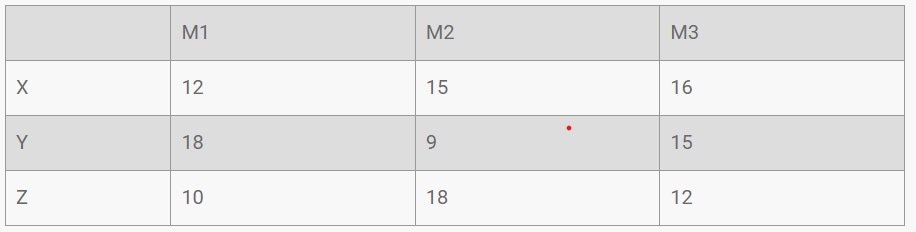
A unit of Y can be manufactured only after 3 units of X and 4 units of Z have been manufactured. What is the minimum time required to manufacture 15 units of Y?
Answer: A. 1359 minutes — Concept: When several products are produced by multiple machines with different per-unit times and every machine has a fixed daily capacity, the minimum total…
- A.
1359 minutes
- B.
1388 minutes
- C.
1309 minutes
- D.
1259 minutes
Attempted by 3 students.
Show answer & explanation
Correct answer: A
Concept: When several products are produced by multiple machines with different per-unit times and every machine has a fixed daily capacity, the minimum total production time is achieved by (1) assigning each product to the machine that produces it fastest, then (2) if that overloads any one machine beyond its daily capacity, shifting only as many units as needed to the next-fastest machine for that product, choosing to shift whichever product frees up the overloaded machine's capacity at the lowest extra time cost per minute of capacity freed.
Application:
To manufacture 15 units of Y, 3 × 15 = 45 units of X and 4 × 15 = 60 units of Z must be manufactured first.
Per-unit times (minutes): X — M1: 12, M2: 15, M3: 16; Y — M1: 18, M2: 9, M3: 15; Z — M1: 10, M2: 18, M3: 12. Each machine has 12 hours = 720 minutes available per day.
Assigning each product to its fastest machine gives X → M1, Y → M2, Z → M1. But M1 alone cannot make all of X (45 × 12 = 540 minutes) and all of Z (60 × 10 = 600 minutes) — together that is 1140 minutes, more than M1's 720-minute daily limit.
Keep all 45 units of X on M1: 45 × 12 = 540 minutes, leaving M1 with 720 − 540 = 180 minutes of capacity.
Use that remaining 180 minutes on M1 for Z: 180 ÷ 10 = 18 units of Z, taking 180 minutes.
The remaining 60 − 18 = 42 units of Z must go to the next-fastest machine for Z, which is M3: 42 × 12 = 504 minutes.
Produce all 15 units of Y on its fastest machine, M2: 15 × 9 = 135 minutes.
Total minimum time = 540 + 180 + 504 + 135 = 1359 minutes.
Cross-check:
Moving units off M1 to relieve its overload should cost as little extra time as possible. Moving a unit of Z from M1 to M3 costs only 12 − 10 = 2 extra minutes, while moving a unit of X from M1 to M2 would cost 15 − 12 = 3 extra minutes, and to M3 would cost 16 − 12 = 4 extra minutes. Since shifting Z is the cheapest option and 42 units of Z is exactly enough to bring M1 down to its 720-minute limit, this allocation is confirmed to give the minimum possible total time.