Directions for questions: Refer to the following information regarding data…
2023
Directions for questions: Refer to the following information regarding data interpretation questions and answer them accordingly :
A factory employs three machines M1, M2 and M3 to manufacture three products X, Y and Z. Each machine runs for 12 hours a day. The following table gives the time taken (in minutes) by each machine to manufacture 1 unit of each of the products.
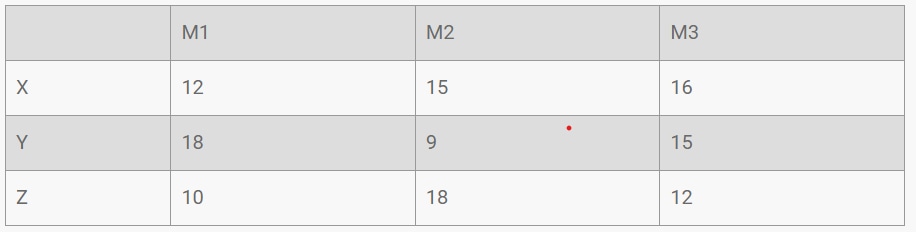
On a particular day, the demand for 40 units of X and 50 units of Y must be met. Once a machine is chosen to manufacture a product, that machine manufactures the product's entire required quantity for the day (that is, production of X, and separately of Y, is not split across machines). If the remaining production is of product Z only, what is the maximum number of units of Z that can be manufactured on that day?
Answer: C. 99 — Concept: This is a machine-allocation puzzle in which each of the mandatory products (X and Y) is manufactured using ONE single machine for the whole day —…
- A.
78
- B.
67
- C.
99
- D.
98
Attempted by 3 students.
Show answer & explanation
Correct answer: C
Concept: This is a machine-allocation puzzle in which each of the mandatory products (X and Y) is manufactured using ONE single machine for the whole day — the standard convention for this class of allocation problems — while the day's full demand for X and for Y must still be met. Under that convention, maximizing the residual product Z means choosing, for each mandatory product, the ONE machine where that specific product's own per-unit time is the smallest; this uses up the fewest machine-minutes to satisfy the fixed demand, leaving the most minutes free across the day. Each machine's own leftover minutes are then converted into units of the residual product using that same machine's per-unit time for it.
Application: Each machine works 12 hours = 720 minutes a day. From the given table:
X takes 12, 15 and 16 minutes per unit on M1, M2 and M3 respectively; the least is 12 on M1, so produce all 40 units of X on M1.
Y takes 18, 9 and 15 minutes per unit on M1, M2 and M3 respectively; the least is 9 on M2, so produce all 50 units of Y on M2.
M1 is now left with 720 − (40 × 12) = 720 − 480 = 240 minutes. Z takes 10 minutes per unit on M1, so M1 can additionally produce 240 ÷ 10 = 24 units of Z.
M2 is now left with 720 − (50 × 9) = 720 − 450 = 270 minutes. Z takes 18 minutes per unit on M2, so M2 can additionally produce 270 ÷ 18 = 15 units of Z.
M3 makes no X or Y at all, so its full 720 minutes are free. Z takes 12 minutes per unit on M3, so M3 can produce 720 ÷ 12 = 60 units of Z.
Total units of Z = 24 + 15 + 60 = 99.
Cross-check: X and Y were each routed to the one machine where that specific product's own per-unit time is the smallest in its column (12 for X against 15 and 16; 9 for Y against 18 and 15) — no other single-machine assignment for X and Y stays within each machine's 720-minute limit while leaving more spare time overall, so this allocation preserves the maximum combined leftover capacity for Z. Multiplying out and re-adding (24 + 15 + 60) confirms the total of 99 units.