A team of 5 players Ashwin, Rahul, Sachin, Virat and Rohit participated in a…
2025
A team of 5 players Ashwin, Rahul, Sachin, Virat and Rohit participated in a tournament and played four matches.
The following table gives partial information about their individual scores and the total runs scored by the team in each match.
Each column has two values missing. These are the runs scored by the two lowest scorers in that match.
None of the two missing values is more than 10% of the total runs scored in that match.
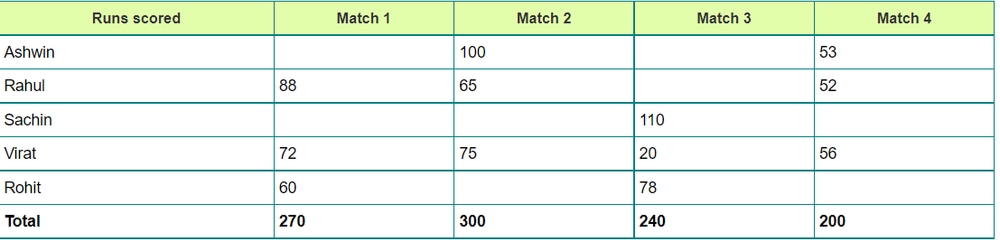
What is the maximum possible percentage contribution of Ashwin in the total runs scored in the four matches?
Answer: A. 19.7% — CONCEPT: In a table where each column has two missing entries belonging to the two lowest scorers, the missing pair in a column must sum to (column total…
- A.
19.7%
- B.
19.9%
- C.
20.1%
- D.
20.5%
Attempted by 3 students.
Show answer & explanation
Correct answer: A
CONCEPT: In a table where each column has two missing entries belonging to the two lowest scorers, the missing pair in a column must sum to (column total minus the sum of the known entries in that column). Two constraints then bound how large one missing value can be: (a) no missing value may exceed 10% of that column's total (the problem's own rule), and (b) since the missing pair is declared to be the two LOWEST scorers, neither missing value may reach the lowest KNOWN score in that column. To maximise one person's total across matches, push their value in each match to the highest amount allowed by whichever of these two constraints is stricter, leaving the other missing entry to absorb the remainder.
APPLICATION:
Total runs across all four matches = 270 + 300 + 240 + 200 = 1010.
Match 1 (Ashwin missing): known scores are Rahul 88, Virat 72, Rohit 60, summing to 220; the two missing entries (Ashwin, Sachin) sum to 270 − 220 = 50. The 10% cap for this match is 27 (10% of 270), and 27 is well below every known score, so the cap does not clash with the lowest-scorer ordering. Ashwin's maximum here is therefore 27, leaving Sachin at 50 − 27 = 23.
Match 2: Ashwin's score is already given as 100, so no maximisation is needed here.
Match 3 (Ashwin missing): known scores are Sachin 110, Virat 20, Rohit 78, summing to 208; the two missing entries (Ashwin, Rahul) sum to 240 − 208 = 32. The raw 10% cap here is 24, but the lowest-scorer ordering is the tighter constraint: since the missing pair must be the two LOWEST scorers and Virat's known 20 is the next-higher score, both missing values must stay below 20. Ashwin's maximum is therefore 19, leaving Rahul at 32 − 19 = 13.
Match 4: Ashwin's score is already given as 53, so no maximisation is needed here.
Ashwin's maximum total = 27 + 100 + 19 + 53 = 199 runs.
Maximum percentage contribution = 199 / 1010 × 100% ≈ 19.7%.
CROSS-CHECK: In Match 1 the binding limit is the 10% cap (27, well under the lowest known score of 60); in Match 3 the binding limit is the lowest-scorer ordering (19, tighter than the raw 24 cap). Since each match's value was pushed to the stricter of its two limits, 199 runs is genuinely the maximum — not merely a valid value. 199/1010 = 0.19702…, i.e. 19.7%.