P, Q, R, S, T, V and W are seven members of a family. Each one of them has a…
2023
P, Q, R, S, T, V and W are seven members of a family. Each one of them has a different profession- doctor, teacher, lawyer, engineer, architect, chartered accountant and banker and their incomes are different. There are two married couples in the group. R is the doctor and earns more than the engineer and lawyer. T is married to the chartered accountant and she earns the least. No lady is either lawyer or engineer. Q, the teacher, earns less than P- the banker. W is married to Q and he earns more than S and P. V is not the lawyer. The Chartered accountant earns less than lawyer but more than the banker.
What is the profession of T?
Answer: C. ARCHITECT — Concept: Selection/decision-table puzzles like this one are solved by first locking in every profession stated directly in the clues, then using indirect…
- A.
LAWYER
- B.
CA
- C.
ARCHITECT
- D.
ENGINEER
Show answer & explanation
Correct answer: C
Concept: Selection/decision-table puzzles like this one are solved by first locking in every profession stated directly in the clues, then using indirect clues - gender restrictions, marriage links, and income comparisons - to eliminate the remaining possibilities until only one profession is left for each person.
R is the doctor, Q is the teacher, and P is the banker - each stated outright in the passage (direct clues).
The clue that T (referred to as "she") earns the least establishes that T is female. Combined with "No lady is either lawyer or engineer," T cannot be the lawyer or the engineer.
T is described as married to the chartered accountant, so T and the chartered accountant are two distinct people - T herself cannot be the CA.
With doctor, teacher and banker already assigned to R, Q and P, and lawyer, engineer and CA all ruled out for T, the only profession left for T is architect.
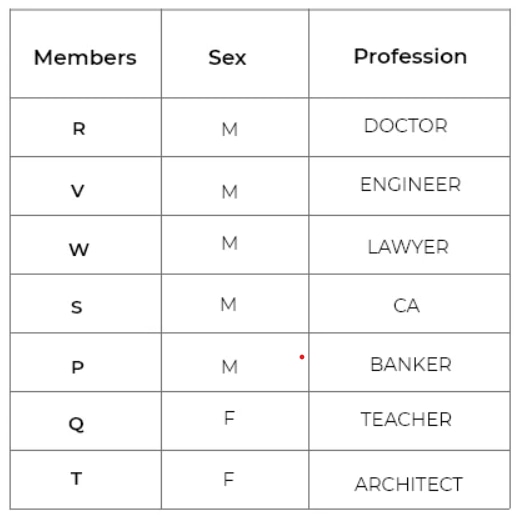
Cross-check: The reference table below (matching the original source) completes the arrangement as V-Engineer, W-Lawyer and S-Chartered Accountant, which satisfies every income and marriage clue given; note that T's profession as architect follows directly from the clues above regardless of exactly how these remaining three roles are resolved.
The table below summarizes the complete assignment: