Each of the following questions is based on the following information: Six…
2024
Each of the following questions is based on the following information: Six flats on a floor in two rows facing North and South are allotted to P, Q, R, S, T and U.
Q gets a North facing flat and is not next to S.
S and U get diagonally opposite flats.
R next to U, gets a south facing flat and T gets North facing flat.
If the flats of P and T are interchanged then whose flat will be next to that of U?
Answer: C. R — In a double-row seating arrangement with three flats facing each other in each row, "next to" means adjacent within the SAME row, and two flats are…
- A.
P
- B.
Q
- C.
R
- D.
S
Attempted by 3 students.
Show answer & explanation
Correct answer: C
In a double-row seating arrangement with three flats facing each other in each row, "next to" means adjacent within the SAME row, and two flats are "diagonally opposite" when one sits at an end of its row and the other sits at the far end of the opposite row. Fix the rows first from the direction clues, then the seat order from the adjacency clues, and finally re-apply any stated swap.
Step-by-step:
R gets a south-facing flat and is next to U; since "next to" only applies within a row, U must also be in the south-facing row.
S and U are diagonally opposite, so they sit in different rows; since U is in the south-facing row, S must be in the north-facing row.
Q and T are already placed in the north-facing row, so that row is {Q, S, T}; by elimination, the south-facing row is {P, R, U}.
Q is not next to S, so in a row of three they must occupy the two end flats with T in the middle - the north-facing row reads Q-T-S or S-T-Q.
S sits at an end of the north-facing row, so its diagonal partner U sits at the far end of the south-facing row; R, the only other person in that row, takes the middle flat next to U, leaving P at the remaining end - the south-facing row reads P-R-U.
Interchanging P and T moves T into P's former flat; the south-facing row becomes T-R-U - R still occupies the flat next to U.
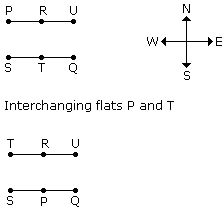
Cross-check: R was already stated to be next to U before any swap, and the P-T interchange only replaces the occupant of the OTHER end of the south-facing row (P's flat, now T's) - the flat adjoining U is untouched by the swap, so the neighbour of U cannot change.
Hence, R's flat is next to U's flat, both before and after interchanging P and T.