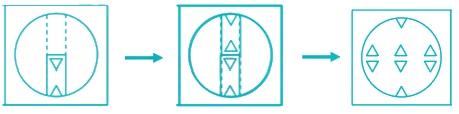
A piece of paper is folded and cut/punched as shown below in the question…
2025
A piece of paper is folded and cut/punched as shown below in the question figures. From the given answer figures, indicate how it will appear when opened.
Attempted by 10 students.
Show answer & explanation
In a paper-folding-and-punching problem, every crease in the paper acts like a mirror line: whatever shape is cut through the folded layers reappears reflected across each crease once the paper is opened. A crease running through the interior of the sheet doubles the shapes on either side of it, while a crease that coincides with the sheet's own outer edge produces just one reflected shape at that edge, not a repeat of it.
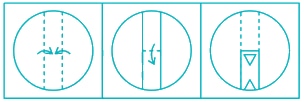
The circle is first folded along two vertical creases, bringing the left third and the right third in over the middle third, so the visible folded packet becomes the width of the middle strip.
The strip is then folded once more along a crease running across it, stacking its upper portion over its lower portion.
A downward-pointing triangle and an upward-pointing triangle, touching tip to tip, are punched through the folded packet near its centre.
Unfolding the crease from step 2 reflects this pair, so the vertical strip now carries a downward triangle sitting exactly on the circle's top edge, an upward-then-downward triangle pair in the middle of the strip, and an upward triangle sitting exactly on the circle's bottom edge.
Unfolding the two vertical creases reflects this same strip into the left and right thirds of the circle as well, so the pair of an upward-pointing triangle above a downward-pointing triangle now appears in three columns spread across the circle (left, centre, right), while the single triangle at the very top and the single triangle at the very bottom stay as one each, because that crease already lies on the sheet's own edge and is not affected by the vertical folds.
The figure with exactly three columns of an upward triangle over a downward triangle inside the circle, plus one downward triangle on the top edge and one upward triangle on the bottom edge, matches this derivation exactly.
A figure that turns the side columns into diamond shapes cannot be right: folding and cutting only ever reflects the same triangular notch, and it can never change a triangle into a rhombus.
A figure that keeps only the centre triangle pair, with just four simple inward-pointing arrows at the top, bottom, left and right edges, drops the effect of the two vertical creases altogether -- the same pair must also reappear in the left and right thirds.
A figure that repeats the boundary triangle three times along the top arc and three times along the bottom arc over-counts that crease: since it lies on the sheet's own edge, it can only ever contribute one triangle at the top and one at the bottom, not three of each.