From the given answer figure, select the one in which the question figure is…
2024
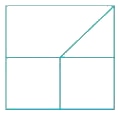
From the given answer figure, select the one in which the question figure is hidden/embedded.
Attempted by 25 students.
Show answer & explanation
Concept: In an embedded-figure question, every line segment of the given figure — its orientation, its length, and the exact points where it starts and ends — must appear as a subset of one answer figure's lines once that figure's extra lines are set aside. A line that looks similar but stops at a different point (for example, at an edge's midpoint instead of a corner) is not a genuine match, however alike it appears at a glance.
Application: The given figure is a square with three lines meeting at its centre: a full horizontal line running edge to edge, a vertical line running only from the centre down to the bottom edge, and a diagonal running from the centre straight to the top-right corner.
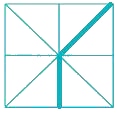
Tracing these three lines through each answer figure, only one figure is built from a full horizontal line, a full vertical line (top edge to bottom edge), and both true corner-to-corner diagonals meeting at the centre. In that figure, the horizontal line matches the given horizontal, the lower half of its vertical line matches the given vertical segment, and one of its two diagonals — the one running from the centre to the top-right corner — matches the given diagonal exactly in both angle and endpoints. That is the only figure in which the given figure is hidden/embedded.
Cross-check: Every other figure fails on the same distinctive feature — the centre-to-corner diagonal:
One figure's slanted lines only connect the midpoints of the square's edges, forming an inscribed diamond, so they never reach a corner.
One figure has no vertical line at all, and its slanted lines cross above and below the mid-height line instead of meeting at one central point.
One figure adds extra slanted lines to a vertical line and a midpoint-to-midpoint diamond, but, like the diamond variants, none of its diagonals reach a corner of the square.
Since a genuine corner-to-corner diagonal is present in only one figure, that figure — the one combining a full horizontal line, a full vertical line, and both true diagonals through the centre — is the answer.