A person starts from point A and travels 3 km eastwards to B and then turns…
2024
A person starts from point A and travels 3 km eastwards to B and then turns left and travels thrice that distance to reach C. He again turns left and travels five times the distance he covered between A and B and reaches his destination D. The shortest distance between the starting point and the destination is
Answer: B. 15 km — Concept: In a direction-and-distance problem built from straight segments meeting at right-angle turns, the shortest (straight-line) distance between the…
- A.
12 km
- B.
15 km
- C.
16 km
- D.
18 km
Attempted by 1 students.
Show answer & explanation
Correct answer: B
Concept: In a direction-and-distance problem built from straight segments meeting at right-angle turns, the shortest (straight-line) distance between the start and the end point equals the hypotenuse of the right triangle formed by the net horizontal displacement and the net vertical displacement, found via the Pythagorean theorem: hypotenuse = sqrt(horizontal2 + vertical2).
Segments running in opposite directions along the same axis are subtracted, not added, to get the net displacement on that axis.
Application: the movements are shown in the figure below.
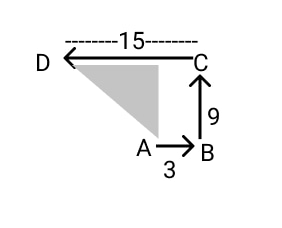
A to B = 3 km east (given).
At B, turn left (now facing north) and travel thrice AB: BC = 3 x 3 = 9 km north.
At C, turn left again (now facing west) and travel five times AB: CD = 3 x 5 = 15 km west.
Net horizontal displacement = CD - AB = 15 - 3 = 12 km. AB points east and CD points west (opposite directions on the same axis), so they are subtracted, not added.
Net vertical displacement = BC = 9 km.
Shortest distance AD = sqrt(122 + 92) = sqrt(144 + 81) = sqrt(225) = 15 km.
Cross-check: 12, 9, 15 is exactly 3 times the (4, 3, 5) set - a scaled 3-4-5 Pythagorean triple - confirming the hypotenuse is 15 km without needing a calculator.