B is to the East of A, and A is to the North of C. If P is to the South of C,…
2024
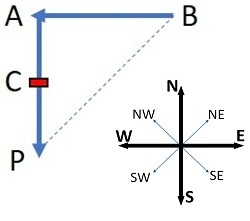
B is to the East of A, and A is to the North of C. If P is to the South of C, then in which direction of B is P located?
Answer: B. South-West — Concept: In a direction-sense (compass) problem, each "X is in the direction of Y" statement fixes X and Y along one compass axis — north-south or east-west —…
- A.
South-East
- B.
South-West
- C.
South
- D.
North
Attempted by 3 students.
Show answer & explanation
Correct answer: B
Concept: In a direction-sense (compass) problem, each "X is in the direction of Y" statement fixes X and Y along one compass axis — north-south or east-west — relative to each other. To find the direction of one point from another, place every point on a common pair of axes using these relations, then read off the horizontal (east-west) and vertical (north-south) offset between the two points of interest; a nonzero offset on both axes combines into the matching intercardinal direction (for example, a westward offset together with a southward offset gives South-West).
A is North of C, so C lies directly below A on the same north-south line.
P is South of C, so P lies further below C, still on that same north-south line as A and C.
B is East of A, so B sits on a separate, east-west-shifted line at A's height, not on the A-C-P line.
Comparing P to B: P lies west of B's line (back toward A and C) and south of B's row (down past C).
Cross-check: Taking A as the origin with north as +y and east as +x, both C and P fall on the y-axis below A (negative y), while B sits at a positive x-offset at A's height (y = 0). Since P has both a smaller x-coordinate and a smaller y-coordinate than B, the horizontal and vertical checks agree: P lies South-West of B, consistent with the diagram below.