x and y are two trains which started at the same time from A and B…
2025
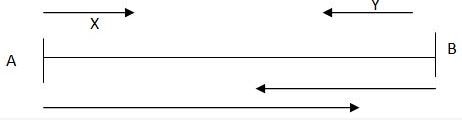
x and y are two trains which started at the same time from A and B respectively and running at a uniform speed in opposite direction. Which train runs faster?
I. When they met, x was nearer to B than y was to A.
II. Y has less number of bogies than x.
Answer: A. Statement i alone is sufficient but statement ii alone is not sufficient. — Concept: In a data-sufficiency question about relative speed, if two bodies start moving at the same instant and arrive at a common meeting point at the same…
- A.
Statement i alone is sufficient but statement ii alone is not sufficient.
- B.
Both statements i and ii together are sufficient but neither of statements alone is sufficient.
- C.
Statement ii alone is sufficient but statement i alone is not sufficient.
- D.
Question cannot be answered even with the help of both the statements together.
Show answer & explanation
Correct answer: A
Concept: In a data-sufficiency question about relative speed, if two bodies start moving at the same instant and arrive at a common meeting point at the same instant, the time elapsed for both is identical. Since speed = distance ÷ time, comparing the distances each body covered over that identical time interval directly compares their speeds — no separate speed or time data is required.
Let the meeting point be M. Train x started from A, so the distance it covered is AM; train y started from B, so the distance it covered is BM.
Statement I says x was nearer to B than y was to A at the meeting point — that is, x's remaining distance to B (numerically equal to the distance y already covered, BM) is smaller than y's remaining distance to A (numerically equal to the distance x already covered, AM).
So Statement I is telling us BM < AM — the distance y covered is smaller than the distance x covered, over the SAME elapsed time (both started together and met together).
Since time is identical for both, a larger distance covered means a higher speed: x, having covered more ground, must be running faster than y. Statement I alone answers the question.
Statement II only states that y has fewer bogies than x. The number of bogies a train pulls does not determine its speed, so Statement II alone gives no information about which train is faster.
Because Statement I already fixes the answer on its own, combining it with Statement II (which is irrelevant) adds nothing — Statement I alone is sufficient and Statement II alone is not sufficient.
Cross-check with a sample distance: let AB = 100 km and the meeting point M be 60 km from A. Then x covered AM = 60 km and y covered BM = 40 km in the same time. x's remaining distance to B is 40 km and y's remaining distance to A is 60 km, so x (40 km left) is indeed nearer to B than y (60 km left) is to A — consistent with Statement I. And since x covered 60 km against y's 40 km in equal time, x's speed is higher — confirming Statement I alone settles the comparison.
The figure below shows x moving from A and y moving from B, approaching each other and meeting somewhere between the two ends.
Result: Statement I alone is sufficient; Statement II alone is not sufficient, and no combination is needed beyond Statement I.