How many points will be on the face opposite to the face which contains 2…
2024202520252025
How many points will be on the face opposite to the face which contains 2 points?
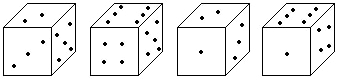
Answer: D. 6 — Concept: On a cube, a given face touches (shares an edge with) exactly four of the other five faces in any view; the one face it can never touch is the face…
- A.
1
- B.
5
- C.
4
- D.
6
Attempted by 5 students.
Show answer & explanation
Correct answer: D
Concept: On a cube, a given face touches (shares an edge with) exactly four of the other five faces in any view; the one face it can never touch is the face directly opposite it. So if a face is seen together with four different digits across several images, the digit it is never seen with must be its opposite. When two dice both show one identical face fixed at the identical position, the second die is just the first one turned around the axis through that fixed face — such a turn can only cycle the remaining four faces along one fixed rotational ring, never reorder them, so only one pairing of the ring is possible.
The three visible faces (top, front, right) of the four dice are: Die 1 shows 2, 3, 5; Die 2 shows 6, 4, 5; Die 3 shows 2, 1, 3; Die 4 shows 6, 1, 4.
Face 1 is seen together with 2 and 3 (Die 3) and with 6 and 4 (Die 4) — that covers all four of the other faces except 5. Since 1 is never seen with 5, faces 1 and 5 must be opposite each other.
Face 2 is seen together with 3 and 5 (Die 1) and with 1 and 3 (Die 3) — three of its four neighbours are confirmed as 1, 3 and 5. Its fourth neighbour, and hence its opposite, must be one of the two remaining faces, 4 or 6, so a further check is needed.
Die 1 and Die 2 both show 5 on the right face — so face 1 (opposite 5) sits on the left in both, and Die 2 is simply Die 1 turned around this fixed 5–1 axis. Such a turn cycles the other four faces (top, front, bottom, back) together as one ring; in Die 1 this ring reads top=2, front=3, bottom=opposite of 2, back=opposite of 3. Turning about the axis can only move whole consecutive pairs of this ring into the (top, front) slots — so Die 2's (top, front) = (6, 4) must match a consecutive pair of that ring. Checking the ring (2, 3, opposite-of-2, opposite-of-3), the only pair that can equal (6, 4) is (opposite-of-2, opposite-of-3) itself. So opposite of 2 is 6, and opposite of 3 is 4.
Cross-check: Die 3 and Die 4 both show 1 on the front face, so face 5 (opposite 1) sits at the back in both, and Die 4 is Die 3 turned about this same 1–5 axis. Die 3's ring (top, right, bottom, left) reads (2, 3, opposite-of-2, opposite-of-3); Die 4 shows (top, right) = (6, 4), which again can only match the ring pair (opposite-of-2, opposite-of-3) — independently confirming opposite of 2 is 6 (and opposite of 3 is 4) from a completely different pair of dice.
Result: The face opposite the face carrying 2 points carries 6 points.