Find the number of triangles in the given figure.
202320232025
Find the number of triangles in the given figure.

Answer: C. 14 — Concept: To count triangles in a compound figure built from straight lines, work level by level -- first count the elementary (simplest) triangles bounded…
- A.
10
- B.
12
- C.
14
- D.
16
Attempted by 9 students.
Show answer & explanation
Correct answer: C
Concept: To count triangles in a compound figure built from straight lines, work level by level -- first count the elementary (simplest) triangles bounded directly by segments with nothing crossing through them, then check every combination of two or more adjacent elementary triangles to see whether the combined outline is itself a straight-sided triangle, and finally sum across all levels. When the figure is symmetric about an axis, this can be cross-checked: triangles pair up across the axis (each pair counted twice), except any triangle that is itself symmetric about the axis, counted once.
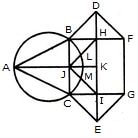
Application: Label the figure as shown -- A is the apex on the left; B and C are the points where the circle meets the vertical line BC; D, F are the top corners and E, G the bottom corners of the outer shape; H, K and I lie on the central vertical line, where it meets the upper horizontal line through B and F, the horizontal axis through A, and the lower horizontal line through C and G respectively; J is where this horizontal axis meets the line BC.
Simplest (single-region) triangles: ABJ, ACJ, BDH, DHF, CIE and GIE -- 6 in number.
Triangles formed by combining exactly two adjacent simple regions: ABC, BDF, CEG, BHJ, JHK, JKI and CJI -- 7 in number.
The one largest triangle formed by combining all four central regions: JHI -- 1 in number.
Total = 6 + 7 + 1 = 14 triangles.
Cross-check: The figure is symmetric about the horizontal line through A, J and K (B mirrors to C, D to E, F to G, H to I). Every triangle not lying on this axis pairs with its mirror image -- (ABJ, ACJ), (BDH, CIE), (DHF, GIE), (BDF, CEG), (BHJ, CJI), (JHK, JKI) -- six pairs, i.e. 12 triangles -- plus the two triangles that are symmetric about the axis themselves, ABC and JHI, each counted once. 12 + 2 = 14, matching the direct count.