Find the number of triangles in the given figure.
202520242025
Find the number of triangles in the given figure.

Answer: C. 21 — To count triangles in a composite figure built from overlapping straight lines, do not stop at the visually obvious (smallest) triangles. Group every triangle…
- A.
10
- B.
19
- C.
21
- D.
23
Attempted by 20 students.
Show answer & explanation
Correct answer: C
To count triangles in a composite figure built from overlapping straight lines, do not stop at the visually obvious (smallest) triangles. Group every triangle by how many of the smallest indivisible triangles it is built from - its 'component size' - and sum the counts across all size classes, using only combinations whose three sides are single straight lines actually drawn in the figure.
Label the figure's vertices as shown: B is the apex of the triangular roof; A and C are the top corners of the square; G and E are the bottom corners; H, D, F are the midpoints of the left, right, and bottom sides; I is the midpoint of the top side AC; J is the centre of the square, where both diagonals and the vertical line BF cross.
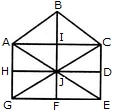
Smallest (1-component) triangles: ABI, BIC, AIJ, CIJ, AHJ, CDJ, JHG, JDE, GJF, EJF - 10 in number.
2-component triangles (each formed by joining two adjoining simplest triangles across a shared straight edge): ABC, BCJ, ACJ, BAJ, AJG, CJE, GJE - 7 in number.
4-component triangles (each diagonal of the square splits it into two halves, each made of four simplest triangles): ACG, ACE, CGE, AGE - 4 in number.
Total number of triangles = 10 + 7 + 4 = 21.
Cross-check by regrouping a different way: triangles touching the apex B are ABI, BIC, ABC, BAJ, BCJ - 5 in number; triangles lying entirely within the square (not touching B) are the remaining 8 simplest square triangles plus ACJ, AJG, CJE, GJE (4 two-component) plus ACG, ACE, CGE, AGE (4 four-component) - 16 in number. 5 + 16 = 21, matching the earlier total.