

How to Compare Job Offers Beyond Salary
Compare job offers using dependable pay, benefits, learning, work expectations, flexibility, and your own career priorities—not just the headline salary.
KnowledgeGate Team
Exam prep & CS education
Updated 31 Oct 20266 min read

A higher salary can look like the obvious choice—until a long commute, unclear working hours, limited learning, or a role that does not match your goals changes the picture. Comparing offers well means looking at the whole experience you are agreeing to, not just the largest number in the compensation section.
Start with the written offer
Before comparing, make sure you have complete information from each employer. Ask for the details in writing and separate confirmed terms from statements that are still verbal or conditional. A recruiter’s estimate of a future bonus, for example, should not be treated as guaranteed pay.
Create one row per offer and record the role title, team, reporting manager, location, work arrangement, start date, probation terms, notice period, and the date by which you need to respond. Ask whether a joining bonus has repayment conditions and whether a service agreement or other commitment applies; get the terms in writing and clarify anything you do not understand. If something is missing, ask a concise question before making a decision. Indeed’s job offer comparison guide similarly recommends gathering complete information and comparing offers against your own priorities.
Compare the full compensation package
Look beyond the headline annual package. Separate recurring, dependable compensation from variable or conditional components. Depending on the offer, these may include fixed pay, performance bonus, joining bonus, incentives, equity, retirement contributions, insurance, paid leave, or allowances. Do not assume that two employers use the same definitions for “cost to company” (CTC), annual compensation, or take-home pay.
For each component, ask:
Is the amount guaranteed, target-based, discretionary, or conditional?
When does it become payable, and what happens if you leave before then?
Is equity a grant, an estimate, or a confirmed number of shares? What vesting conditions apply?
What deductions, employee contributions, or eligibility rules affect the amount you actually receive?
Which benefits begin immediately, and which begin only after probation or a waiting period?
Use the written terms to estimate the dependable monthly amount you can plan around. Keep one-time payments separate from recurring income. If an offer includes a large variable component, compare its target amount separately and ask how performance is measured. Do not count a best-case bonus as guaranteed salary.
Measure the job you will actually do
Titles can hide very different day-to-day work. Ask each manager what the first three to six months are expected to involve, which projects you may work on, and how success will be assessed. Find out how much of the role is coding, analysis, customer support, testing, documentation, operations, or coordination.
Think about what you want to learn next. A role with mentorship, code review, training time, or ownership of real projects may build skills that matter for your next move. Ask who will review your work, how feedback is given, and whether development goals are part of regular one-to-ones. Avoid relying on vague promises such as “fast growth”; ask what growth has meant for people in similar roles.
For students choosing a first job, the quality of the learning environment can matter as much as the starting title. A role that gives you a strong foundation and useful examples to discuss later may be a better fit than one that sounds impressive but offers little support.
Check time, flexibility, and commute
Working hours affect more than your calendar. Confirm the normal schedule, expected availability outside it, weekend or on-call duties, time-zone overlap, and how often deadlines require extra hours. Ask what “hybrid” or “flexible” means in practice: how many office days, whether those days are fixed, and whether the policy can change by team.
For an in-office role, estimate commute time and cost using a realistic route and schedule. For remote work, ask whether you must live in a certain location, travel to the office periodically, or provide your own equipment. Add these practical costs to your comparison. A slightly lower salary may leave you with more usable time or lower expenses; that trade-off depends on your own priorities.
Consider the manager, team, and stability
Your manager shapes the work environment you experience each day. During the hiring process, notice whether expectations are clear, questions receive direct answers, and interviewers describe the role consistently. Ask how the team handles feedback, disagreements, and changing priorities. These conversations cannot guarantee what a workplace will be like, but they can help you identify unanswered questions.
Learn about the team’s immediate goals and how your position fits them. Ask whether the role is new or replacing someone, and what success would look like after the first few months. You can also research the organisation’s products, customers, and recent public updates. Treat public reviews as individual accounts rather than proof of what your own team will be like.
Use a comparison worksheet around your priorities
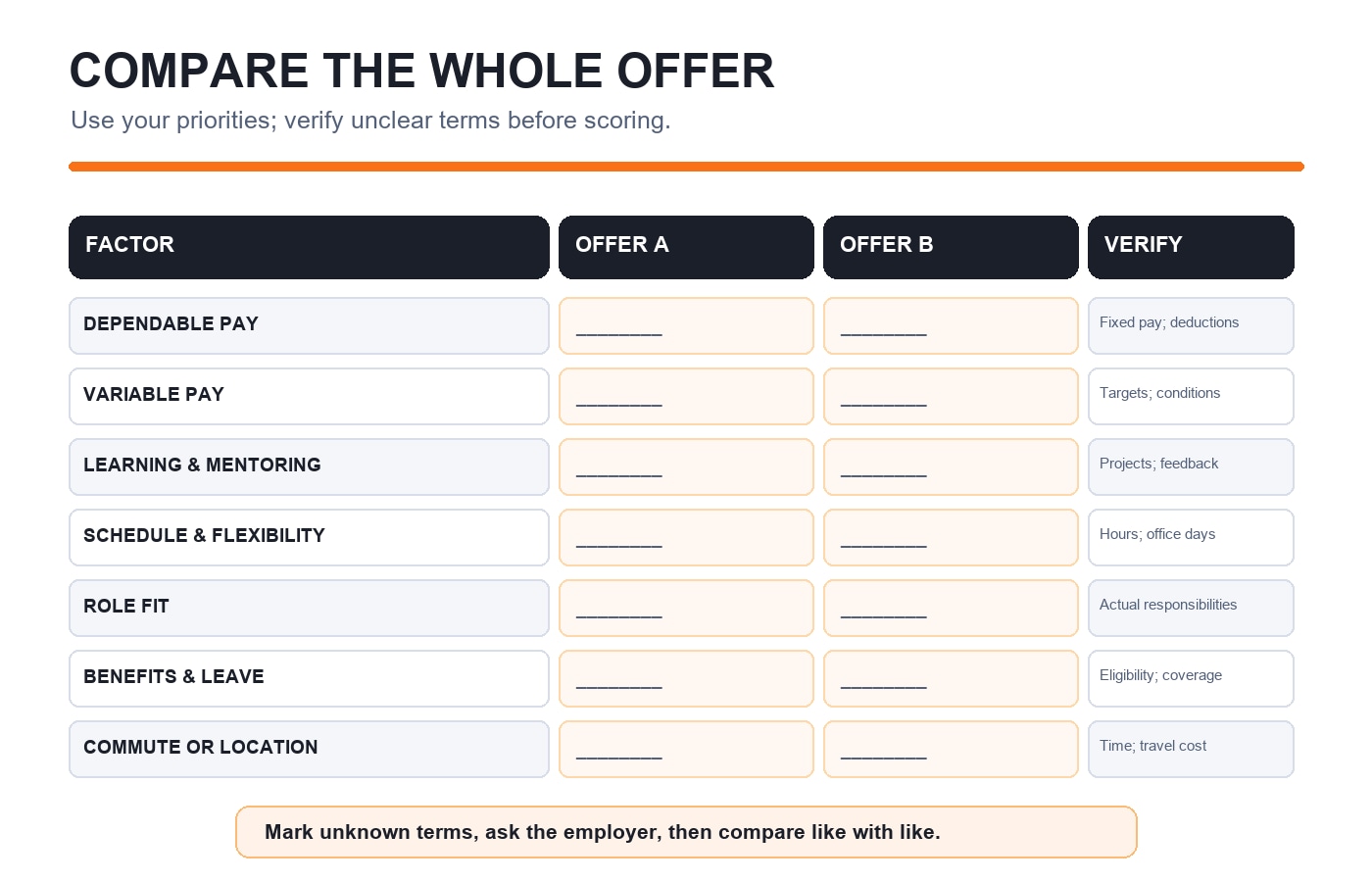
First separate non-negotiables from preferences. If an offer fails a requirement you cannot accept—such as a location, schedule, or minimum dependable income—set it aside before scoring. For the remaining offers, a simple comparison worksheet helps make assumptions visible. Choose the factors that matter to you and rate each offer using the same scale. If you want to weight the results, assign each factor an importance value (for example, 1–3) before rating offers, then multiply the rating by that value. Give more weight to what matters most to you; the numbers are only a decision aid. For example, compare dependable pay, learning, manager support, role fit, flexibility, commute, benefits, and stability.
Factor | Offer A | Offer B | What to verify |
|---|---|---|---|
Dependable monthly pay | Fixed pay and deductions | ||
Variable compensation | Conditions and payout timing | ||
Learning and mentorship | Projects, feedback, and support | ||
Schedule and flexibility | Hours, office days, on-call work | ||
Role fit and interest | Actual first-month responsibilities | ||
Benefits and leave | Eligibility, coverage, waiting periods | ||
Commute or location | Time, cost, and attendance expectations |
The scores are prompts for discussion, not a machine that should make the decision. If one offer scores higher because you guessed at an important detail, mark that item “unknown” and ask the employer. A short conversation can change the comparison more than another round of spreadsheet formatting.
Ask focused questions and negotiate respectfully
Once you know what matters, ask each employer about the same key uncertainties. You might say: “I’m excited about the role. Could you clarify how the variable component is calculated and when employees become eligible for it?” Or: “Could you describe the team’s typical office schedule and how often this role supports work outside standard hours?”
If you want to negotiate, choose a specific request and connect it to your fit and priorities. Compensation may be one topic, but you can also discuss start date, flexibility, learning support, or role scope. Keep the conversation professional, do not invent competing offers, and get any agreed changes in writing before accepting.
Make the decision that fits your next step
Before you respond, review the complete written terms and ask yourself: Can I meet my financial needs with the dependable compensation? Do I understand the daily work and schedule? Will I learn skills I value? Do the manager and team expectations feel clear? Which trade-offs am I willing to accept?
There may not be one offer that wins every category. Choose the combination that best supports your current responsibilities and longer-term direction. For interview and application preparation, explore KnowledgeGate’s Interview & Resume Preparation course and Aptitude for Placement course. You can also read AI Is Changing Campus Hiring: How Students Can Show Their Skills for more placement guidance.
Take time to clarify the terms, compare like with like, and choose with your own priorities in view. The right offer is the one whose real conditions—not only its headline salary—fit the life and career you are building.
Keep learning

How to Use AI in Your Job Search Without Losing Your Own Voice
Use AI to explore job roles, refine applications, and practise interviews while keeping your claims truthful, your voice natural, and your choices your own.
Updated 31 Oct 20266 min readPlacement Preparation

What to Do When You Have No Internship Experience
No internship yet? Turn coursework, projects, volunteering, and other real experience into credible evidence for entry-level roles.
31 Oct 20266 min readPlacement Preparation

Which Skill Sets Are in Demand for Tech Jobs?
Explore the technical and human skill combinations showing up across software, AI, data, cloud, and security roles, and how students can prove them with focused projects.
Updated 31 Oct 20265 min readPlacement Preparation

AI Is Changing Campus Hiring: How Students Can Show Their Skills
Make your technical skills visible in AI-assisted campus hiring with clear resume evidence, one explainable project, and a practical interview routine.
Updated 30 Oct 20265 min read53 viewsPlacement Preparation