Phases of Compiler MCQs: 12 Solved Questions with Explanations
Solve 12 compiler-phase MCQs and learn why each answer is correct through a source-to-target trace, phase handoffs and a quick trap checklist.
KnowledgeGate Team
Exam prep & CS education
3 Sep 20268 min read88 views
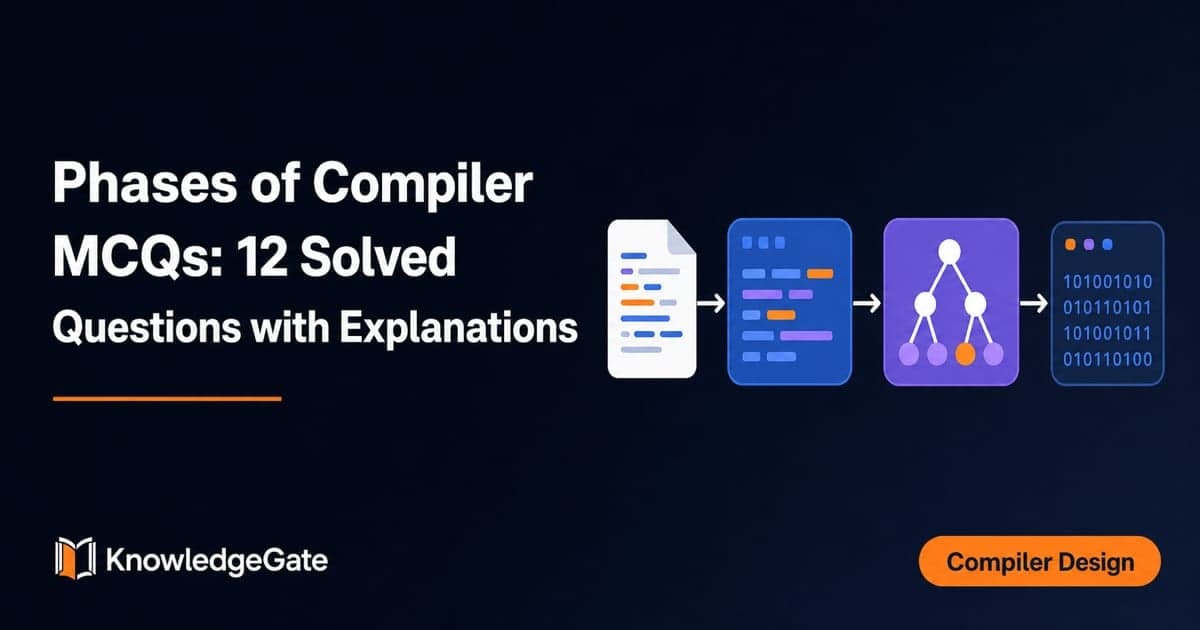
Compiler-phase questions look like memory checks, but distractors repeatedly swap a phase's input, output, formal model or responsibility. Identify the representation entering and leaving a phase before selecting an answer. First trace total = base + rate * 4; from source statement to target code, then apply the same handoff check to each MCQ.
Choose an option first. Then explain the relevant phase handoff in one sentence before reading the solution. Open the linked solved page after each explanation to retry the question in its topic context. If you are building a broader study plan, place this topic within GATE CS Exam Preparation.
Related reading: compiler fundamentals and lexical analysis.
1. Compiler phases in one worked source-to-target trace
The usual sequence is lexical analysis, syntax analysis, semantic analysis, intermediate code generation, code optimization and target code generation. The symbol table and error handling support several phases, so they are not merely extra stages in a one-way chain. The broader Compiler Design syllabus places these handoffs in context.
Assume the symbol table records two compile-time integer constants, base: const int = 12, rate: const int = 3 and total: int. Compile total = base + rate * 4;.
Lexical output: eight tokens:
<id,total>,<assign,=>,<id,base>,<plus,+>,<id,rate>,<mul,*>,<int,4>,<semicolon,;>.Syntax output:
=(total, +(base, *(rate, 4))). The tree preserves multiplication before addition.Semantic result:
rate * 4isint;base + (...)isint; assignment tototal: intis valid.Unoptimized three-address code:
t1 = rate * 4;t2 = base + t1;total = t2.Optimization:
rate * 4 = 3 * 4 = 12, thenbase + 12 = 12 + 12 = 24, so the result becomestotal = 24.Illustrative target code:
MOV R0, #24, followed bySTORE total, R0.
The invariant is simple: each phase consumes one representation and hands a more structured or more target-specific representation to the next.
2. Phases of compiler MCQs 1-3: tokens, parser input and grammar
Question 1
Exam reference: BEL 2023, Probationary Engineer.
Name the phase of compiler, which separates characters of the source language into groups that logically belong together, these groups are called tokens.
A. Code optimization
B. Syntax analysis
C. Error handling
D. Lexical analysis
Correct answer: D. Lexical analysis.
Lexical analysis groups characters into tokens. Parsing consumes them later; optimization and error handling do not perform that grouping. Solved page.
Question 2
Exam reference: Indian Space Research Organization 2025.
Which compiler phase receives tokenized output?
A. Lexical Analyser
B. Parser
C. Pre-processor
D. Assembler
Correct answer: B. Parser.
The lexical analyser produces tokens; the parser receives them and checks grammar. The pre-processor and assembler work at other points. Solved page.
Question 3
Exam reference: UGC NET 2023.
Which phase of compiler checks the grammar of programming?
A. Code Optimization
B. Semantic Analysis
C. Code Generators
D. Syntax Analysis
Correct answer: D. Syntax Analysis.
Syntax analysis checks grammatical structure. Semantic analysis instead checks meaning, including type and declaration consistency. The correct choice is D. Solved page.
3. Phases of compiler MCQs 4-6: types, static checking and phase functions
Question 4
Exam reference: DSSSB 2024, TGT.
Which of the following phase of the compiler, gathers type information and saves it in either the syntax tree or the symbol table, for subsequent use during intermediate code generation?
A. Semantic Analyzer
B. Code Analyzer
C. Syntax Analyzer
D. Lexical Analyzer
Correct answer: A. Semantic Analyzer.
The semantic analyser records type information for later code generation. The lexer classifies tokens, while the parser checks grammatical form. Solved page.
Question 5
Exam reference: Beltron Programmer 2025, Shift-3.
Which of the following statements about statically typed languages is true?
A. Types are associated with values, not variables
B. Variable types can change during execution
C. Type checking is done at runtime
D. Type errors are caught during compilation
Correct answer: D. Type errors are caught during compilation.
Static checking happens before execution. Here the integer operands produce an int, valid for total: int; a string assignment would fail compilation. Solved page.
Question 6
Exam reference: BEL 2023, Probationary Engineer.
Match the phases of compiler with its function.
Phases
Function
I
Intermediate code generator
1
Keeps track of the names used by the program
II
Code generation
2
Create a stream of simple instructions
III
Table management
3
Produces the object code
A. I - 1; II - 2; III - 3
B. I - 1; II - 3; III - 2
C. I - 2; II - 3; III - 1
D. I - 2; II - 1; III - 3
Correct answer: C. I - 2; II - 3; III - 1.
Intermediate code generation creates simple instructions, code generation emits object code, and table management records names. Thus I-2, II-3 and III-1. Solved page.
4. Phases of compiler MCQs 7-9: order and front-end roles
Question 7
Exam reference: UGC NET 2023, December.
Arrange the following phases of a compiler as per their order of execution (start to end)
(A) Target code generation
(B) Syntax Analysis
(C) Code optimization
(D) Semantic Analysis
(E) Lexical Analysis
Choose the
correct
answer from the options given below :
A. (B), (E), (D), (A), (C)
B. (E), (D), (B), (A), (C)
C. (E), (B), (D), (C), (A)
D. (B), (D), (E), (A), (C)
Correct answer: C. (E), (B), (D), (C), (A).
Characters become tokens before parsing and semantic checking. Optimization precedes target code. Intermediate-code generation normally appears before optimization but is not listed. Solved page.
Question 8
Exam reference: UGC NET 2017, November.
Match the description of several parts of a classic optimizing compiler in List–I with the names of those parts in List–II
List–I
(a) A part of a compiler that is responsible for recognizing syntax
(b) A part of a compiler that takes as input a stream of characters and produces as output a stream of words along with their associated syntactic categories
(c) A part of a compiler that understands the meanings of variable names and other symbols and checks that they are used in ways consistent with their definitions
(d) An IR-to-IR transformer that tries to improve the IR program in some way
List–II
(i) Optimizer
(ii) Semantic Analysis
(iii) Parser
(iv) Scanner
A. iii,iv,ii,i
B. iv,iii,ii,i
C. ii,iv,i,iii
D. ii,iv,iii,i
Correct answer: A. iii,iv,ii,i.
Syntax recognition means parser, character conversion means scanner, symbol meaning means semantic analysis, and IR improvement means optimizer. The match is (iii), (iv), (ii), (i). Solved page.
Question 9
Exam reference: UGC NET 2017, November.
Consider the following statements related to compiler construction:
I. Lexical Analysis is specified by context-free grammars and implemented by pushdown automata.
II. Syntax Analysis is specified by regular expressions and implemented by finite-state machine.
Which of the above statement(s) is/are correct?
A. Only I
B. Only II
C. Both I and II
D. Neither I nor II
Correct answer: D. Neither I nor II.
The associations are swapped. Lexical work uses regular expressions and finite automata; syntax uses context-free grammars and pushdown automata. Both statements are false. Solved page.
5. Phases of compiler MCQs 10-12: tools, code and data handoffs
Question 10
Exam reference: GATE 2009.
Match all items in Group 1 with correct options from those given in Group 2.
Group 1 Group 2
P. Regular expression 1. Syntax analysis
Q. Pushdown automata 2. Code generation
R. Dataflow analysis 3. Lexical analysis
S. Register allocation 4. Code optimization
A. P-4. Q-1, R-2, S-3
B. P-3, Q-1, R-4, S-2
C. P-3, Q-4, R-1, S-2
D. P-2, Q-1, R-4, S-3
Correct answer: B. P-3, Q-1, R-4, S-2.
Regular expressions support lexical analysis, pushdown automata support parsing, dataflow analysis supports optimization, and register allocation belongs to code generation. Solved page.
Question 11
Exam reference: Indian Space Research Organization 2008.
Which of the following class of statement usually produces no executable code when compiled?
A. declaration
B. assignment statements
C. input and output statements
D. structural statements
Correct answer: A. declaration.
A plain declaration mainly supplies compile-time information, usually without an executable instruction. Initialization or language-specific runtime work can differ, hence “usually.” Solved page.
Question 12
Exam reference: GATE 2017, Set 2.
Match the following according to input (from the left column) to the compiler phase (in the right column) that processes it:
A.
B.
C.
D.
Correct answer: C. .
Semantic analysis consumes the syntax tree, lexical analysis the character stream, code generation the IR, and parsing the token stream. Solved page.
6. The compiler-phase traps these 12 MCQs expose
Trap | Correct distinction | Questions |
|---|---|---|
Tokens | Lexer produces; parser consumes | Q1-Q3 |
Syntax/semantics | Structure versus types and names | Q3-Q5 |
Order | Follow data dependencies | Q7-Q8 |
Formal tools | Regex/FA: lexical; CFG/PDA: syntax | Q9-Q10 |
Symbol table | Supports several phases | Q4 and Q6 |
Declarations | May emit no executable instruction | Q11 |
Use this 20-second routine: identify whether the stem asks for input, output, job, order or model. Write the adjacent handoff, then reject options that confuse producer and consumer.
Then use Compiler Design MCQs for wider practice.
7. Phases of compiler: the next practice step
Redo Q7, Q9, Q10 and Q12 without looking, on a blank page. Q7, Q9, Q10 and Q12 test phase order, formal models, tools and representation handoffs. Then replay total = base + rate * 4; and state the artifact after every phase. Your optimized value must still be 24.
Use GATE Guidance by Sanchit Sir for a sequenced Compiler Design learning route. Move to the GATE Test Series as a timed follow-up only after concept practice.
The short version: when a phase question feels ambiguous, identify the representation entering the phase and the representation leaving it. That single input-output check resolves most distractors.
Keep learning
Normal Forms & BNF MCQs: 10 Solved Grammar Questions with Explanations
Solve ten exam-standard grammar questions on CNF, GNF, BNF notation, derivation counts, parse trees and conversion bounds, with every answer worked step by step.
Updated 1 Sep 20268 min read50 viewsCompiler Design MCQs
LALR(1) Parser and State Merging MCQs: 12 Solved Questions
Solve 12 published LALR(1) MCQs with fresh explanations, from parser hierarchy and state counts to LR(1) core merging, conflicts and grammar classification.
Updated 30 Aug 20267 min readCompiler Design MCQs
Operator Precedence MCQs: 10 Solved Grammar and Parse-Tree Questions
Solve 10 published Operator Precedence questions on grammar rules, precedence, associativity, parser facts, and expression trees, with fresh explanations.
Updated 29 Aug 20267 min readCompiler Design MCQs
Simplification of CFG MCQs: 12 Solved Questions with Explanations
Solve 12 published-bank CFG simplification MCQs with fresh explanations, elimination checklists, derivation checks, ambiguity reasoning, and a full mixed simplification.
Updated 27 Aug 20268 min readCompiler Design MCQs