OS Basics and Goals MCQs: 12 Solved Questions with Explanations
Solve 12 published OS Basics and Goals MCQs, commit to each option, and learn the distinctions through direct explanations and worked resource examples.
KnowledgeGate Team
Exam prep & CS education
30 Aug 20268 min read55 views
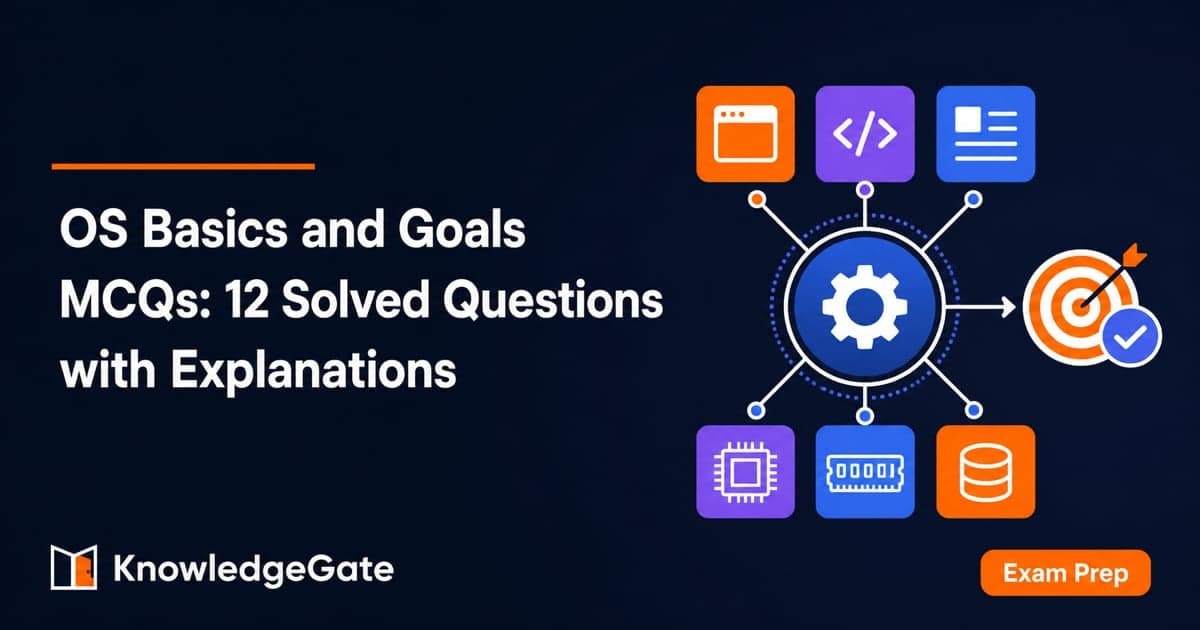
OS goals and responsibility boundaries are easy to blur because distractors swap the operating system for a compiler, driver, boot loader, application or service. This set concentrates on purpose, startup, device access, kernel residency, I/O, memory, protection, accounting and compilation. The earlier OS Basics MCQs set covers system calls, operating modes and process states, so use it for that adjacent angle rather than repeating this set. The responsibility map and one memory-and-CPU trace below give you a single reference for all 12 questions. Questions 5 and 12 lead into the broader Operating System MCQs hub. Commit to each option before checking the explanation, then classify every miss as a purpose, boundary or terminology error.
1. Build the OS purpose and responsibility map first
Layer or role | What it does | What it does not do |
|---|---|---|
Operating system | manages CPU, memory, files, devices, protection and accounting | does not compile source code |
Kernel | resident core that handles privileged resource control | is not the user interface alone |
Boot loader | selects and loads an installed OS at startup | is not a PCB or FCB |
Device driver | translates OS I/O requests for a device | is not the Control Panel |
Compiler | translates source code | is not an OS service in the classification tested here |
On a 512 MB machine, the OS uses 64 MB; P1-P3 need 120 MB, 80 MB, 200 MB. So 64 + 120 + 80 + 200 = 464 MB, and 512 - 464 = 48 MB. Over 100 ms, P1-P3 receive 40 ms, 35 ms, 15 ms; 100 - 40 - 35 - 15 = 10 ms is idle/overhead. OS allocates memory/CPU; a compiler translates main.c.
2. OS Basics and Goals MCQs 1-2: primary purpose and startup selection
Question 1
ISRO 2009, Computer Science
The primary purpose of an operating system is
A. To make most efficient use of the computer hardware
B. To allow people to use the computer
C. To keep systems programmers employed
D. To make computers easier to use
Choose your option before checking the answer.
Correct answer: A. To make most efficient use of the computer hardware.
The primary systems goal is efficient resource management. In the 100 ms trace, the OS assigns CPU time and tracks the free 48 MB so it cannot be double-allocated. Ease of use matters, but it is not the primary purpose keyed here. Option C is not a technical objective.
Question 2
BPSC 2024, Computer Science
On a system where multiple operating systems are installed, the decision to load a particular one at startup is made by ______.
A. Process control block
B. File control block
C. Boot loader
D. More than one of the above
E. None of the Above
Choose your option before checking the answer.
Correct answer: C. Boot loader.
A menu lists Linux and Windows. The boot loader reads the selection and starts loading that OS. A PCB records process state, while an FCB stores file metadata. Neither structure chooses between installed operating systems before the kernel starts, so the other combined choices also fail.
3. OS Basics and Goals MCQs 3-4: device access and the user interface role
Question 3
NVS 2017, Computer Science
This system software provides an interface to a hardware device, enabling the operating system to access that hardware.
A. Control Panel
B. Device Driver
C. Program installer
D. Firmware
Choose your option before checking the answer.
Correct answer: B. Device Driver.
For a 4 KB print request, the application calls the OS, which passes a generic request to the printer driver. The driver creates device-specific commands. Control Panel offers configuration, an installer adds software, and firmware runs on or close to hardware. The OS-facing interface here is the device driver.
Question 4
UGC NET November 2020, Paper I
An operating system is an interface between:
A. Software and hardware
B. Compiler and hardware
C. User and computer
D. Program and software
Choose your option before checking the answer.
Correct answer: C. User and computer.
When a user requests save notes.txt, the OS provides a file operation and coordinates storage without requiring controller commands. Option A sounds plausible because the OS also mediates program access to hardware. However, this question uses the conventional description of the OS as the user-computer interface.
4. OS Basics and Goals MCQs 5-6: booting and responsibility boundaries
Question 5
UGC NET December 2006, Computer Science Paper 2
Loading operating system from secondary memory to primary memory is called
A. Compiling
B. Booting
C. Refreshing
D. Reassembling
Choose your option before checking the answer.
Correct answer: B. Booting.
At startup, firmware begins execution, then the bootstrap or boot loader finds the OS on an SSD and loads its kernel into RAM, illustratively from address 0x00100000. That sequence is booting. Compiling translates source code, refreshing reloads or redraws state, and reassembling is not the name for moving the operating system into primary memory.
Question 6
UPPSC Polytechnic Lecturer 2022, Computer Science
Which one of the following is not the function of an operating system?
A. Memory Management
B. Virus Protection
C. Process Management
D. Processor Management
Choose your option before checking the answer.
Correct answer: B. Virus Protection.
Placing P1, P2, and P3 into 120 MB, 80 MB, and 200 MB regions is memory management. Dividing the 100 ms CPU window is processor and process management. Dedicated virus protection is not a core OS function in the classification tested by this past question, although modern operating systems may include security tools.
5. OS Basics and Goals MCQs 7-8: kernel residency and core functions
Question 7
DSSSB 2021, Computer Science, TGT - Shift 2
Inner most layer of operating system which is always present in main memory is known as ______.
A. Hardware
B. User interface
C. Application program
D. Kernel
Choose your option before checking the answer.
The kernel is the privileged core that handles CPU scheduling, memory control, interrupts, and device coordination. In the simplified 512 MB example, treat the OS-reserved 64 MB as the kernel region. Hardware sits below the operating system, while the user interface and application programs are not the innermost resident core of the OS.
Question 8
DSSSB 2021, Computer Science, TGT - Shift 2
Which of the following are the functions performed by operating system?
I. Process Management
II. Memory Management
III. Security
A. I and II
B. II and III
C. I and III
D. I, II and III
Choose your option before checking the answer.
Correct answer: D. I, II and III.
Each statement maps to a concrete OS action. Process management schedules P1 for 40 ms. Memory management records P2's 80 MB allocation. Security prevents P3 from writing into P2's region. All three are operating-system responsibilities, so the inclusive option is correct. Security here means protection and access control, not merely antivirus software.
6. OS Basics and Goals MCQs 9-10: I/O coordination and interrupt terminology
Question 9
Bihar STET 2025, Computer Science
The I/O subsystem in an operating system is responsible for:
A. Allocating memory for processes
B. Managing the file system
C. Managing input/output operations between processes and input/output devices
D. Allocating CPU time to processes
Choose your option before checking the answer.
Correct answer: C. Managing input/output operations between processes and input/output devices.
For a 4 KB disk read, the I/O subsystem queues the process's request, works through the device driver, and notifies the process when data arrives. Memory allocation, file-system organisation, and CPU scheduling are related OS responsibilities, but each belongs to a different management area. This stem asks specifically about the path between processes and devices.
Question 10
DSSSB 2018, Computer Science
Which of the following statements is FALSE?
A. A trap is a hardware-generated interrupt caused either by an error or a user request.
B. An operating system is interrupt-driven.
C. A bootstrap program is loaded at power-up or reboot.
D. The program running at all times on a computer is the kernel.
Choose your option before checking the answer.
A keyboard event or device completion can produce a hardware interrupt. A system-call instruction or division by zero produces a synchronous trap or exception in the terminology tested here, so A is false. B describes OS control flow, C describes startup, and D identifies the continuously resident program in the textbook model. Those three statements are true.
7. OS Basics and Goals MCQs 11-12: memory placement and OS services
Question 11
HPSC 2021, Computer Science
In a simple memory-management model, where can the operating system reside in main memory?
A. Either low memory or high memory (depending on system design and interrupt-vector location)
B. In the low memory
C. In the high memory
D. None of the above
Choose your option before checking the answer.
Take a hypothetical 64 KiB address space. One design can reserve addresses 0 through 8191 for the OS, leaving 8192 through 65535 for user code. Another can reserve 57344 through 65535 for the OS. Because placement follows architecture and interrupt-vector design, neither low-only nor high-only is universally correct.
Question 12
UPPSC Polytechnic Lecturer 2022, Computer Science
Which of the following service is not supported by OS?
A. Protection
B. Accounting
C. Compilation
D. I/O Operation
Choose your option before checking the answer.
Correct answer: C. Compilation.
Protection controls access, accounting can record that P1 used 40 ms of the sample CPU window, and I/O operation coordinates the 4 KB read. Compilation instead translates a source file such as main.c into object code and is performed by a compiler.
8. Diagnose the misses and choose the next practice step
Misses on Questions 1, 4, 6, 8, or 12 mean you should rebuild the purpose-versus-service map. For Questions 2 or 5, redraw the boot sequence. For Questions 3 or 9, trace one I/O request from process to driver to device. For Questions 7, 10, or 11, revisit kernel, interrupt, and placement vocabulary.
Redo all 12 tomorrow in 9 minutes, then spend 3 minutes explaining Questions 10 and 11 aloud without looking. Exam-focused readers can continue with GATE Guidance by Sanchit Sir, placement-focused readers with CS Fundamentals for Placements, and topic browsers with GATE CS Exam Preparation.
Keep learning
Process Basics and PCB MCQs: 12 Solved Questions with Explanations
Solve 12 Process Basics and PCB questions, then use each explanation to repair the exact concept boundary behind the correct option.
Updated 20 Oct 20268 min readOperating System MCQs
Critical Section MCQs: 12 Solved Questions on Race Conditions and Mutual Exclusion
Practise critical-section MCQs on race conditions, mutual exclusion, Bakery ordering, stale writes and priority inversion, with explanations and two complete traces.
Updated 16 Oct 20268 min readOperating System MCQs
Hardware Synchronization MCQs: 10 Solved Test-and-Set, Spinlock and Barrier Questions
Attempt 10 hardware synchronization questions, then check concise explanations of atomic instructions, busy waiting, lock failures and barrier races.
Updated 12 Oct 20267 min readOperating System MCQs
SJF and SRTF Scheduling MCQs: 11 Solved Questions with Step-by-Step Explanations
Solve 11 SJF and SRTF questions with ready-queue decisions, Gantt traces, waiting-time calculations and checked explanations.
Updated 7 Oct 20267 min read82 viewsOperating System MCQs