

Optimal Merge Pattern Interview Questions and Answers: Greedy Proof, Min-Heap Trace and Code
Learn how to explain and implement Optimal Merge Pattern through one exact heap trace, a correctness proof, common traps and ten concise interview answers.
KnowledgeGate Team
Exam prep & CS education
Updated 10 Nov 20266 min read
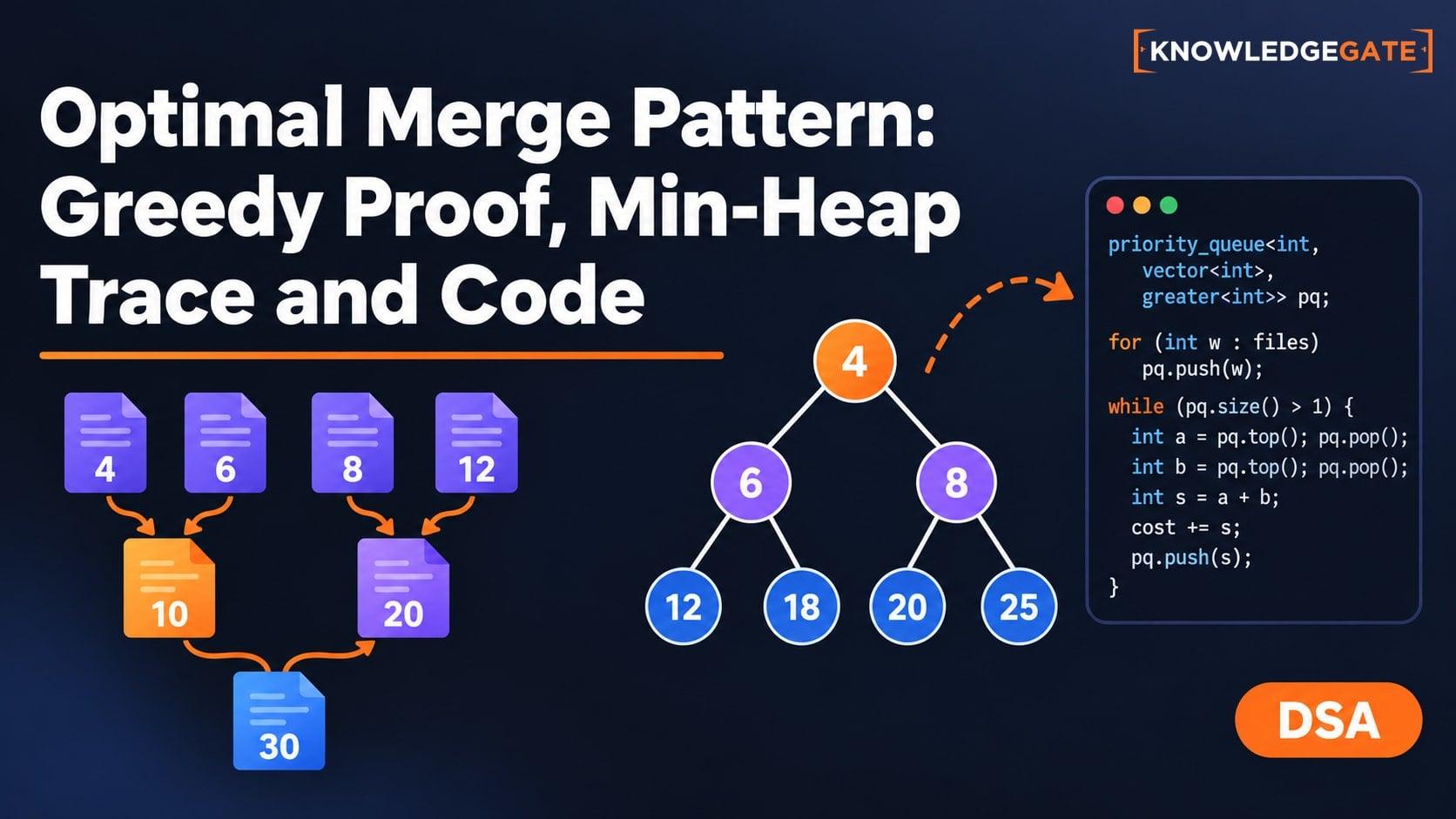
A strong answer states the rule, traces a heap, proves the greedy choice, and explains complexity. The same four-file example connects those pieces to pseudocode, a counterexample, and ten model answers. Interview formats vary, so explain both the result and why it works.
1. Optimal Merge Pattern in a 60-second interview answer
Given n files with non-negative sizes, merging sizes a and b costs a + b, and that sum returns to the pool. Minimise all merge costs until one file remains. Input order does not affect the optimum.
Build a min-heap. Remove its two smallest values, add them as merged, add merged to totalCost, reinsert it, and repeat. Small files should be charged through more levels; large files should stay closer to the final merge.
A screening answer should state the definition, trace and complexity. A deeper round may ask for the exchange proof, a counterexample and edge cases. DSA using Java structures heaps, greedy algorithms and interview-oriented DSA.
2. Trace the min-heap on files 5, 10, 20 and 30
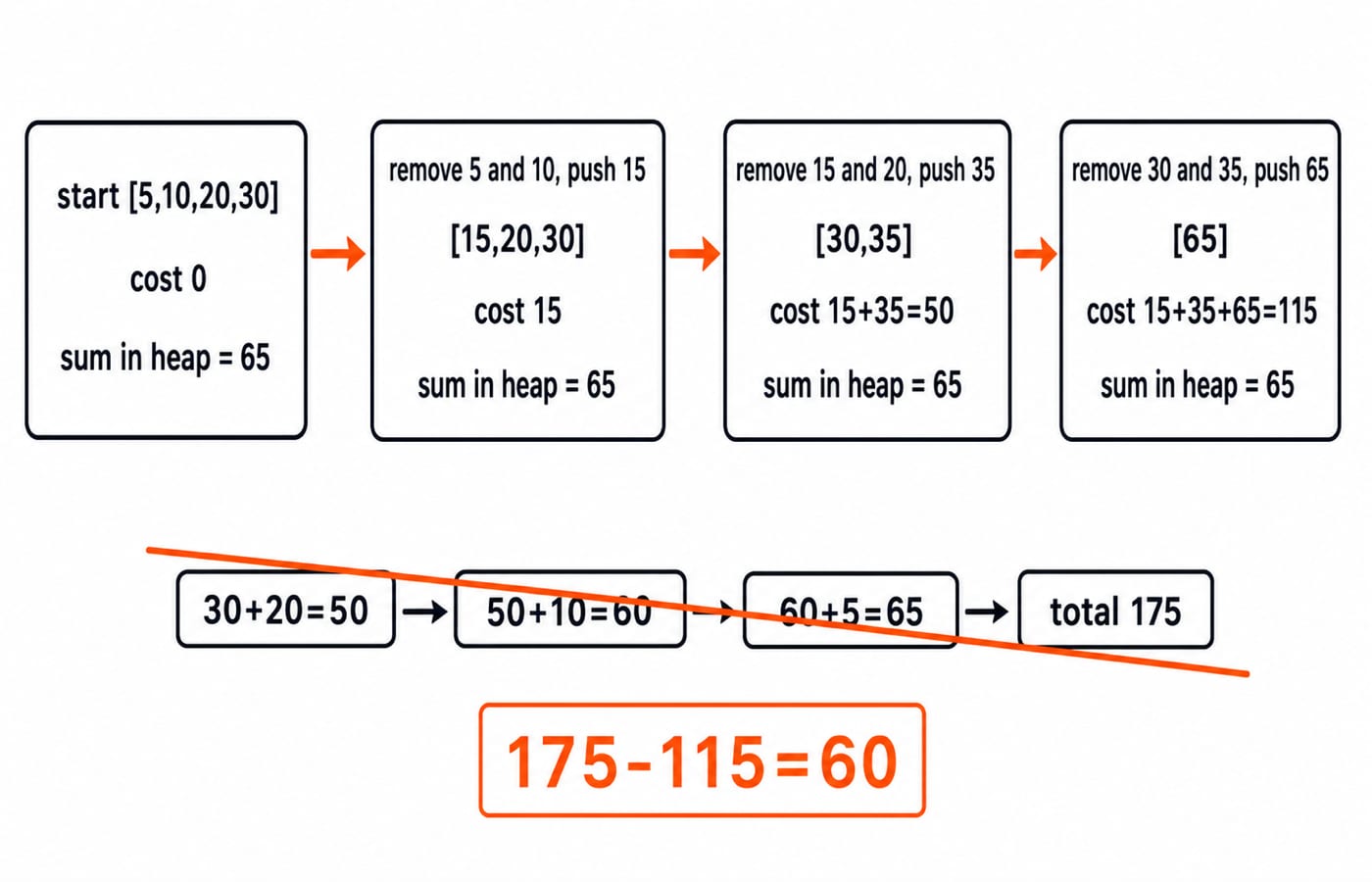
Start with sizes = [5, 10, 20, 30]. The heap contents below are shown in logical sorted order for clarity. An actual heap array need not print in sorted order.
step | two removed | merged size | heap after reinsertion | cost added | cumulative cost |
|---|---|---|---|---|---|
Start | none | none |
|
|
|
1 |
|
|
|
|
|
2 |
|
|
|
|
|
3 |
|
|
|
|
|
Two useful invariants hold after every step. The values remaining in the heap always sum to 65, and cumulative cost equals the sum of the merged values produced so far. These checks expose arithmetic errors.
A poor order exposes the penalty: 30 + 20 = 50, then 50 + 10 = 60, then 60 + 5 = 65. Its cost is 50 + 60 + 65 = 175, which is 175 - 115 = 60 above the greedy cost. This comparison is useful, but it is not the proof.
3. Why merging the two smallest files is safe
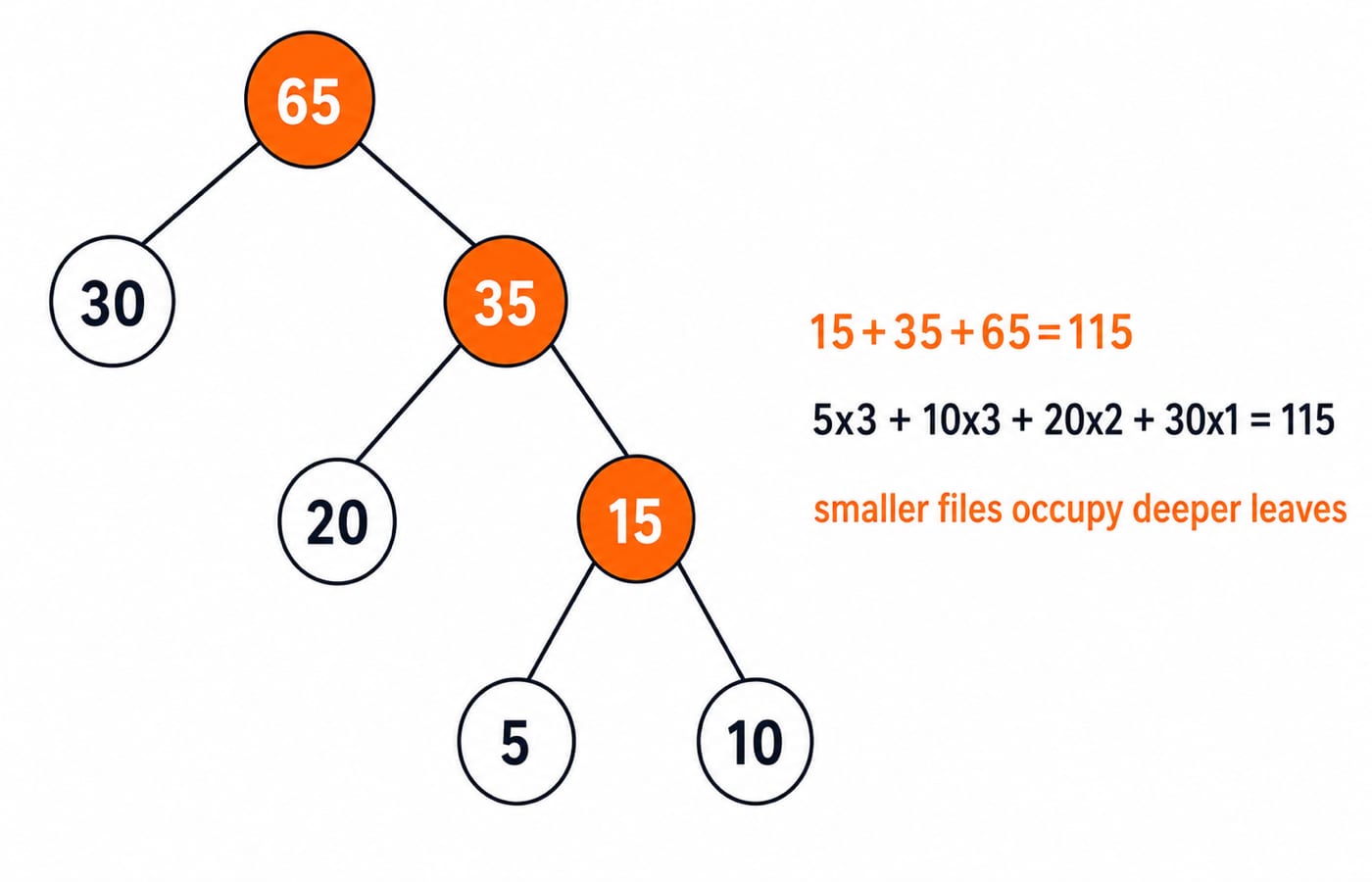
Represent a binary merge schedule as a full binary tree. Files are leaves and each internal node is a merged sum. Total cost equals both the sum of the internal-node weights and weighted external path length, sum(file size x leaf depth).
A deepest leaf has a leaf sibling. Let a and b be the two smallest sizes. Swapping them into a deepest sibling pair cannot increase weighted path length: smaller weights move to depths at least as large as the displaced weights. Contract them into one pseudo-file of weight a + b. The remaining tree is the same problem with one fewer item, so recursion proves the choice.
For our tree, 5 and 10 have depth 3, 20 has depth 2, and 30 has depth 1. Therefore 5x3 + 10x3 + 20x2 + 30x1 = 15 + 30 + 40 + 30 = 115. See Greedy Algorithms: Huffman, Knapsack, Activity Selection for wider greedy context.
4. Turn the greedy idea into safe pseudocode and honest complexity
The implementation should make invalid input and overflow risk explicit:
minimumMergeCost(sizes):
    reject if any size is negative
    if length(sizes) <= 1: return 0
    heap = heapify(copy(sizes) as wide integers)
    wide_integer totalCost = 0
    while size(heap) > 1:
        a = popMin(heap)
        b = popMin(heap)
        wide_integer merged = a + b
        totalCost = totalCost + merged
        push(heap, merged)
    return totalCost
For the example, (a,b,merged,totalCost) becomes (5,10,15,15), (15,20,35,50), then (30,35,65,115). Return accumulated cost 115, not final size 65.
Bottom-up heap construction is O(n). Exactly n-1 merges each perform two O(log n) removals and one O(log n) insertion, so total time is O(n log n) and heap space is O(n). Use a 64-bit or wider accumulator because repeated sums can exceed a narrow integer. Zero sizes are valid if the problem permits them, negatives are invalid, and duplicates need no special branch.
5. Five screening-depth interview questions with model answers
question | model answer | proof or number to say aloud |
|---|---|---|
1. What is the Optimal Merge Pattern problem? | Repeatedly merge two files at cost | The process ends after |
2. What greedy choice do you make? | Choose the two smallest current sizes. Keeping early sums small reduces costs that recur later. | First merge: |
3. Which data structure fits the operation? | A min-heap supports two minimum removals and reinsertion efficiently. Its root exposes the next minimum. | Three heap operations per merge. |
4. What is the minimum cost for | The merged values are |
|
5. What are the time and space costs? | Heapify is |
|
6. Five deep-dive follow-ups, proof boundaries and optimisations
question | model answer | proof or number to say aloud |
|---|---|---|
6. Why is the greedy choice correct? | Exchange the smallest weights into a deepest sibling pair, then contract. Recursion preserves the choice. | Path length cannot increase; the parent is |
7. Is sorting once and pairing adjacent files enough? | No. Fixed pairs on |
|
8. How is this related to Huffman coding? | Both combine two smallest weights to minimise weighted path length. Merge Pattern reports work; Huffman maps depths to code lengths. | Same rule, different meaning. |
9. Can already-sorted input be processed faster? | Yes. Use queues for untouched sizes and generated sums, taking the smaller front twice. |
|
10. What edge cases should the code handle? | Empty or one returns | Optimal tied trees may differ. |
This proof covers only binary additive costs. Different fan-in, costs, dependencies or constraints require a fresh proof.
7. Mistakes, tests and a focused practice loop
mistake | correction |
|---|---|
Using a max-heap | Use a min-heap. |
Forgetting reinsertion | Push every merged sum back. |
Adding only original sizes | Add every produced merged value. |
Returning final size | Return accumulated cost |
Running | Run exactly |
Claiming heap time is | State |
Using a narrow accumulator | Use a 64-bit or wider type. |
Test [] -> 0, [42] -> 0, [7,7,7] -> 35 because 7+7=14 and 14+7=21, [1,2,3,100] -> 115, and [5,10,20,30] -> 115. Tied trees may differ.
The linked MCQ page owns question-by-question practice; this post owns interview reasoning, proof and implementation. Use Optimal Merge Pattern MCQs: 10 Solved Questions for GATE for worked checks, then place the topic in the wider sequence through KnowledgeGate learning modules.
8. The short version and next implementation step
Recall: min-heap -> remove two smallest -> add merge cost -> reinsert sum -> repeat n-1 times -> O(n log n). Here, 15+35+65=115; the poor order costs 175.
Now reproduce the heap table and deepest-sibling proof from memory. Then code a wide-accumulator function that passes all five tests. For broader practice across languages and placement problems, continue with Coding for Placements, without treating any course as a hiring guarantee.
Keep learning
Heap Sort Interview Questions and Answers: Trace, Code, and Follow-Ups
Learn to build a max-heap, trace every extraction, explain iterative sift-down, justify the time and space bounds, and handle common Heap Sort follow-ups.
Updated 2 Nov 20265 min readInterview Corner

Optimal Merge Pattern MCQs: 10 Solved Questions with Explanations
Practise the optimal merge rule across MCQ and NAT problems. Each solution shows the sorted pool, total merge cost, comparison adjustment, or storage order you need.
Updated 9 Aug 20268 min read71 viewsAlgorithms MCQs
Merge Sort Interview Questions and Answers: Traces, Complexity, and Code
Prepare crisp merge sort interview answers through a fully traced array, boundary-safe Java implementation, complexity proof, stability example, and inversion-count follow-up.
Updated 3 Nov 20266 min readInterview Corner
Compiler Design Semester Guide: Trace One Program from Tokens to Target Code
Follow one assignment through lexical analysis, parsing, semantic checks, TAC, optimization and abstract target instructions, with every hand-off made visible.
Updated 18 Oct 20267 min readCompiler Design