

Java Array MCQs: 10 Solved Questions on Indexing, Defaults and References
Trace all 10 Java array questions. Learn to separate compile-time errors, bounds errors, defaults, nested indexing and shared-array mutation.
KnowledgeGate Team
Exam prep & CS education
Updated 31 Oct 20267 min read
The questions test zero-based indexing, default values, reference aliasing, method calls and nested subscripts. For the wider programming route, start with Coding & DSA.
Java array MCQs: use a four-pass trace before choosing
Use the same four passes on every question:
Check whether the code as printed is valid Java.
Write the array length and legal indices.
Mark which variables point to the same array object.
Evaluate nested brackets from the inside out.
For int[] a = {4, 7, 9}, the legal indices are 0, 1, 2; a[1] = 7, while a[3] throws ArrayIndexOutOfBoundsException. Keep that run-time error separate from the compile-time error in X.length() and the null default in a new String[].
Java array defaults and initialization: Q3, Q4 and Q10
Q3. Default element in a newly allocated String array (UPLT 2018) (module page)
String[] var1;
var1 = new String[3];
System.out.println(var1[1]);
(a)
an empty string(b)
null(c)
0(d)
a garbage character
Answer: (b) null. Java reference-array elements default to null. String[] var1 = new String[3] creates three reference slots, all initialized to null, so var1[1] is neither "", 0 nor a garbage value.
Q4. The untouched third slot (RPSC Programmer - P2 2024)
What will be the value of arr[2] in the following code?
 String[] arr = new String[3];
 arr[0] = "Maths";
 arr[1] = "Science";
(a)
Null(b)
"Science"(c)
"Maths"(d)
" "
Answer: (a) Null. The Java value is spelled null. After the assignments, the slots are arr[0] = "Maths", arr[1] = "Science", and arr[2] = null, which is different from the one-space string " ".
Q10. The same default-value trap in another paper (UPPSC Polytechnic Lecturer 2018)
String[] var1;
var1 = new String[3];
System.out.println(var1[1]);
(a)
an empty string(b)
null / (null)(c)
0 / शून्य(d)
a garbage character
Answer: (b) null / (null). This independent exam item repeats Q3's default-value check almost exactly. In the corrected Java form, every newly allocated String[] slot starts as null, so var1[1] prints null deterministically.
Java array declarations and length syntax: Q6 and Q7
Q6. One-dimensional double array as a method parameter (RPSC Programmer - P2 2024)
Which of the following correctly declares a method that accepts one dimensional array of double as a parameter?(a)
public void fun(double *arr[])(b)
public void fun(double[] arr)(c)
public void fun(arr double[])(d)
public void fun(double arr)
Answer: (b) public void fun(double[] arr). Java can place brackets with the type or identifier, but it does not use a C-style pointer declarator. Option (d) accepts one scalar double, while (a) and (c) are invalid Java parameter syntax.
Q7. Array length is a field, not a method (Kendriya Vidyalaya Sangathan 2017)
What correction is required for the following Java code snippet to compile?
 int [] X = new int [10];
 for (int P = 0; P < X.length(); P++)
     X [P] = 5;
(a)
X[P] = 5 should be X(P) = 5(b)
P <= X.length() should be P < X.length()(c)
X.length() should be X.length(d)
P++ should be P+1
Answer: (c) X.length() should be X.length. The corrected loop is for (int P = 0; P < X.length; P++) X[P] = 5;. It assigns 5 at indices 0 through 9, then stops when P becomes 10; an array has a length field, while a String has a length() method.
Arrays in C: Declaration, Initialization and Worked Examples also uses brackets, but Java arrays have a length field and reference semantics rather than C pointer rules.
Java zero-based indexing and array traversal: Q2, Q5 and Q9
StringBuffer is not an array, but both structures use zero-based positions. Q2 tests that transferable indexing rule; Q5 and Q9 apply indexing to arrays directly.
Q2. Zero-based mutation in a StringBuffer (RSSB SCI - Paper 2 2022)
What will be the output of the program?
 public class Test2 {
   public static void main (String [ ] args) {
     StringBuffer S1 = new StringBuffer("Complete");
     S1.setCharAt(1, 'i');
     S1.setCharAt(7, 'd');
     System.out.println(S1);
   }
 }
(a)
Complete(b)
lomplede(c)
Cimpletd(d)
Coipletd
Answer: (c) Cimpletd. StringBuffer uses zero-based positions. Index 1 in Complete is o, and index 7 is the final e; replacing them with i and d produces Cimpletd.
Q5. Enhanced for traversal preserves array order (RPSC Programmer - P2 2024)
What is the output of the following code?
 public class ex {
     public static void main(String[] args) {
         int[] a = {1, 2, 3, 4, 5};
         print(a);
     }
     public static void print(int[] a) {
         for(int n : a) {
             System.out.print(n + " ");
         }
     }
 }
(a)
Compilation error(b)
5 4 3 2 1(c)
Runtime error(d)
1 2 3 4 5
Answer: (d) 1 2 3 4 5. The enhanced loop visits n = 1, then 2, 3, 4, and 5, preserving array order without reversing or sorting. The program prints a trailing space after 5, which the answer choice does not show.
Q9. Evaluate nested subscripts from inside to outside
What will be output for the following code?
class Main
{
         public static void main(String args[])
        {
                int arr[] = new int[] {0 , 1, 2, 3, 4, 5, 6, 7, 8, 9};
                int n = 6;
               n = arr[arr[n] / 2];
               System.out.print(n);
         }
}
(a)
3(b)
0(c)
6(d)
1
Answer: (a) 3. Start with n = 6. First, arr[n] = arr[6] = 6; integer division gives 6 / 2 = 3; then arr[3] = 3, and that final value is assigned to n.
Java array references and method mutation: Q1 and Q8
Q1. Element copy versus reference assignment (UGC NET Computer Science, January 2017)
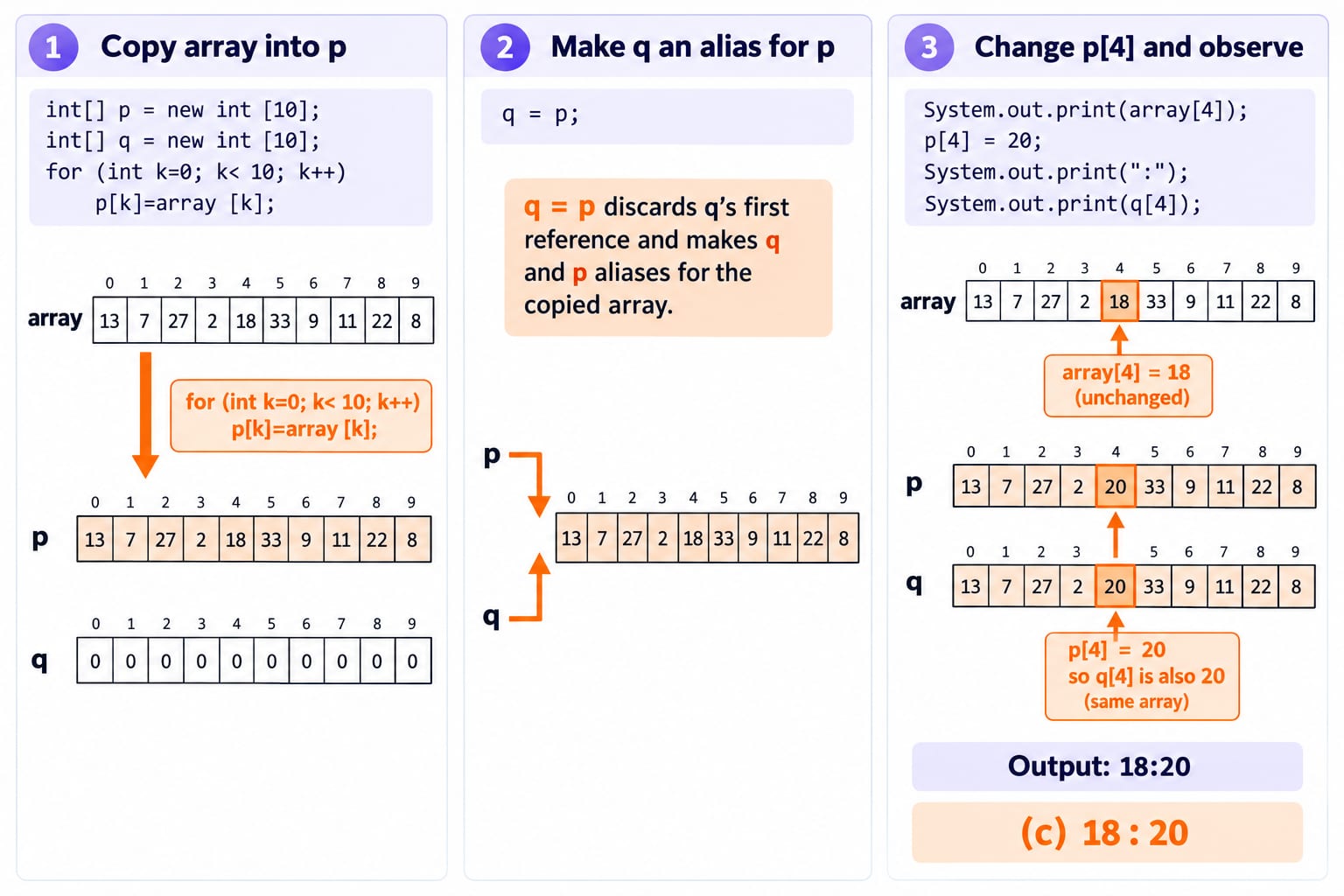
Given the array of integers ‘array’ shown below:
array: 13 | 7 | 27 | 2 | 18 | 33 | 9 | 11 | 22 | 8

What is the output of the following JAVA statements?

int[] p = new int [10];

int[] q = new int [10];

for (int k=0; k< 10; k++)

    p[k]=array [k];

q=p;

p[4]=20;

System.out.println(array[4]+":"+q[4]);
(a)
20 : 20(b)
18 : 18(c)
18 : 20(d)
20 : 18
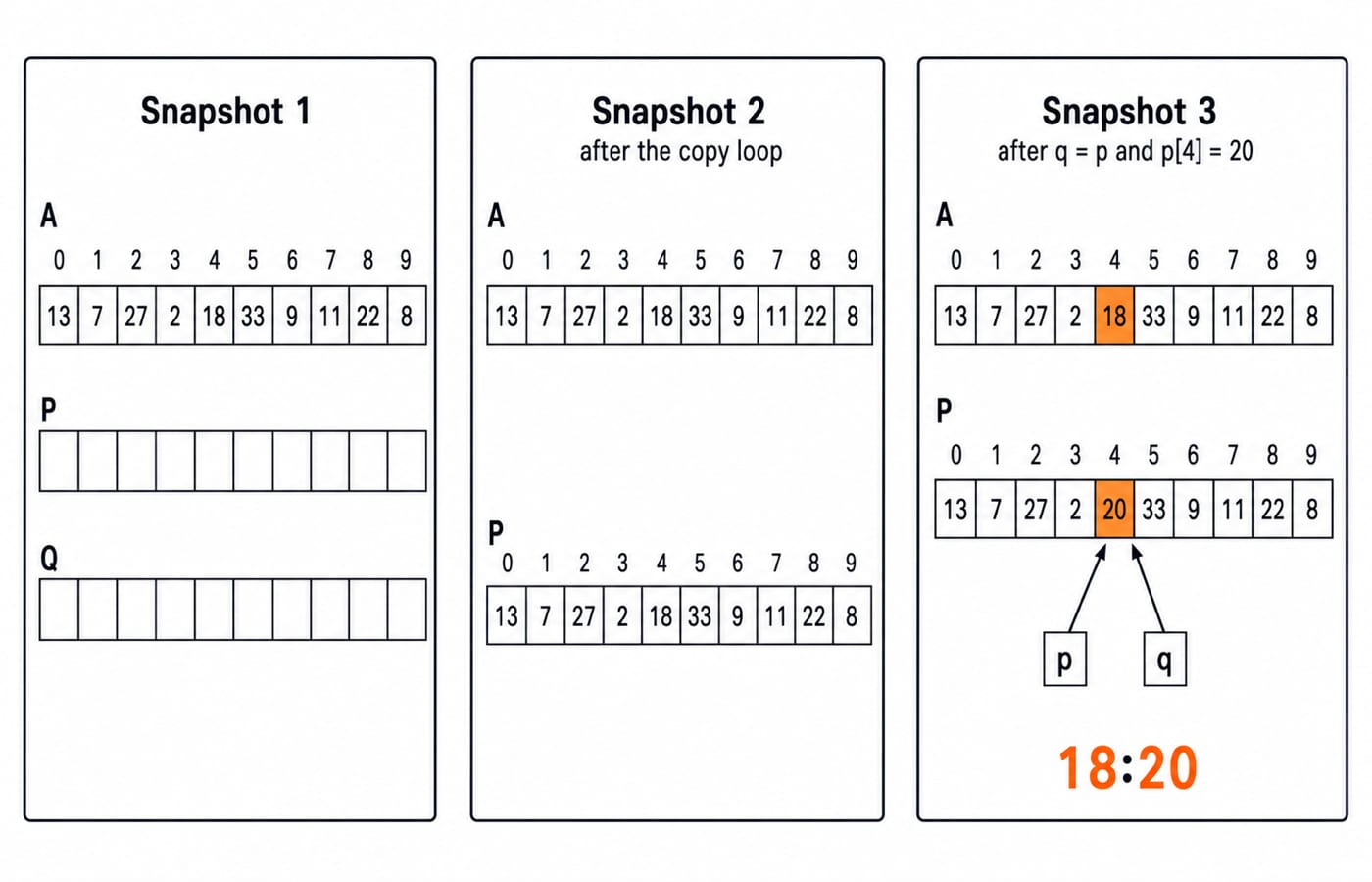
Answer: (c) 18 : 20. The loop copies all ten values into a distinct p array, but q = p discards q's first reference and makes q and p aliases for the copied array. Therefore p[4] = 20 also means q[4] = 20, while the original array[4] remains 18; the exact printed form is 18:20.
Q8. Passing an array to a method passes the reference value (UGC NET Computer Science, July 2018)
What is the output of the following JAVA program?
class simple

{

    public static void main(String[ ] args)

    {

        simple obj = new simple();

        obj.start();

    }

    void start()

    {

        long [] P = {3, 4, 5};

        long [] Q = method (P);

        System.out.print (P[0] + P[1] +P[2]+":");

        System.out.print (Q[0] + Q[1] + Q[2]);

    }

    long [ ] method (long [ ] R)

    {

        R[1] = 7;

        return R;

    }

} //end of class
(a)
12:15(b)
15:12(c)
12:12(d)
15:15
Answer: (d) 15:15. R receives the same array reference as P, changing the one object from {3, 4, 5} to {3, 7, 5}. The returned reference becomes Q, and each sum is 3 + 7 + 5 = 15.
What these Java array MCQs are actually testing
Q3, Q4 and Q10 test defaults; Q6 and Q7 test syntax; Q2, Q5 and Q9 test positions; Q1 and Q8 test aliasing and mutation.
Trap | Exact result to remember |
|---|---|
| Three |
| The array field |
| Both variables alias the copied array |
|
|
Where a question is printed with typing errors, fix the obvious slips first and then trace the intended code.
Java array MCQs: the short version and next step
Remember: arrays are zero-indexed, reference slots default to null, arrays use the length field, assignments can create aliases, and methods can mutate shared arrays.
Now re-trace Q1 after changing only p[4] = 20 to array[4] = 30. The copy into p already preserved 18 at index 4, and q still aliases p, so the two reads are array[4] = 30 and q[4] = 18. The new output is 30:18.
Continue with the Java Course, Concepts, MCQs and Coding Questions, then practise one-operation-at-a-time tracing with Stacks and Queues MCQs: 12 Solved (GATE).
Go deeper with the full courseData Structures
Keep learning
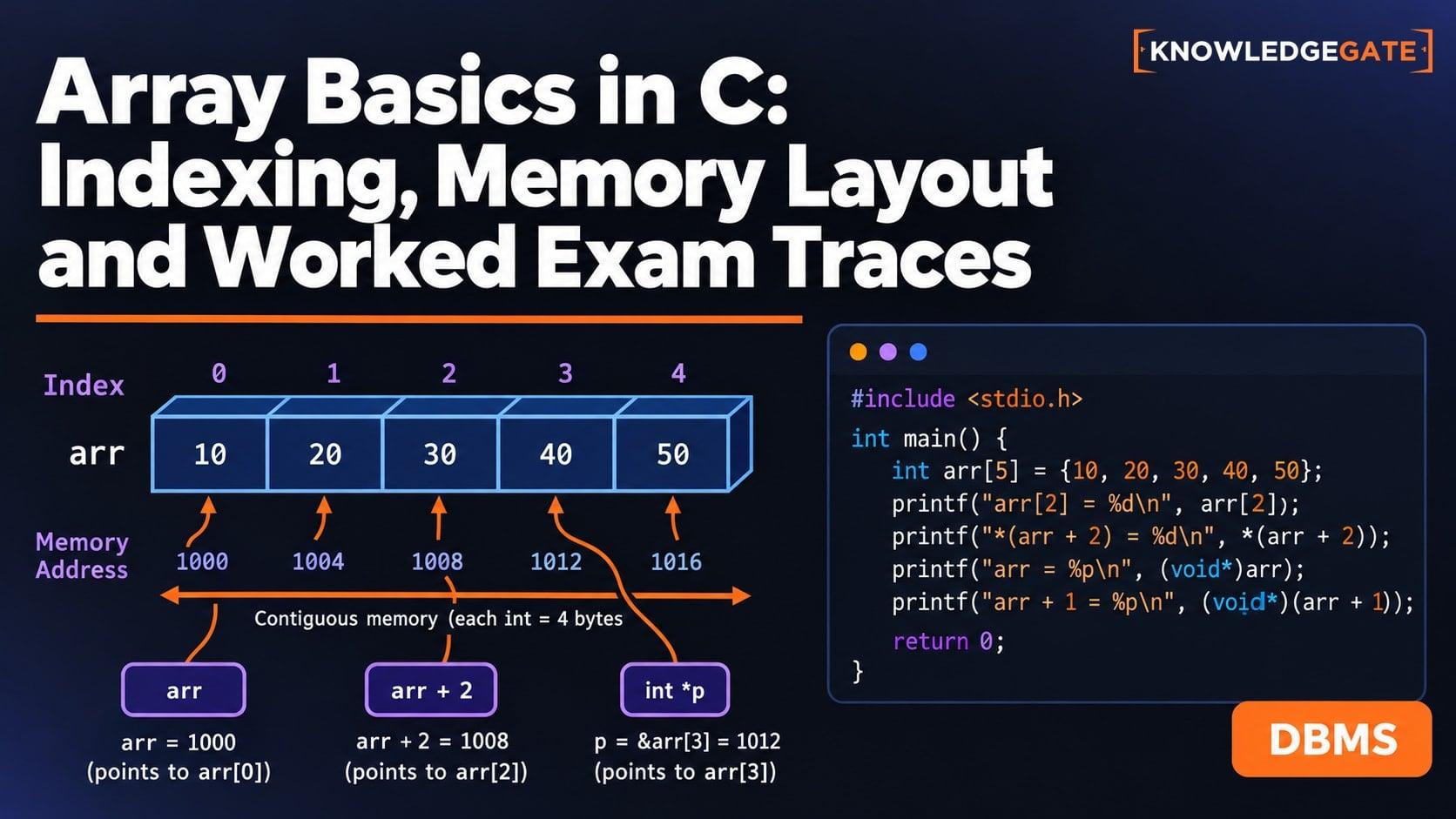
Array Basics in C: Indexing, Memory Layout and Worked Exam Traces
C arrays become much easier once indices, addresses, loop bounds, and mutations are kept separate. Build that model with two complete traces and common-error checks.
Updated 16 Sep 20266 min read55 viewsC Programming & Data Structures
Arrays in Java: Indexing, Traversal and Worked Examples
Build a reliable model of Java arrays, then trace mutation, traversal, copying, logical deletion and ragged rows with exact values.
Updated 20 Nov 20266 min readJava

Other Array Types MCQs: 10 Solved Questions with Explanations
Work through 10 live MCQs and learn how index alignment, logical size, physical capacity, sparse storage, and 1-based heap arithmetic determine each answer.
Updated 29 Oct 20267 min readData Structures MCQs
3D and Multidimensional Array MCQs: 10 Solved Questions with Explanations
Solve ten multidimensional-array questions with lower-bound normalisation, address formulas, array transformations, and careful step-by-step traces.
Updated 20 Oct 20268 min readData Structures MCQs