IBPS SO IT Officer Data Structures and programming: professional knowledge topics
IBPS SO IT Officer Data Structures and programming: arrays, linked lists, stacks, trees, hashing, sorting, complexity and C basics for the Mains PK paper.
KnowledgeGate Team
Exam prep & CS education
Updated 18 Jul 20266 min read339 views
Data Structures and programming sit inside the Professional Knowledge paper of the IBPS SO IT Officer Mains, the technical paper that separates the IT Officer post from a general banking role. Prelims asks for English, reasoning and quantitative aptitude; Professional Knowledge is where a computer-science background finally earns marks. The catch is breadth, because the same paper also draws on DBMS, operating systems, networks, software engineering and digital logic, so Data Structures has to be learned for judgement rather than volume. It is not a memory subject; it is about choosing the right structure and knowing what each operation costs.
Data Structures for IBPS SO IT: the building blocks
Every data structure is a trade-off between how fast you can access, insert, and delete. Start with the linear structures and be precise about their costs. The Data Structures Professional Knowledge module works through the same four structures in recorded lessons, with the costs derived rather than asserted.
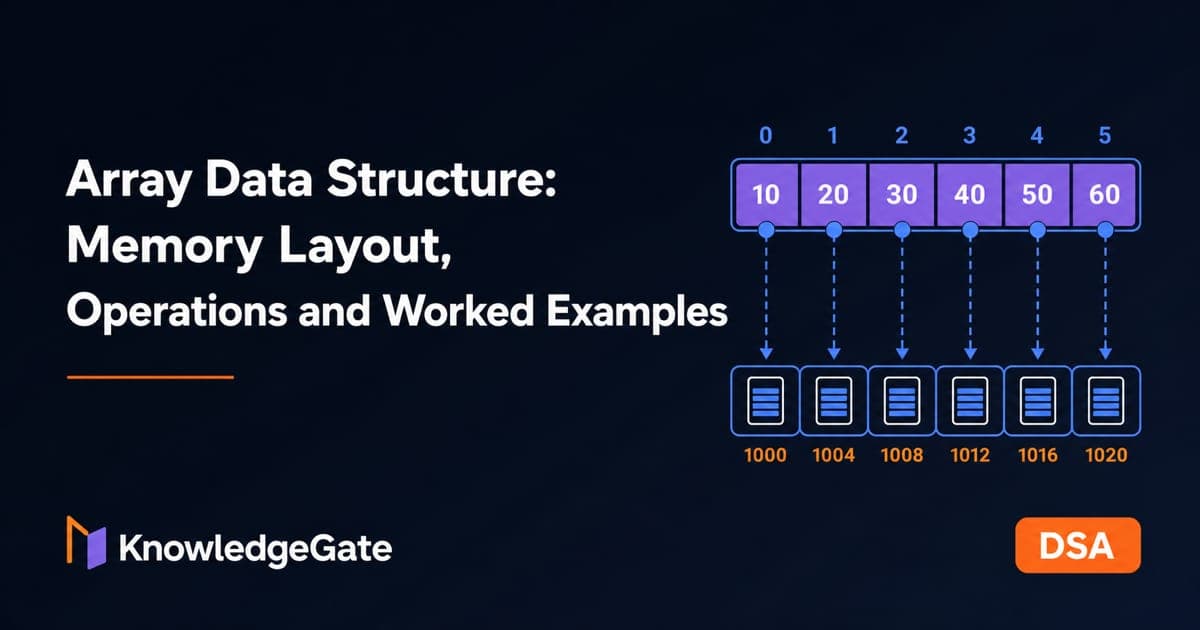
Array: a contiguous block with constant-time access by index, but costly insertion or deletion in the middle because elements must shift.
Linked list: nodes joined by pointers, giving cheap insertion and deletion but only sequential access, no direct indexing.
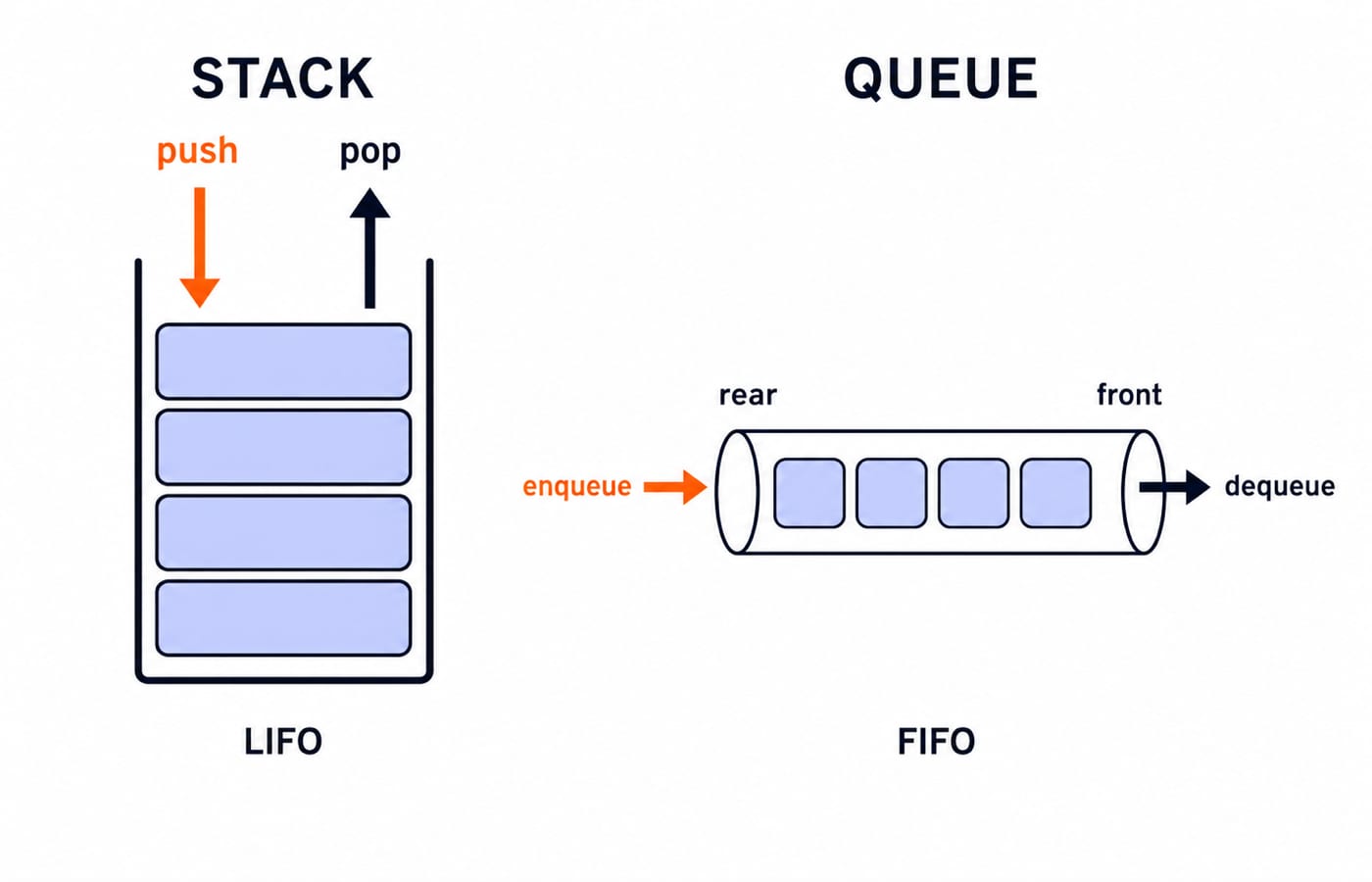
Stack: last-in first-out (LIFO), with push and pop at one end. It powers function calls, undo operations, and expression evaluation.
Queue: first-in first-out (FIFO), with enqueue at the rear and dequeue at the front. A circular queue reuses freed slots efficiently.
Trees and the non-linear structures
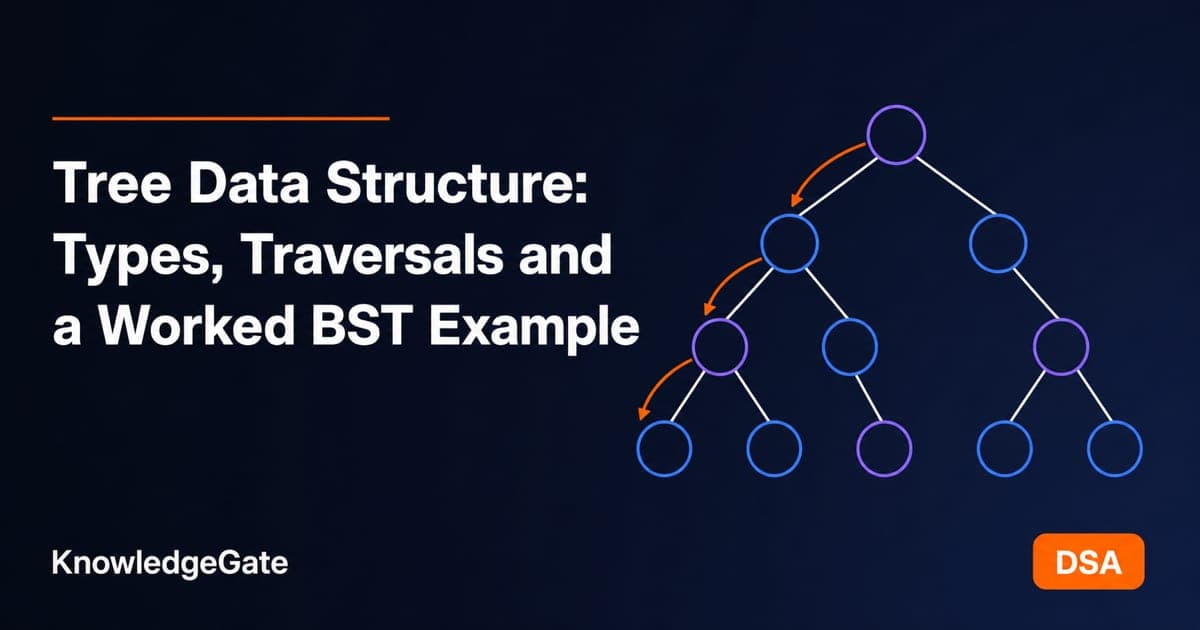
A tree is a hierarchy with one root and no cycles. The binary search tree (BST) keeps smaller keys left and larger keys right, so search, insert, and delete run in time proportional to the height. A balanced tree keeps the height near log n, which is why balancing matters. Know the three depth-first traversals: inorder (left, root, right), which prints a BST in sorted order, preorder (root, left, right), and postorder (left, right, root). A heap is a complete binary tree used to build priority queues and to power heap sort; a min-heap keeps the smallest key at the root, a max-heap the largest.
Binary search tree: a worked traversal example
Insert 50, 30, 70, 20, 40, 60, 80 into an empty BST in that order. 50 is the root. 30 is smaller so it becomes the left child, 70 is larger so it becomes the right child. 20 lands left of 30, 40 right of 30, 60 left of 70, and 80 right of 70.
Inorder gives 20, 30, 40, 50, 60, 70, 80, sorted. Preorder gives 50, 30, 20, 40, 70, 60, 80, and postorder gives 20, 40, 30, 60, 80, 70, 50.
Searching for 60 touches 50, then 70, then 60, so three comparisons. Cost follows the height: a balanced tree with n keys needs about O(log n) comparisons, a degenerate one O(n), and inserting already sorted keys degenerates the tree into a linked list.
Hashing and graphs
Hashing stores and retrieves data in close to constant time by mapping a key through a hash function to an index. Two keys landing on the same index is a collision, resolved either by chaining (a linked list at each slot) or by open addressing (probing for the next free slot). A well-designed hash table gives average-case O(1) lookup, which is why it underlies dictionaries and symbol tables.
A graph is a set of vertices joined by edges, directed or undirected, and it models networks, dependencies, and maps. The two core traversals are breadth-first search (BFS), which explores level by level using a queue, and depth-first search (DFS), which goes deep using a stack or recursion. Recognising which traversal a described procedure is performing is a frequent exam question.
Sorting, searching, and complexity: where the marks hide
Complexity is the vocabulary the paper uses to ask about every structure above. Big-O describes how running time grows with input size n. Fix these:
Linear search: O(n). Binary search: O(log n), but only on sorted data.
Bubble, selection, and insertion sort: O(n²) in the average and worst case.
Merge sort: O(n log n) always, and stable. Quick sort: O(n log n) on average but O(n²) in the worst case.
Heap sort: O(n log n) with constant extra space.
Sorting a million records with an O(n²) method costs on the order of a trillion operations. An O(n log n) method costs about twenty million, roughly fifty thousand times fewer. That gap is why the paper asks which algorithm you would choose, not just whether you can name one. The full best, average and worst case grid, with the stability and in-place columns, is set out in Sorting Algorithms Compared: complexity, stability, and the n log n lower bound.
Programming basics: C and the object-oriented ideas
The programming half of this area tests fundamentals rather than anything you have built, and C is the usual vehicle. Be solid on:
Data types and storage: int, float, char, and how a pointer holds a memory address.
Pointers: the operators & (address-of) and * (dereference), and why call by reference lets a function change the caller's variable.
Arrays and pointers: an array name behaves like a pointer to its first element.
Control flow and functions: loops, conditionals, and recursion, where a function calls itself with a base case that stops it.
For object-oriented concepts, keep four words crisp: encapsulation (bundling data with methods), abstraction (hiding detail behind an interface), inheritance (a class deriving from another), and polymorphism (one interface, many implementations). A quick definitional question on any of these is common, often as a match-the-term item or a short code snippet asking which principle it demonstrates. A class is the blueprint, and an object is a specific instance created from it. C and these four ideas together make up the Programming Languages track of the IBPS SO IT Officer Mains course.
How Data Structures and programming are tested in the IBPS SO IT Mains
Professional Knowledge is one paper stretched across the whole computer-science syllabus; our IBPS SO IT Mains course splits it into thirteen subject tracks, from digital logic through to compiler design. That breadth is why Data Structures and programming arrive as short standalone items rather than long derivations. Expect the complexity of a named operation, the output of a six-line C snippet, the traversal order of a small tree, and the best or worst case of a named sort. The KnowledgeGate question bank carries over 1,400 Data Structure questions and more than 1,200 on programming languages, which is enough to drill each of those four shapes on its own.
Traversal orders and complexity classes are settled results, so learn them as facts. The paper's question count, timing and marking rules are not settled; they belong to the current notification at ibps.in, so confirm them there before you plan your attempt.
Your next step
This subject is built by tracing code and structures on paper, then confirming on questions.
Trace one BST by hand: insert 50, 30, 70, 20, 40, 60, 80, then insert the same seven keys in ascending order and watch the tree collapse into a linked list.
Dry-run one recursive C function on paper, writing down every parameter at each call, until the base case stops feeling like magic.
For all three stages, Prelims, Mains and the interview, the IBPS SO IT Officer Scale-1 bundle covers the full selection process in one place.
The wider banking-IT line-up sits under the Banking and Insurance category.
Data Structures rewards the candidate who has computed things, not the one who has read about them. Get the complexity list to where you can recite it cold, hand-trace a tree without looking, and this becomes the part of Professional Knowledge you can count on.
Keep learning
Array Data Structure: Memory Layout, Operations and Worked Examples
Understand how arrays map indices to memory, then practise address calculation, exact shift counts, searching and dynamic-array growth with worked examples.
Updated 24 Oct 20266 min readDSA & Algorithms
Tree Data Structure: Types, Traversals and a Worked BST Example
Build one nine-node binary search tree, classify its shape, trace four traversals, and work through insertion, search, deletion and complexity checks.
Updated 21 Oct 20266 min readDSA & Algorithms
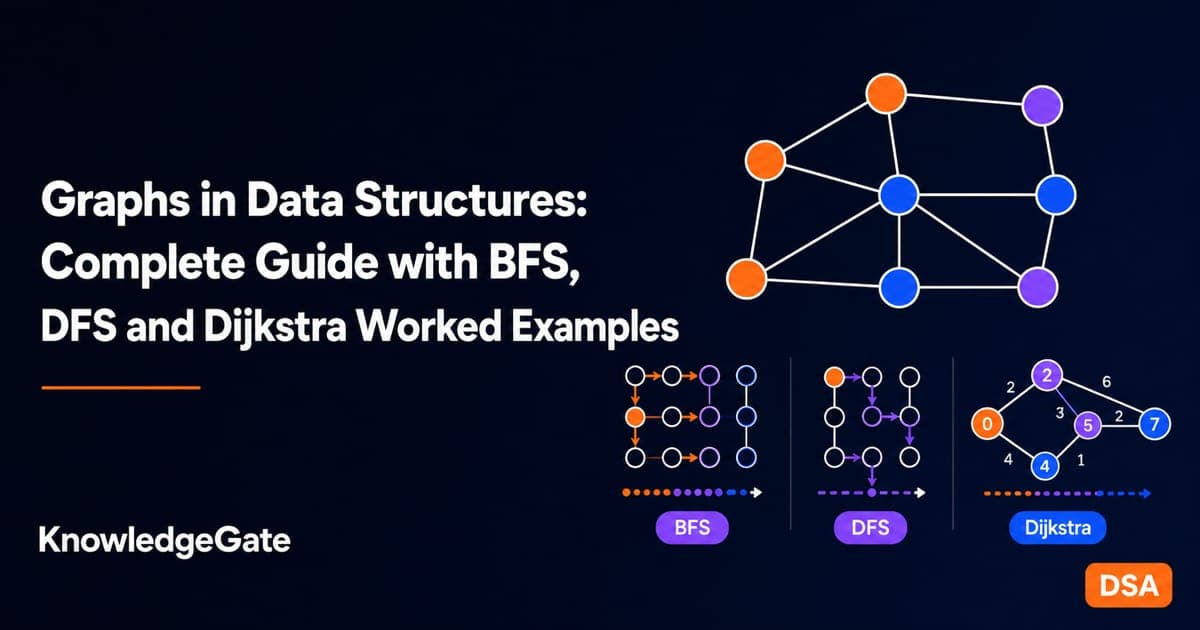
Graphs in Data Structures: Complete Guide with BFS, DFS and Dijkstra Worked Examples
Learn graph terminology, representations and algorithm selection by tracing one unweighted graph with BFS and DFS, then solving a weighted graph with Dijkstra.
Updated 17 Oct 20266 min readDSA & Algorithms

Physical Security and Cryptography Basics: Controls, Keys and Worked Examples
Learn how physical and cryptographic controls work together, then apply them in a four-asset server-room model and a step-by-step toy RSA example.
Updated 13 Oct 20265 min readDSA & Algorithms