

Division Operator in Relational Algebra: Worked DBMS Example and Exam Traps
Learn relational division by solving one student-course dataset three ways, then test your understanding against extra tuples, duplicates, and an empty divisor.
KnowledgeGate Team
Exam prep & CS education
Updated 19 Nov 20265 min read
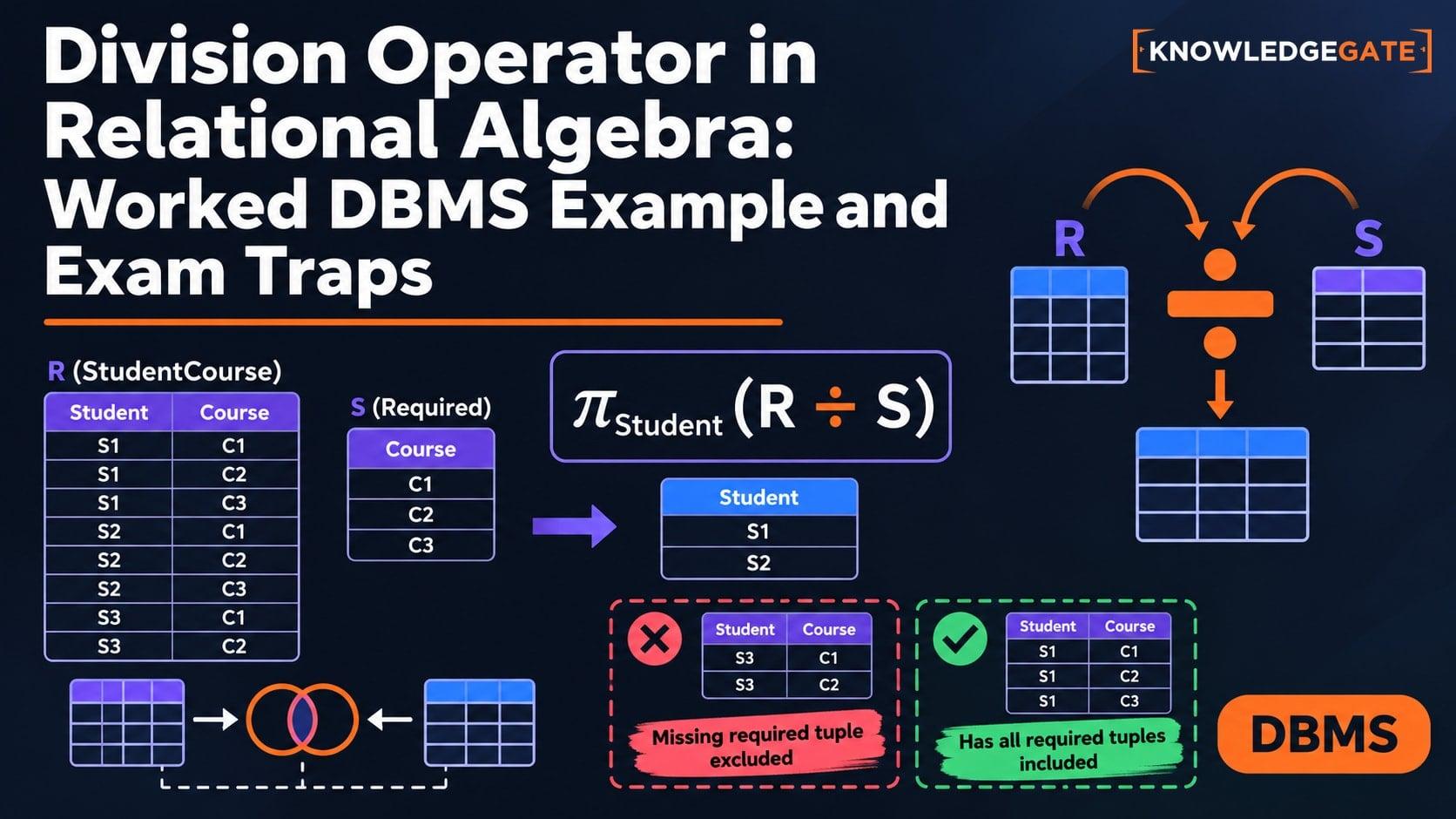
Joins naturally answer whether a matching row exists. Division answers the harder "for every" question, but the operator is often shown as a symbol without showing how non-qualifying rows are eliminated. The fixed TAKES ÷ REQUIRED example can be evaluated by direct set checking, primitive relational-algebra operations, and SQL's double NOT EXISTS. An extra row is allowed, while one missing requirement causes failure.
What the division operator means
Start with the schema. If the dividend is R(X,Y) and the divisor is S(Y), then R ÷ S returns a relation over X. The divisor's attributes must be attributes of the dividend, and the quotient contains the dividend's remaining attributes.
In symbols, x ∈ R ÷ S exactly when ∀y ∈ S, (x,y) ∈ R. In plain English, keep an x only if it is paired with every y required by S. This is a set-containment test, not exact-set equality. An x may have additional Y values and still qualify. Under relational set semantics, duplicate tuples neither help nor hurt.
The typical question is, "Which students have taken every required course?" The broader CS Fundamentals for Exams & Placements category connects this operator to the surrounding DBMS syllabus.
Set up one exact TAKES ÷ REQUIRED example
The same university data appears in Relational Algebra in DBMS: Complete Guide with Worked Queries, where selection, projection, joins, and division are traced together. Missing-pair proof, double-NOT EXISTS, duplicate handling, and empty-divisor reasoning are the extra work required for a division-only problem.
Let the dividend be TAKES(student, course):
student | course |
|---|---|
Asha | DBMS |
Asha | OS |
Asha | CN |
Bharat | DBMS |
Bharat | OS |
Charu | DBMS |
Charu | OS |
Charu | CN |
Charu | AI |
Dev | DBMS |
Dev | CN |
The divisor REQUIRED(course) contains three rows, in order: DBMS, OS, and CN. We need TAKES ÷ REQUIRED. The result schema is RESULT(student) because division removes course.
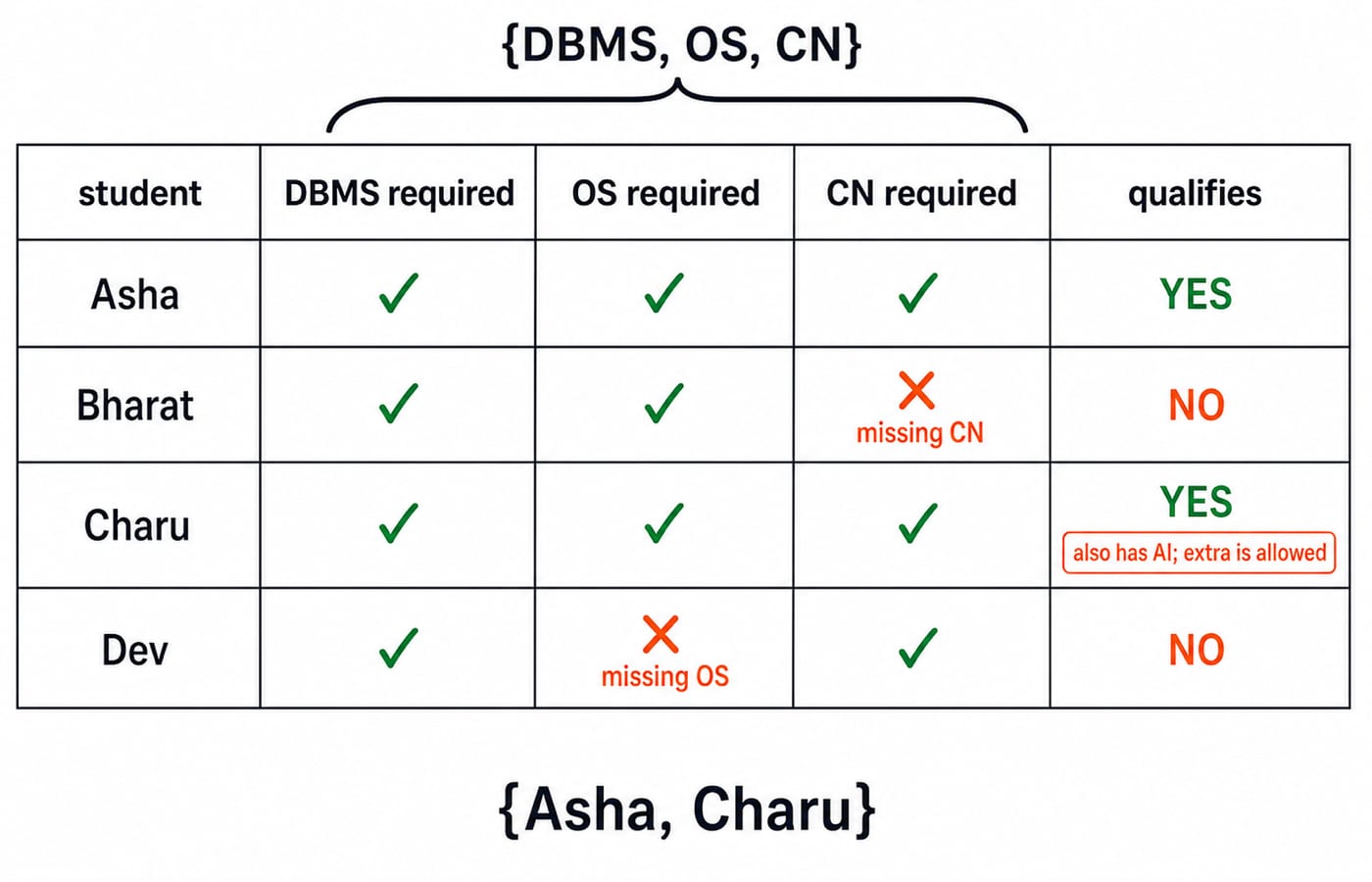
Before deciding who qualifies, list the observed sets:
Asha:
{DBMS, OS, CN}Bharat:
{DBMS, OS}Charu:
{DBMS, OS, CN, AI}Dev:
{DBMS, CN}
The test is not row count. It is whether each set contains {DBMS, OS, CN}. Asha and Charu contain the required set. Bharat is missing CN, while Dev is missing OS.
Compute the quotient step by step with primitive operators
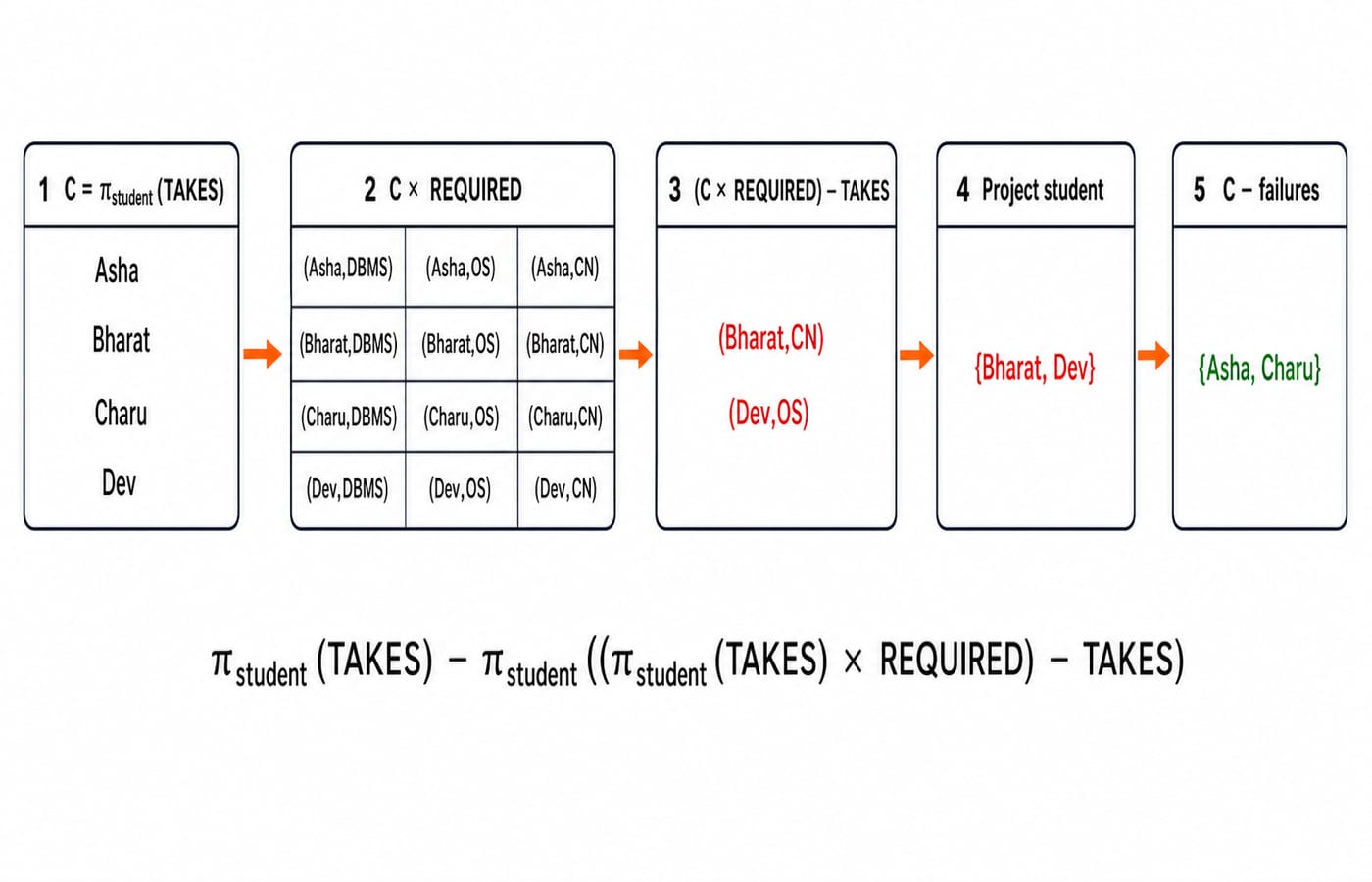
First find every possible quotient value:
C = π_student(TAKES) = {Asha, Bharat, Charu, Dev}
Next form every required pair in C × REQUIRED. There are 4 × 3 = 12 tuples:
Asha:
(Asha,DBMS),(Asha,OS),(Asha,CN)Bharat:
(Bharat,DBMS),(Bharat,OS),(Bharat,CN)Charu:
(Charu,DBMS),(Charu,OS),(Charu,CN)Dev:
(Dev,DBMS),(Dev,OS),(Dev,CN)
Now subtract the pairs that actually occur in TAKES:
MISSING = (C × REQUIRED) - TAKES = {(Bharat,CN), (Dev,OS)}
Charu's (Charu,AI) row is irrelevant. It occurs in TAKES, but not in the required-pair product, so it cannot create a missing pair. Project the students who failed: π_student(MISSING) = {Bharat, Dev}.
Finally, remove them from the candidate set:
RESULT = C - π_student(MISSING) = {Asha, Charu}
The standard rewrite binds these steps together:
TAKES ÷ REQUIRED = π_student(TAKES) - π_student((π_student(TAKES) × REQUIRED) - TAKES)
Difference performs the universal-quantifier work. It finds one counterexample, a required pair that is absent, and eliminates that student. Direct checking confirms the result: Asha has all three rows, Charu has all three plus AI, Bharat lacks CN, and Dev lacks OS.
Express the same "for every" condition in SQL
SQL can express the same logic with two nested NOT EXISTS conditions:
SELECT DISTINCT t1.student
FROM TAKES AS t1
WHERE NOT EXISTS (
  SELECT 1
  FROM REQUIRED AS r
  WHERE NOT EXISTS (
    SELECT 1
    FROM TAKES AS t2
    WHERE t2.student = t1.student
      AND t2.course = r.course
  )
)
ORDER BY t1.student;
Read it inside out. The inner query looks for a candidate's matching course. The middle NOT EXISTS identifies a required course for which no match exists. The outer NOT EXISTS keeps candidates with no missing requirement.
For Bharat, r.course = 'CN' has no matching row, so Bharat is excluded. For Dev, the failure occurs at r.course = 'OS'. Charu has matches for DBMS, OS, and CN. AI is never consulted because it is not in REQUIRED. The output is:
student |
|---|
Asha |
Charu |
There is no literal universal-quantifier keyword here. The two absence checks build the "for every" meaning.
Division traps, edge cases, and corrections
Trap: Demand an exact course-set match. Wrong result: Charu is rejected because of AI. Correction: Test whether the required set is a subset.
Trap: Compare
COUNT(*)across allTAKESrows with the required count. Wrong result: Charu has 4 rather than 3 and is rejected. Correction: Filter or join toREQUIRED, then count distinct required courses, or use doubleNOT EXISTS.Trap: Let duplicate rows increase the count. Wrong result: Two DBMS rows can imitate two different requirements under SQL bag semantics. Correction: Enforce suitable keys and use
COUNT(DISTINCT course)in a counting solution.Trap: Divide relations with incompatible schemas. Wrong result: The removed attributes are undefined. Correction: Rename attributes when necessary and ensure the divisor's heading is contained in the dividend's heading.
The empty divisor is important. If REQUIRED has zero rows, the formal expression returns every student in π_student(TAKES): Asha, Bharat, Charu, and Dev. Nobody can be missing a required course. The double NOT EXISTS query preserves this vacuous-truth result. A naive inner-join-plus-GROUP BY version may form no groups and return a different answer.
How practice questions test division
Exam questions usually ask you to compute a quotient from two small relations, identify an English "all" query, rewrite division with projection, product, and difference, choose the double-NOT EXISTS equivalent, or catch extra-tuple and empty-divisor traps.
Try this speed check: R(A,B) = {(1,p),(1,q),(2,p),(2,q),(2,r),(3,p)} and S(B) = {(p),(q)}. The answer is {1,2}. Value 1 has p and q. Value 2 has both plus r, which does not disqualify it. Value 3 lacks q. Change only the divisor to {p,q,r}, and the answer becomes {2}. Make S empty, and the answer becomes {1,2,3}.
Use this order under time pressure:
Match headings.
Identify quotient attributes.
List candidate X values.
Pair each candidate with every divisor tuple.
Mark missing pairs.
Remove candidates with at least one missing pair.
Operator-wide tuple bounds and equivalence drills belong in Relational Algebra for GATE: Count Tuples, Prove Equivalence. A division-only question adds the universal-condition checks: identify the quotient attributes, construct required pairs, find one missing pair, and test extra or empty divisor cases.
The short version and next step
Division keeps the X values related to every Y in the divisor. Here Bharat fails on CN, Dev fails on OS, Asha qualifies, and Charu qualifies despite her extra AI row. Therefore TAKES ÷ REQUIRED = {Asha, Charu}.
Now add (Bharat,CN) and remove (Charu,OS). The new missing set is {(Charu,OS),(Dev,OS)}, so the quotient is {Asha,Bharat}. Verify it once with the matrix and once with the primitive-operator rewrite. Semester learners can continue with the Zero to Hero Complete CS Course, while placement learners can use CS Fundamentals for Placements by Sanchit Sir.
Keep learning
Query Languages in DBMS: Relational Algebra, SQL and a Worked Query
Follow one database request from plain English to relational algebra, intermediate relations, relational calculus and SQL, with every result traced.
Updated 9 Oct 20265 min readDBMS
Relational Algebra in DBMS: Complete Guide with Worked Queries
Learn relational algebra by tracing selection, projection, set operations, joins, and division through one small university database with exact outputs.
Updated 30 Oct 20265 min readDBMS
Division Operator MCQs: 10 Solved Questions with Explanations
Solve ten published Division Operator MCQs, then use the worked missing-pair method to diagnose errors in universal queries, schemas, and cardinality.
Updated 30 Oct 20268 min readDBMS MCQs

Python Relational and Logical Operator MCQs: 10 Solved Questions
Solve 10 Python operator MCQs step by step. Trace precedence, truthiness, operand-return behaviour, Boolean arithmetic, equality, and invalid symbols.
Updated 20 Nov 20267 min readPython