

Deadlock Prevention in Operating Systems: Conditions, Policies and Worked Examples
Learn how each deadlock-prevention policy breaks a Coffman condition. Worked printer, buffer, allocation and resource-ordering traces show the guarantee and its cost.
KnowledgeGate Team
Exam prep & CS education
Updated 31 Oct 20266 min read
Learners often call every deadlock policy "Banker's algorithm", and that confusion hides the central idea. Banker's algorithm is avoidance: it checks whether a request keeps the current allocation state safe. Prevention changes the rules so that at least one necessary condition can never hold. A valid prevention rule therefore names the condition it makes impossible, proves the guarantee on a resource trace, and accepts a specific capacity or fairness cost.
Deadlock prevention starts with the four necessary conditions
A deadlock is a set of processes that cannot proceed because each awaits something another must release. All four Coffman conditions are required:
Mutual exclusion: at least one resource has only one holder at a time.
Hold and wait: a process holds a resource while requesting another.
No preemption: an allocated resource cannot be forcibly reclaimed.
Circular wait: processes form a closed waiting chain.
Suppose R1 and R2 each have one instance. R1 is assigned to P1, which requests R2; R2 is assigned to P2, which requests R1. This satisfies mutual exclusion (one holder per instance), hold and wait (each holds one while requesting another), no preemption (neither allocation is reclaimed), and circular wait (P1 -> R2 -> P2 -> R1 -> P1).
With one instance per type, that cycle is sufficient for deadlock. With multiple instances, another instance may allow completion, so a cycle alone is insufficient. Prevention makes at least one condition impossible.
Prevention, avoidance and detection are different design choices
Policy | When it acts | Required knowledge | Result |
|---|---|---|---|
Prevention | Before a forbidden pattern forms | A structural rule, not maximum claims | One Coffman condition is impossible |
Avoidance | Before each grant | Current allocation and declared maximum needs | State remains safe |
Detection | After allocation | Allocation and outstanding requests | Find deadlock, then recover |
The earlier Deadlock in Operating Systems: Four Conditions, Banker's Algorithm, and Worked Examples owns the broad map of resource-allocation graphs, avoidance, and detection. Prevention is the narrower problem here: identify the broken condition, prove why a cycle cannot form, and measure the policy's utilisation or fairness cost.
Banker's algorithm is avoidance, not prevention. A safe state has at least one completion order. An unsafe state has no safe order, but is not automatically deadlocked. Use Banker's Algorithm for GATE for focused Available, Max, Allocation, Need, and safe-sequence numericals.
For prevention, ask: Which Coffman condition does this make impossible? Without an answer, it has not been explained as prevention.
Break mutual exclusion only when the resource can genuinely be shared
A read-only file or immutable table can be shared concurrently. A mutex-protected critical section, non-atomic record update, or physical printer cannot simply be declared shareable without breaking correctness.
Concurrent readers observe the same stable data and create no conflicting update, so single-reader ownership is unnecessary. The test is semantic: concurrent use must preserve the resource's required behaviour.
Spooling shows safe mediation. P1 submits a 6-page job and P2 a 4-page job to separate spool files. After writing, neither process holds the printer. One daemon owns the device and outputs 6 + 4 = 10 pages. The applications do not wait while holding the printer, although the device remains non-shareable. Spooling changes the interface; it does not print two pages simultaneously.
This works only when a resource can be shared, copied, virtualised, queued, or safely mediated. It is not a universal fix for locks and devices.
Break hold and wait by requesting everything before execution
One policy requires all resources before execution. Another requires releasing all holdings before a new request. Thus a blocked process holds nothing. Costs include lower utilisation, longer waits, and possible starvation when full sets are rarely available.
Consider job J, which needs one instance each of R1 and R2. It uses R1 for 8 ms, followed by R2 for 5 ms. R2 is occupied until t=6.
At
t=0, the combined request is denied.Jwaits while holding nothing.At
t=6,Jreceives both resources.It uses
R1fromt=6tot=14, which is14 - 6 = 8 ms.It uses
R2fromt=14tot=19, which is19 - 14 = 5 ms, then releases both.
R2 is reserved but unused from t=6 to t=14, an 8 ms interval. R1 is held but unused from t=14 to t=19, a 5 ms interval. The policy wastes capacity but prevents J from waiting for a resource while holding another. It breaks hold and wait, not mutual exclusion; both resources remain exclusive.
Break no preemption only when state can be saved and restored safely
If a process holds resources and requests an unavailable one, the system saves enough state, reclaims its preemptable resources, and retries later. CPU registers and restorable buffers may support this. A printer halfway through a page or an irreversible update may not.
At t=0, P1 holds buffer B1 and P2 holds B2. At t=1, P1 requests B2 while P2 requests B1. The rule saves P1's state and reclaims B1, leaving P1 with zero buffers. At t=2, P2 acquires B1, uses B1+B2, completes at t=4, and releases both. P1 then reacquires B1+B2 and completes at t=7.
Thus P2 runs for 4 - 2 = 2 ms, followed by P1 for 7 - 4 = 3 ms.
The rule breaks no preemption, and it is valid here only because the buffer contents and process progress are recoverable. Repeatedly rolling back P1 could still starve it. Fair retry ordering or ageing addresses that separate liveness problem.
Break circular wait with one global resource order
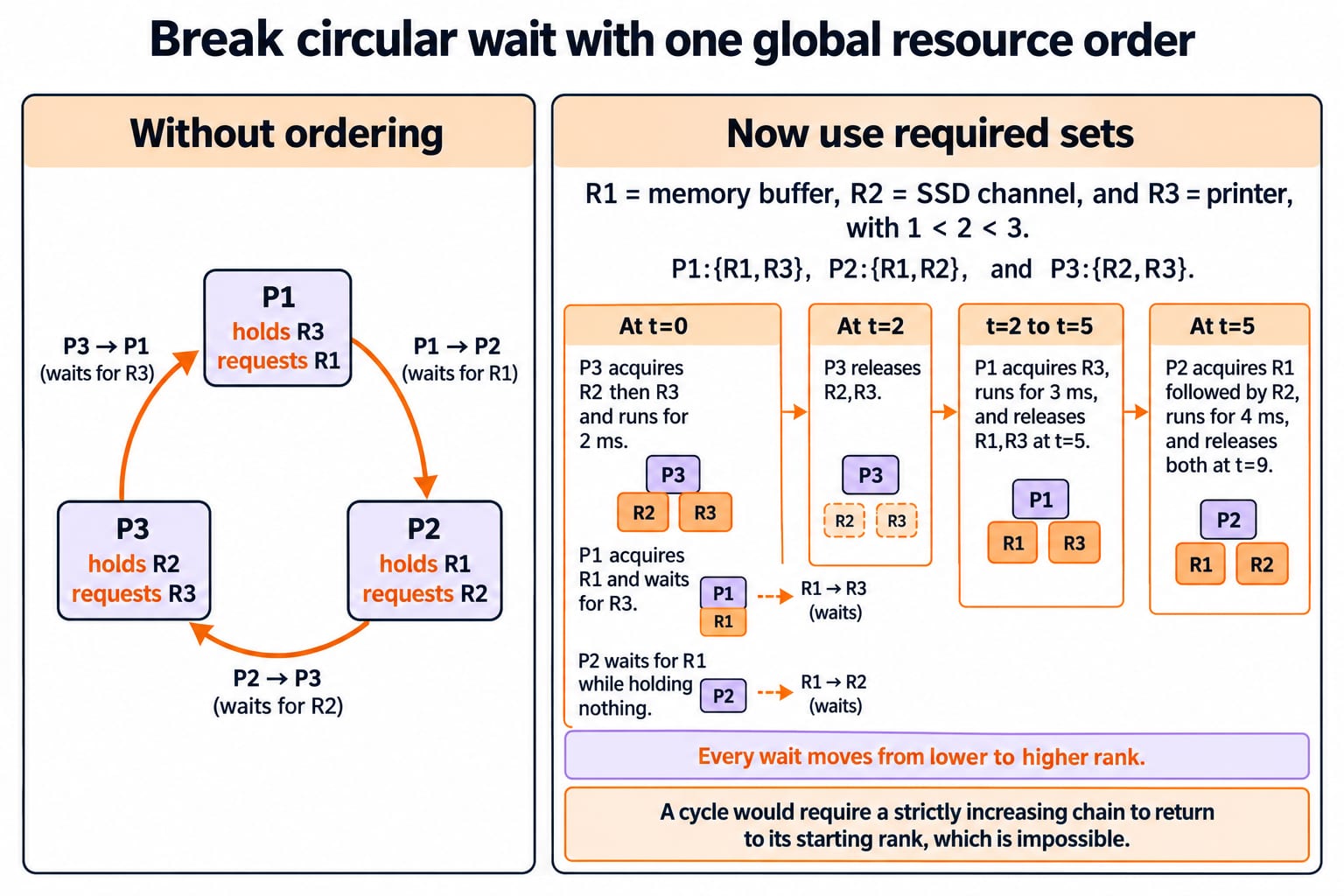
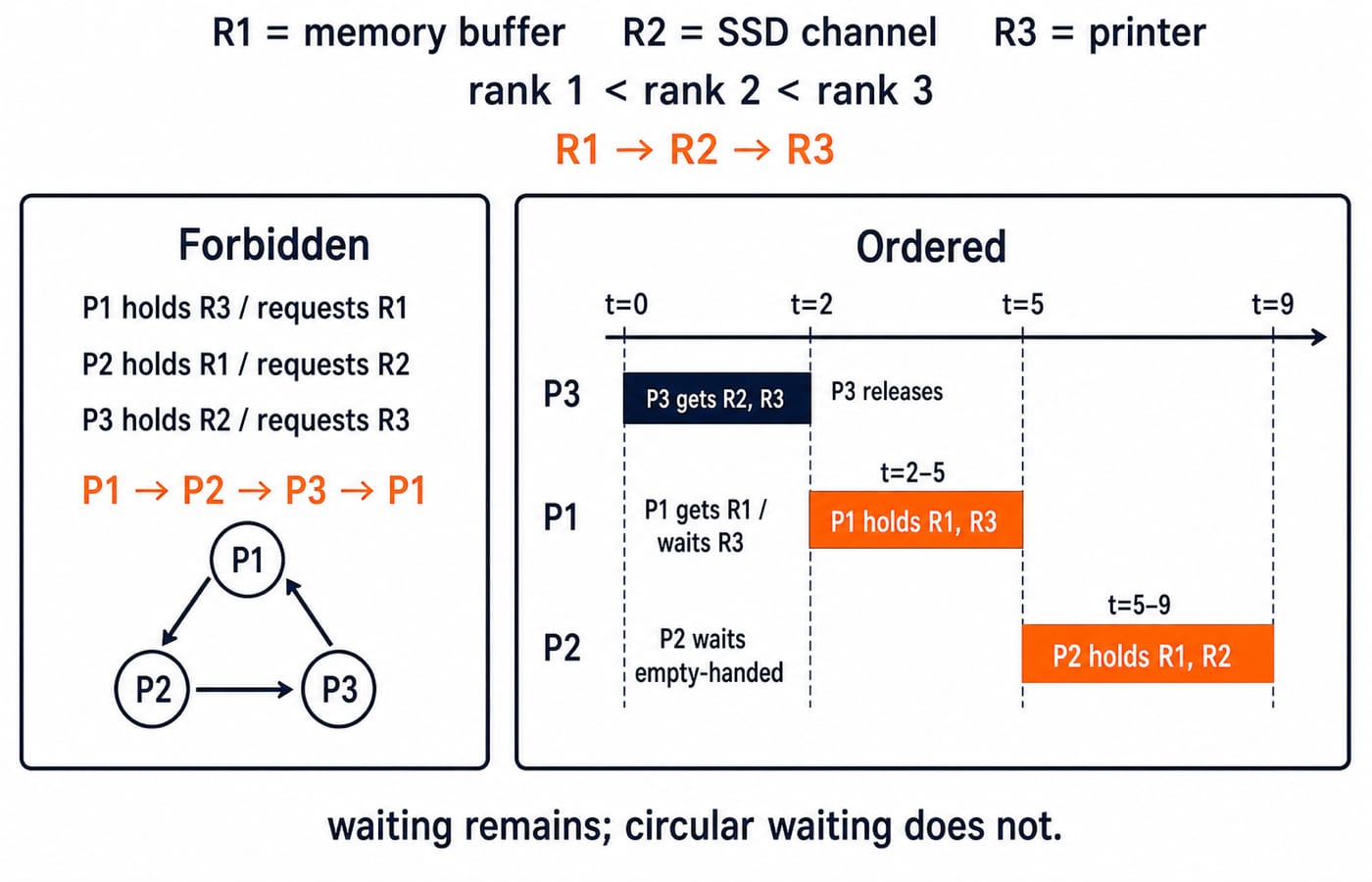
Rank each resource type and allow only strictly increasing requests. A process needing a lower rank must release higher-ranked holdings. Let R1 = memory buffer, R2 = SSD channel, and R3 = printer, with 1 < 2 < 3.
Without ordering, P1 can hold R3 and request R1, P2 hold R1 and request R2, and P3 hold R2 and request R3. This creates P1 -> P2 -> P3 -> P1.
Now use required sets P1:{R1,R3}, P2:{R1,R2}, and P3:{R2,R3}:
At
t=0,P3acquiresR2thenR3and runs for2 ms.P1acquiresR1and waits forR3.P2waits forR1while holding nothing.At
t=2,P3releasesR2,R3.P1acquiresR3, runs for3 ms, and releasesR1,R3att=5.At
t=5,P2acquiresR1followed byR2, runs for4 ms, and releases both att=9.
Every wait moves from lower to higher rank. A cycle would require a strictly increasing chain to return to its starting rank, which is impossible. All components must share the order because one exception can restore the cycle.
How exam questions test prevention, plus the short version
Common problems ask you to match a policy to its broken condition, test an acquisition sequence against a global order, inspect a resource-allocation graph, distinguish the three design choices, or judge whether sharing and preemption are feasible.
The core policy-to-condition mapping is:
All-at-once allocation breaks hold and wait.
Forced reclamation breaks no preemption.
Increasing resource ranks break circular wait.
Banker's safety test is avoidance.
Correct the costly traps too. A cycle is not sufficient with multiple instances. Unsafe does not mean deadlocked. Resource ordering removes circular waiting, not waiting. Spooling changes the interface, not the printer's shareability. Prevention may trade throughput or fairness for its guarantee.
Use this four-step decision card: write the four conditions, name the one the proposed rule breaks, trace allocations with exact arrows or times, then state the cost and applicability limit. Continue through the CS Fundamentals subject route. For a structured course, ZERO TO HERO covers the wider core-CS sequence, while Computer Science Fundamentals for Placements is the placement-focused route.
Go deeper with the full courseOperating System
Keep learning
Deadlock in Operating Systems: Four Conditions and Worked Resource-Allocation Graphs
Learn why a cycle proves deadlock only for single-instance resource types, then trace a three-process deadlock and a multiple-instance escape sequence.
Updated 28 Oct 20266 min read57 viewsOperating Systems
Deadlock in Operating Systems: Four Conditions, Handling Methods and a Worked Banker's Algorithm
Build deadlock reasoning from resource-allocation graphs to safe-state checks. The five-process Banker's example also tests one safe and one unsafe request.
Updated 30 Oct 20266 min read75 viewsOperating Systems

Deadlock in Operating Systems: Four Conditions, Banker's Algorithm, and Worked Examples
Learn to diagnose deadlocks, read resource-allocation graphs, compute Need, verify a Banker's safe sequence, and separate prevention from recovery.
Updated 7 Sep 20266 min read93 viewsOperating Systems
Deadlock Detection and Recovery in Operating Systems: Algorithms, Worked Examples and GATE Traps
Learn when deadlock detection applies, trace single-instance and multiple-instance examples, and verify that a recovery choice really frees the system.
Updated 1 Nov 20266 min readOperating Systems