

Classes and Objects in OOP: Blueprint, Instance and Worked Example
See exactly what a class defines, what new creates, and how two references can reach one object. Follow two Java traces with object counts and final values.
KnowledgeGate Team
Exam prep & CS education
Updated 18 Nov 20265 min read
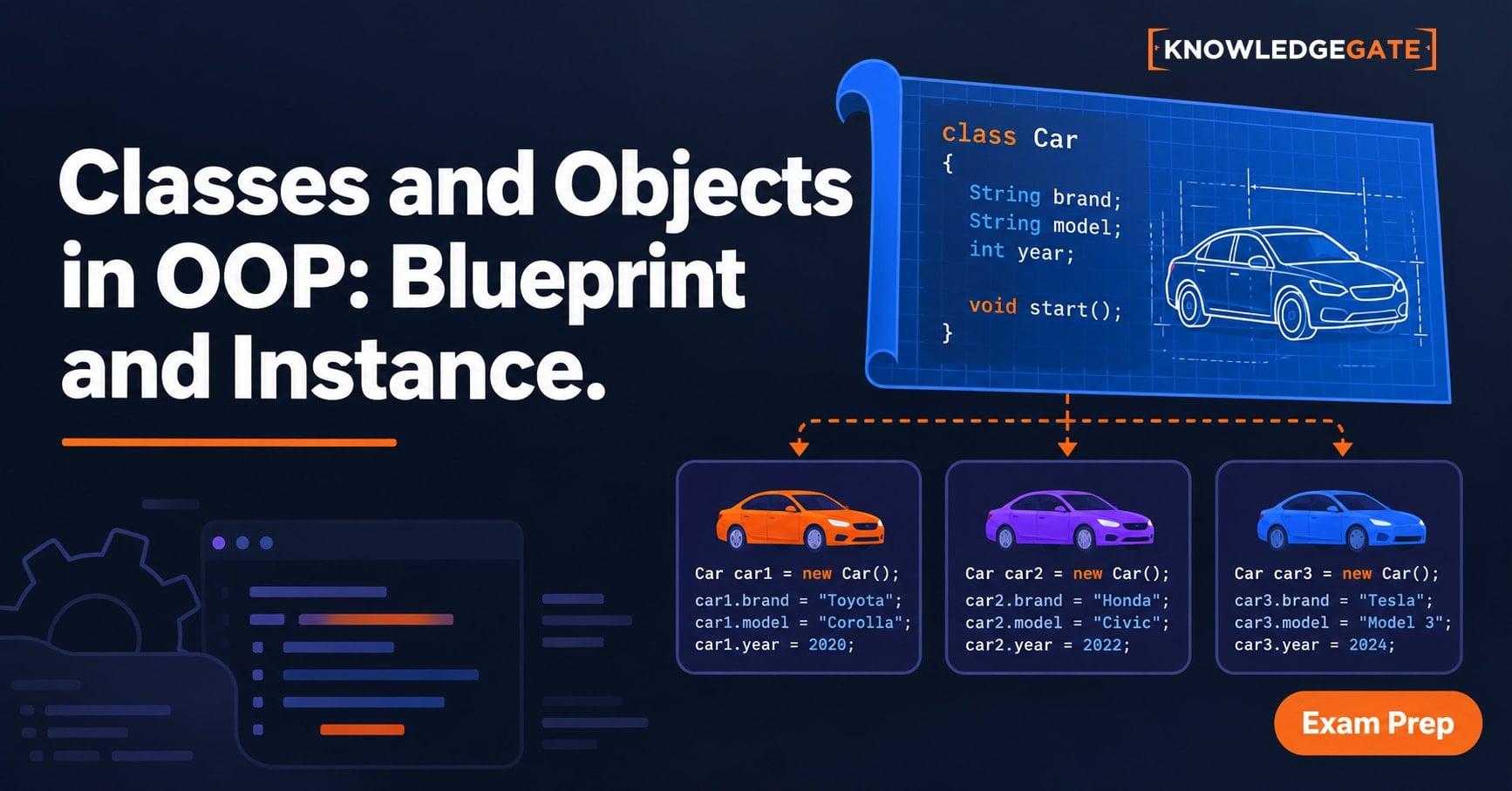
A class is often called a blueprint and an object a house, but that slogan leaves key questions unanswered. Where do values live, what does new create, and why can two variables observe the same change? Java makes the distinction concrete: allocation creates objects, references reach them, and method calls mutate the receiver's state.
Class versus object: the definition behind the blueprint analogy
A class is a programmer-declared type grouping the structure and permitted behaviour of a family of values. An object is one runtime instance, with its own identity and instance state. One class declaration can create zero, one or many objects.
The blueprint can say that every account has an owner, a balance and a deposit operation. It does not hold Asha's 1200 or Ravi's 800. Those values belong to separate objects. deposit(300) is declared once but invoked on a particular receiver.
These ideas support the foundation covered in Coding & Skills. For abstraction, encapsulation, inheritance and polymorphism, read Object Oriented Technology and Programming Languages next.
Read one Java class as data, construction and behaviour
The class definition is:
class BankAccount {
    String owner;
    int balance;
    static int accountCount = 0;
    static String bankCode = "KG01";

    BankAccount(String owner, int openingBalance) {
        this.owner = owner;
        this.balance = openingBalance;
        accountCount++;
    }

    void deposit(int amount) {
        balance = balance + amount;
    }

    void withdraw(int amount) {
        balance = balance - amount;
    }
}
owner and balance are per-object fields. accountCount and bankCode belong to the class and are shared. The constructor sets starting state. In this.owner = owner, the left side is the current receiver's field and the right side is the parameter.
deposit adds to the receiver's balance; withdraw subtracts from it. A production BankAccount would also validate amounts, persist data, calculate interest and coordinate concurrent changes. Those concerns do not alter how fields, methods, constructors and references work. The Java Programming course is the guided language-specific follow-up.
Worked example: create two objects, mutate them and introduce an alias
Trace these statements in order:
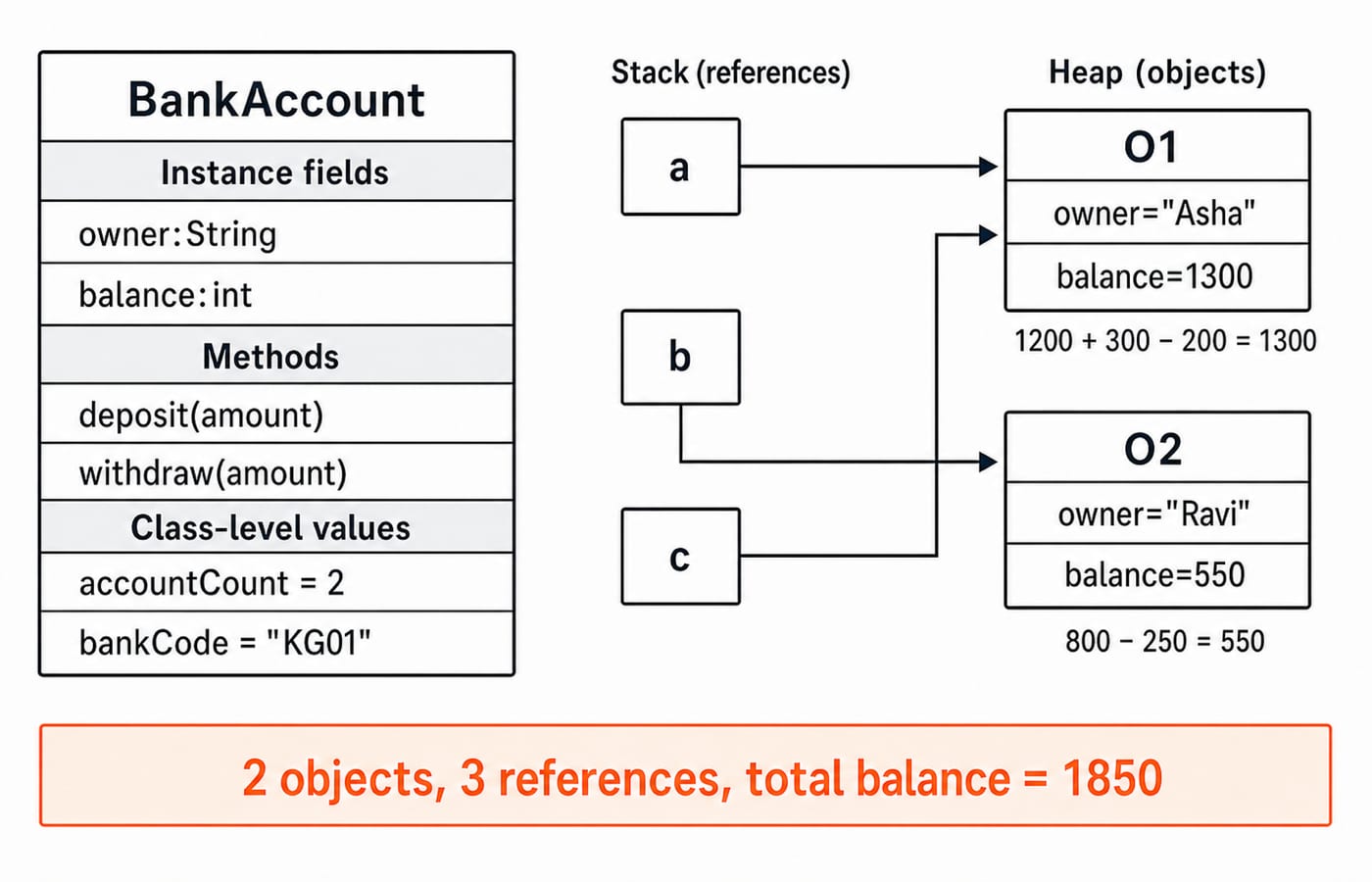
BankAccount a = new BankAccount("Asha", 1200);creates O1 with balance1200;accountCountgoes from 0 to 1.BankAccount b = new BankAccount("Ravi", 800);creates O2 with balance800;accountCountgoes from 1 to 2. Both expose sharedbankCode="KG01".a.deposit(300);makes O11200 + 300 = 1500. O2 stays 800.b.withdraw(250);makes O2800 - 250 = 550. O1 stays 1500.BankAccount c = a;adds a reference, not an object. Bothaandcpoint to O1;accountCountstays 2.c.withdraw(200);makes O11500 - 200 = 1300, visible throughaandc.
Object | References | Owner | Final balance | Shared class value |
|---|---|---|---|---|
O1 |
| Asha | 1300 | KG01 |
O2 |
| Ravi | 550 | KG01 |
The represented balance is 1300 + 550 = 1850. The count result is 2 objects, 3 non-null reference variables, and accountCount=2.
Separate identity, state, behaviour and references
Identity says which object it is, O1 or O2. State is current field data, such as Asha and 1300. Behaviour is an operation such as withdraw(200). A reference such as a, b or c lets code reach an object.
c = a copies the reference value, not O1 or its fields. Thus a == c is true, and mutation through c is visible through a. Reassigning c = b would only redirect c to O2, without merging objects or copying balances.
If BankAccount d = new BankAccount("Asha", 1300); runs next, O3 looks like O1 but has a different identity, so a == d is false. Both the object count and accountCount become 3. Equal-looking state is not identical identity.
Instance members, class members and constructor traps
O1 holds 1300 while O2 holds 550 because balance is an instance field. Both access bankCode="KG01" and accountCount=2 because these are shared static members, not per-object copies.
In Java, new BankAccount("Asha", 1200) creates an object and runs the matching constructor. BankAccount x; only declares a reference, and BankAccount y = null; also creates no object. Since the class declares a two-argument constructor, new BankAccount() is invalid unless a no-argument constructor is added.
Languages differ in allocation, references, value semantics, cleanup and class features. Java allocates these instances with new and lets a, b and c hold references; a language with value semantics may copy state instead. Across those variations, a class defines a type and operations, while an object is one instance with identity and state.
Common misconceptions and how to repair them
Tempting claim | Correction | Trace evidence |
|---|---|---|
A class is an object | A class declaration can exist with zero instances | Objects appear only when the trace executes |
| It copies a reference and creates an alias |
|
Three references mean three objects | References and objects must be counted separately |
|
Changing O1's balance does not change O2's. Changing static bankCode from "KG01" to "KG02", however, makes both objects observe "KG02". accountCount is one shared counter, not a per-object serial number.
A constructor is not an ordinary method with a return type. this.owner = owner does not assign a variable to itself: the left side is the object's field and the right side is the parameter.
When counting, first ask, Did this line use new? It is a clue, not a universal rule. Factory methods and other languages may hide different creation rules, so inspect what the code creates.
How exams test classes and objects
Stable question shapes include definition matching, counting classes, objects and references, tracing state changes, and separating instance from static members. Distractors count aliases as objects, equate similar-looking objects, or treat static fields as per-instance copies.
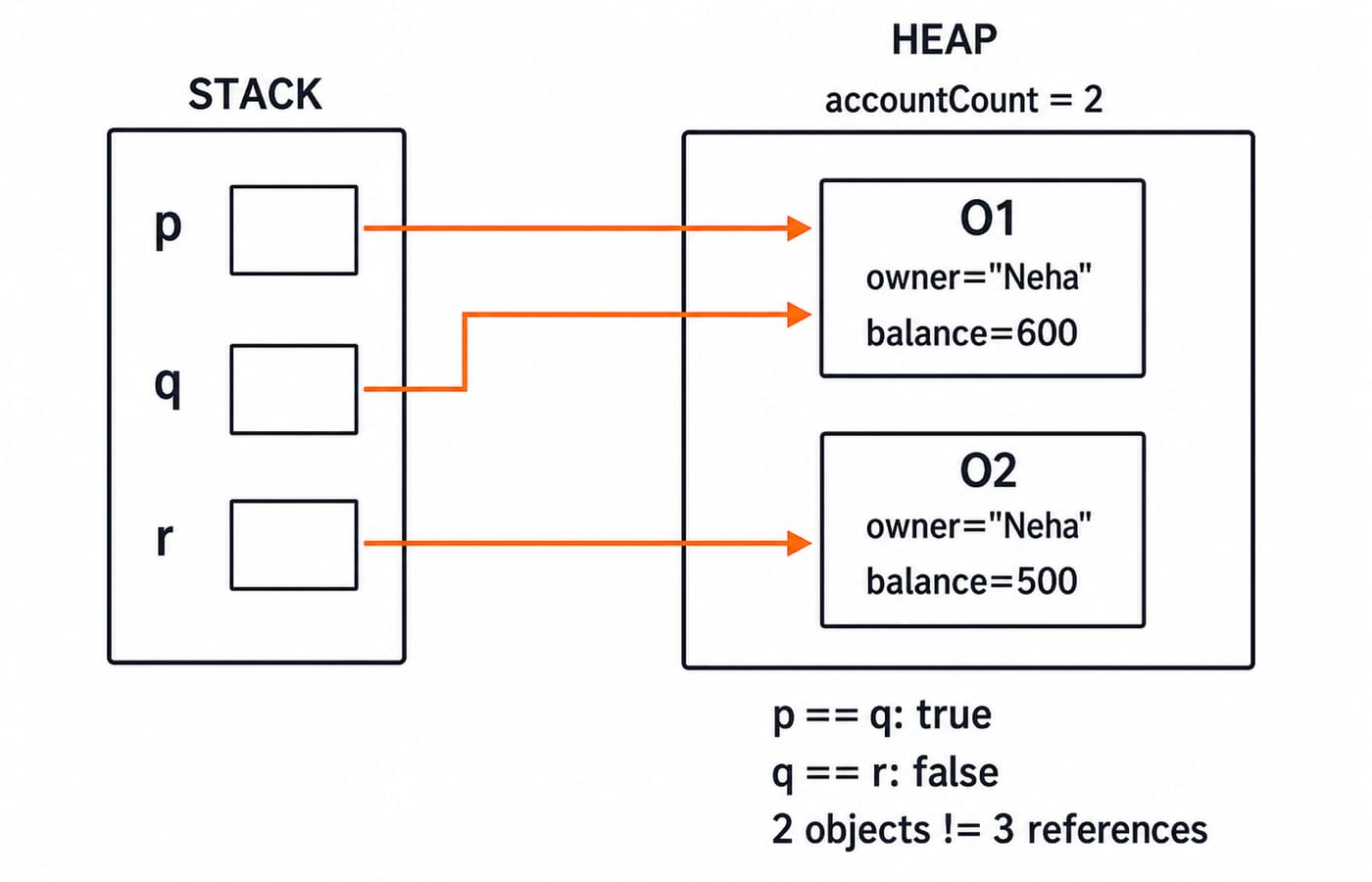
Try this standalone trace from a reset state where accountCount=0:
BankAccount p = new BankAccount("Neha", 500);
BankAccount q = p;
BankAccount r = new BankAccount("Neha", 500);
q.deposit(100);
The first and third lines create 2 objects; all 3 references are non-null. p and q point to O1, whose balance becomes 500 + 100 = 600. r points to O2 at 500. Thus p == q is true, q == r is false, and accountCount=2.
Classes and Objects MCQs provides 12 exam-style drills on constructors, nested classes and concept boundaries. The BankAccount trace above instead develops aliases, reference counts and heap state line by line.
The short version and next step
Keep four points clear:
A class defines a reusable type.
An object is a runtime instance with identity.
Instance fields give each object independent state, such as O1 at 1300 and O2 at 550.
Multiple references can point to one object, as
aandcboth point to O1.
For a five-minute task, redraw the first diagram, explain why c = a leaves accountCount at 2, and solve the Neha trace from memory. Then replace only q = p with q = new BankAccount("Neha", 500). The result is 3 objects, accountCount=3, p at 500, q at 600, and r at 500.
Use the Java course above for structured syntax and implementation practice. If you want to connect these object-oriented basics with placement-oriented coding across languages, continue with Coding for Placements.
Keep learning

Classes and Objects MCQs: 12 Solved OOP Questions with Explanations
Solve 12 classes and objects MCQs, check each explanation, and use a worked Java trace to separate instance state, constructors, overloading and nested classes.
Updated 29 Oct 20267 min readProgramming Languages Survey
OOP Basics in Python: Classes, Objects and Inheritance with Examples
Build one Python BankAccount program step by step, then use it to understand object state, validation, inheritance and runtime method selection.
Updated 27 Oct 20265 min readPython

OOP Basics in Java: Classes, Objects and the Four Pillars with Runnable Examples
Connect Java's OOP syntax to design decisions with a complete Account example. Trace two objects through validation, overriding and runtime dispatch to exact output.
Updated 14 Oct 20265 min readJava
Object-Oriented Programming: Classes, Objects and Inheritance with a Worked Java Example
Trace two Java objects from construction to output, and see how independent state, inheritance and runtime method dispatch work together.
Updated 18 Aug 20267 min readProgramming Languages Survey