

Checksum and CRC MCQs: 12 Solved Questions with Step-by-Step Explanations
Solve 12 checksum and CRC MCQs with checked one's-complement arithmetic, generator conversion, XOR division, and clear remainder-versus-codeword reasoning.
KnowledgeGate Team
Exam prep & CS education
Updated 8 Nov 20268 min read
Checksum and CRC errors often come from one missed rule: appending the wrong number of zeros, using carries during modulo-2 division, or missing the end-around carry in one's-complement addition. A checksum needs fixed-width one's-complement addition; a CRC needs a generator polynomial, XOR division, and a remainder of exactly the generator degree. Solve each item before reading its explanation, then use the Checksum and CRC practice inside CS Fundamentals to extend the drill.
Checksum and CRC rules to fix before solving
Method | Arithmetic | Sender action | Receiver check |
|---|---|---|---|
Checksum | Fixed-width one's-complement addition | Wrap each carry into the low-order end, then complement the sum | All-ones one's-complement sum |
CRC | Polynomial division using XOR, with no carries or borrows | Append | All-zero remainder |
Convert a CRC polynomial by writing every coefficient, including zeros. For example, G(x) = x^3 + x + 1 has coefficients 1,0,1,1, so the divisor is 1011. Its degree is 3, which means the remainder must contain exactly three bits. A leading zero in 011 is part of the answer.
For every numerical question, first identify whether it asks for the remainder or the whole codeword. Then write the padded dividend, perform the correct arithmetic, and match the result to an option. This order prevents most avoidable mistakes.
Checksum MCQs 1-2: purpose and 4-bit end-around carry
Question 1 (RSSB 2022, Computer Science, BCI-Paper2)
Check sum is used for –
A. Error correction
B. Error detection
C. Both (A) and (B)
D. None of these
Correct answer: B. Error detection.
A checksum is a compact value that the receiver recomputes and compares with the transmitted value. A mismatch flags corruption, so the checksum performs error detection. It does not identify the changed bit or reconstruct the original data by itself. Therefore error correction in A is too strong, which also rules out C.
Open the solved practice page.
Question 2
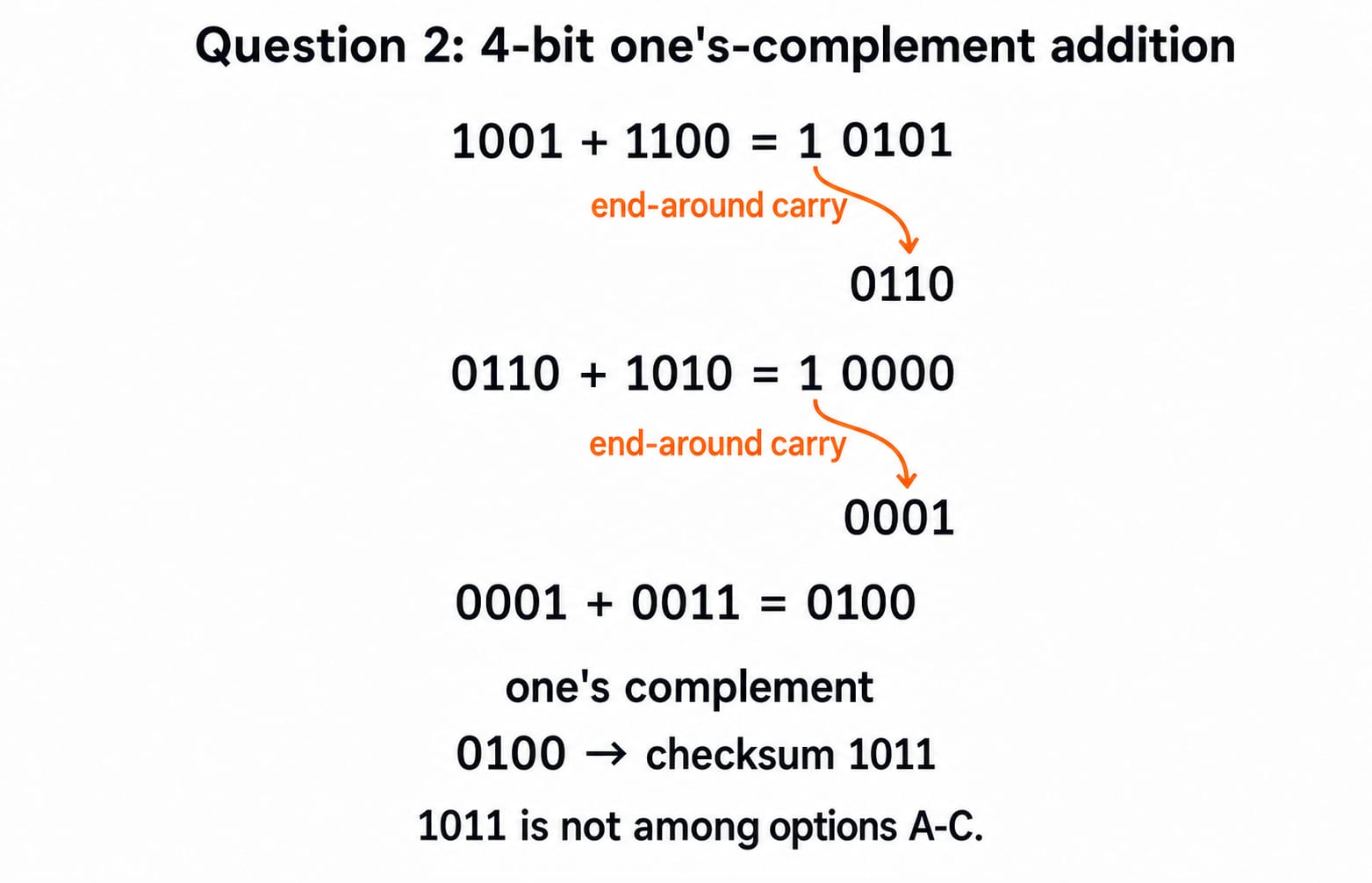
Suppose that a message 1001 1100 1010 0011 is transmitted using Internet Checksum (4-bit word). What is the value of the checksum?
A. 100100
B. 101010
C. 100010
D. None
Correct answer: D. None.
Keep every intermediate result at four bits. 1001 + 1100 = 1 0101; wrapping the carry gives 0110. Next, 0110 + 1010 = 1 0000, which wraps to 0001. Then 0001 + 0011 = 0100. Complementing 0100 gives 1011. That value is absent, so D is correct. The six-bit distractors cannot be a four-bit checksum.
Open the solved practice page.
Checksum MCQ 3: a complete 16-bit calculation
Question 3
Checksum value of 1001001110010011 and 1001100001001101 of 16 bit segment is
A. 1010101000011111
B. 1011111000100101
C. 1101010000011110
D. 1101010000111111
Correct answer: C. 1101010000011110.
In hexadecimal, 1001001110010011 = 0x9393 and 1001100001001101 = 0x984D. Their sum is 0x12BE0, or 1 0010101111100000. Wrap the leading 1 to get 0010101111100001 (0x2BE1). Its complement is 1101010000011110 (0xD41E). The check is 0010101111100001 + 1101010000011110 = 1111111111111111.
Open the solved practice page.
CRC MCQs 4-5: generator properties and detection guarantees
Question 4 (GATE 2009, Computer Science)
Let G(x) be the generator polynomial used for CRC checking. What is the condition that should be satisfied by G(x) to detect odd number of bits in error?
A. G(x) contains more than two terms
B. G(x) does not divide 1+x^k, for any k not exceeding the frame length
C. 1+x is a factor of G(x)
D. G(x) has an odd number of terms.
Correct answer: C. 1+x is a factor of G(x).
Use the parity test at x = 1. An odd-weight error polynomial has E(1) = 1. If 1+x is a factor of G(x), then G(1) = 0, and every multiple of G(x) also evaluates to zero. It cannot equal an odd-weight error polynomial, so that error cannot divide evenly. Option B concerns double-bit separations.
Open the solved practice page.
Question 5
Which of the following is true?
A. CRC can detect all single-bit errors
B. CRC can detect all double-bit errors provided the divisor contains at least two logic 1’s.
C. CRC can detect any odd number of errors provided the divisor is a factor of x.
D. CRC cannot detect burst error of length less than the degree of the polynomial.
Correct answer: A. CRC can detect all single-bit errors.
With a nonzero constant term, the generator cannot divide a single-bit error x^k, so the remainder is nonzero. B needs the stronger condition that G(x) must not divide x^k + 1 for the separation. C requires an x+1 factor. D is reversed: a degree-r generator detects every burst of length at most r.
Open the solved practice page.
CRC MCQs 6-7: distinguish the remainder from the codeword
Question 6
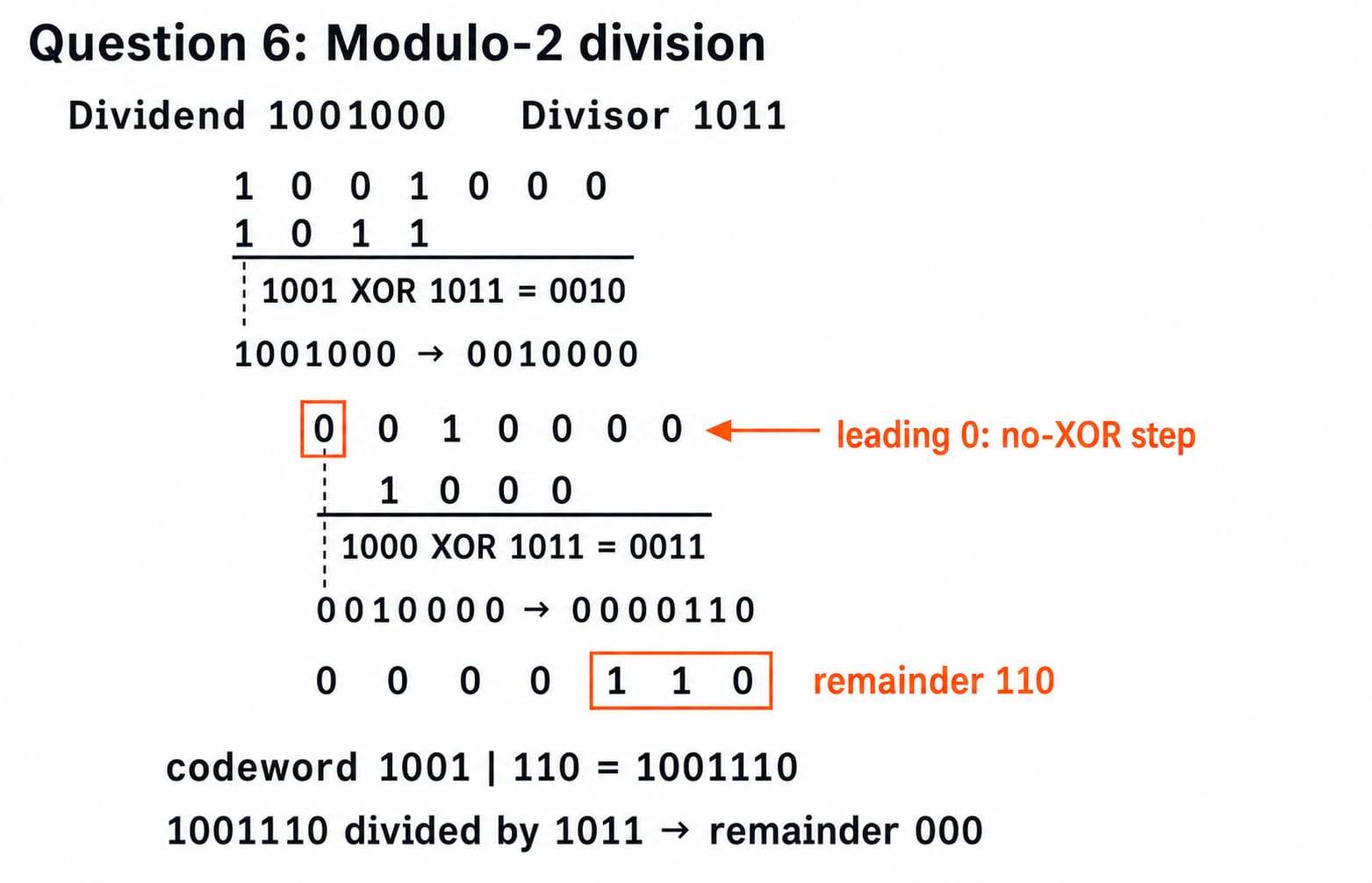
A bit stream 1001 is transmitted using the standard CRC method. The generator data unit is 1011. What is the CRC that is transmitted along with the data bit stream?
A. 011
B. 111
C. 010
D. 110
Correct answer: D. 110.
The four-bit generator has degree 3, so append three zeros: 1001 -> 1001000. Divide 1001000 by 1011 using XOR only. The last three bits are 110. The question asks for the CRC alone, so 110 is the answer. The complete codeword would be 1001 | 110 = 1001110.
Open the solved practice page.
Question 7 (RPSC 2024, Computer Science, Programmer - P1)
The message 1001 is to be transmitted using the CRC polynomial x^3 + x + 1 to protect it from errors. The message that should be transmitted is –
A. 1001000
B. 1001100
C. 1001110
D. 1001011
Correct answer: C. 1001110.
x^3 + x + 1 maps to 1011. Its remainder is 110. Here the question asks for the full transmitted message, so append the remainder to the data: 1001 | 110 = 1001110. Option A is only the padded dividend used during calculation.
Open the solved practice page.
CRC MCQs 8-10: form complete codewords with degree-3 generators
Question 8 (GATE 2021, Computer Science, Set 2)
Consider the cyclic redundancy check (CRC) based error detecting scheme having the generator polynomial
X^3+X+1. Suppose the messagem_4m_3m_2m_1m_0 = 11000is to be transmitted. Check bits c2c1c0 are appended at the end of the message by the transmitter using the above CRC scheme. The transmitted bit string is denoted bym_4m_3m_2m_1m_0c_2c_1c_0. The value of the checkbit sequencec_2c_1c_0is
A. 101
B. 110
C. 100
D. 111
Correct answer: C. 100.
The generator is 1011, so pad the message to 11000000. The auditable XOR states are 01110000, then 00101000, then 00000100. The final three bits are 100, so c2c1c0 = 100. Appending them gives the complete transmitted codeword 11000100.
Open the solved practice page.
Question 9 (GATE 2017, Computer Science, Set 1)
A computer network uses polynomials over
GF(2)for error checking with 8 bits as information bits and usesx^3+x+1as the generator polynomial to generate the check bits. In this network, the message 01011011 is transmitted as:
A. 01011011010
B. 01011011011
C. 01011011101
D. 01011011100
Correct answer: C. 01011011101.
Convert the generator to 1011 and append three zeros: 01011011000. XOR division leaves 101. The transmitted string is therefore 01011011 | 101 = 01011011101. It has 8 + 3 = 11 bits and retains the original eight-bit prefix.
Open the solved practice page.
Question 10 (GATE 2007, Computer Science)
The message 11001001 is to be transmitted using the CRC polynomial x^3 + 1 to protect it from errors. The message that should be transmitted is:
A. 11001001000
B. 11001001011
C. 11001010
D. 110010010011
Correct answer: B. 11001001011.
x^3 + 1 maps to 1001, a degree-3 generator. Pad the message to 11001001000. Modulo-2 division leaves 011. Keep its leading zero and append all three bits: 11001001 | 011 = 11001001011. The result has 11 bits and division by 1001 gives receiver remainder 000.
Open the solved practice page.
CRC MCQs 11-12: final drills, traps and what to practise next
Question 11
A computer network uses polynomials for error checking with 8 bits as information bits and uses x^2 + 1 as the generator polynomial to generate the check bits. In this network, the message 11001010 is transmitted as
A. 1100101001
B. 1100101000
C. 1100101011
D. 1100101010
Correct answer: C. 1100101011.
Convert x^2 + 1 to 101. Its degree is 2, so append only two zeros: 1100101000. XOR division by 101 leaves the two-bit remainder 11. The ten-bit codeword is 11001010 | 11 = 1100101011. The generator degree decides the zero count.
Open the solved practice page.
Question 12 (GATE 2026, Computer Science, Set 2)
Consider the transmission of data bits 110001011 over a link that uses Cyclic Redundancy Check (CRC) code for error detection. If the generator bit pattern is given to be 1001, which one of the following options shows the remainder bit pattern appended to the data bits before transmission?
A. 011
B. 101
C. 000
D. 100
Correct answer: D. 100.
The generator 1001 has degree 3, so the padded dividend is 110001011000. XOR division leaves 100. It is the requested remainder; the full codeword is 110001011100.
Open the solved practice page.
Mistake | Why it fails | Correction |
|---|---|---|
Using ordinary subtraction in CRC | CRC arithmetic has no carries or borrows | Use XOR at every aligned |
Dropping a leading remainder zero | A degree-3 generator requires three remainder bits | Keep |
Returning the padded dividend | Padding is only an intermediate step | For Question 7, return |
Discarding a checksum carry | One's-complement addition uses end-around carry | In Question 2, wrap the carry before complementing |
The short version
Checksum means fixed-width one's-complement addition, end-around carry, then complement. CRC means polynomial-to-bit conversion, r zeros, XOR division, and an r-bit remainder. Redo Questions 2, 8 and 12 without the answers. Together they test the three key habits.
For interview revision, continue with CS Fundamentals for Placements by Sanchit Sir; for broader core-CS study, use Zero to Hero: Complete CS Course. Then practise Computer Networks MCQs or Subnetting MCQs.
Keep learning
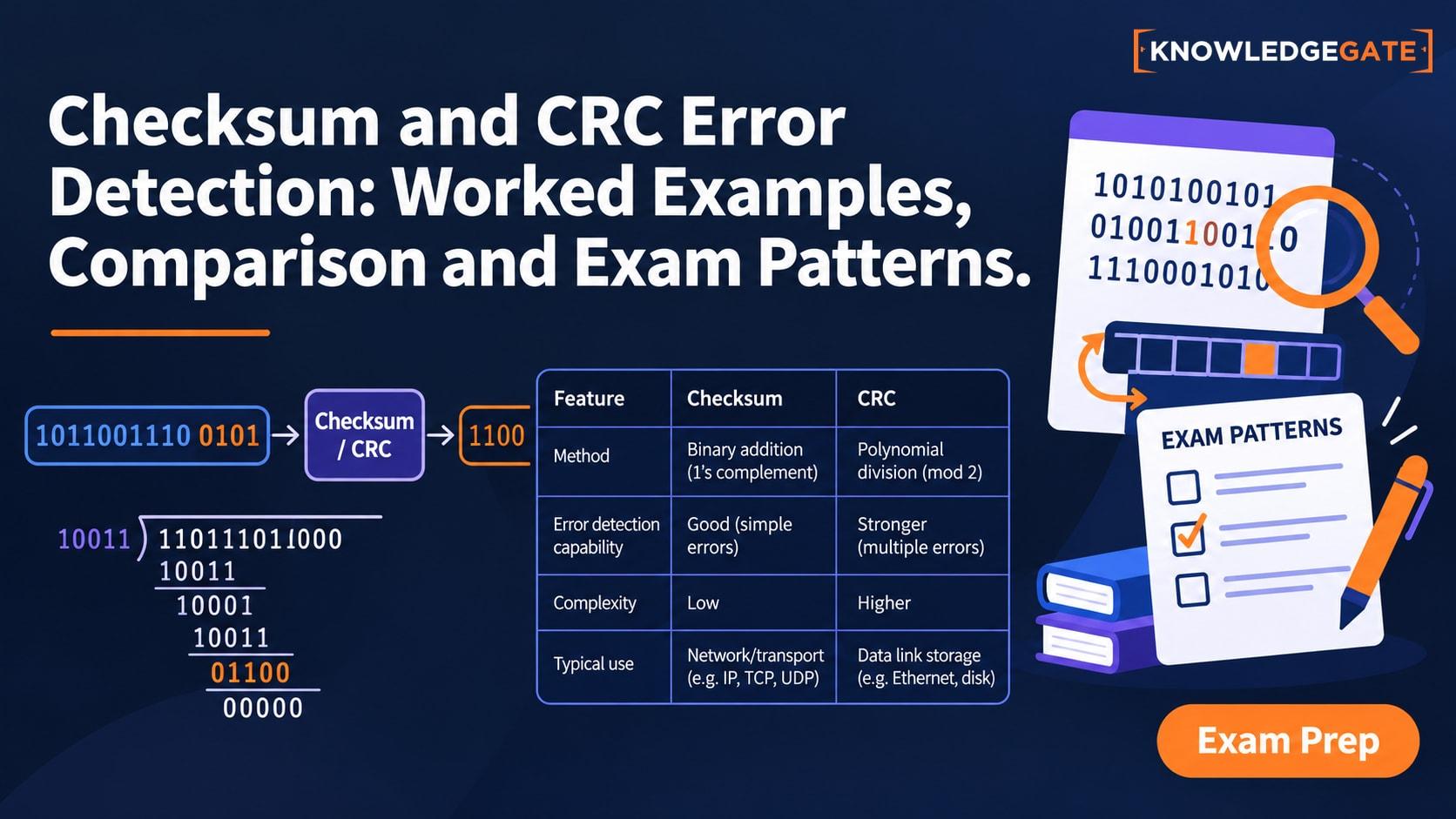
Checksum and CRC Error Detection: Worked Examples, Comparison and Exam Patterns
Learn how checksum and CRC differ, then follow a complete one's-complement checksum and modulo-2 CRC calculation. The guide also covers detection limits and common exam traps.
Updated 7 Nov 20265 min readComputer Networks
CRC, Checksum and Hamming Code for GATE: Error Detection and Correction Numericals Solved
Work through CRC division, an Internet checksum, and Hamming(7,4) encoding and correction without losing marks to convention slips.
Updated 1 Sep 20265 min read214 viewsGATE Strategy & Roadmap

TTL, Protocol & IPv4 Checksum MCQs: 12 Solved Questions with Explanations
Solve 12 published IPv4 questions covering TTL, Protocol, IHL, checksum position, CRC, NAT and hop counting. Each answer includes a fresh, step-by-step explanation.
Updated 30 Oct 20268 min read62 viewsComputer Networks MCQs

RSA Algorithm MCQs: 12 Solved Questions with Step-by-Step Explanations
Practise RSA key generation, modular inverses, encryption, signatures and defining equations, with concise working for conceptual and numerical answers.
Updated 29 Oct 20268 min read153 viewsComputer Networks MCQs