

C++ RAII: Safe Lifetimes for Files, Mutexes and Transactions
Learn how construction, reverse destruction and move-only ownership make cleanup reliable. A single C++ example traces a file, mutex and transaction across success and failure.
KnowledgeGate Team
Exam prep & CS education
Updated 6 Nov 20265 min read
A function opens a file, locks shared state and starts a temporary transaction. Then an early return or exception skips one manual close(), unlock() or rollback(), leaving a bug far from the line that acquired the resource. C++ offers one ownership pattern that makes the same scope control all three lifetimes, so cleanup stays correct when control flow changes. If classes, constructors or destructors are still unfamiliar, review the complete C++ learning path first.
RAII makes scope the owner of cleanup
Resource Acquisition Is Initialization, or RAII, means acquiring a resource while constructing an owning object, keeping ownership in that object, and releasing the resource in its destructor. When a scope ends normally or an exception unwinds it, local objects are destroyed in reverse construction order.
The resource and its owner differ. An operating-system file handle can live inside std::ofstream, a locked std::mutex inside std::lock_guard, and an active logical transaction inside a small Transaction guard. Constructors establish ownership; destructors end it.
RAII guarantees destructor invocation when C++ unwinds a scope. It does not make external systems atomic together, recover data after forced termination, or handle ignored I/O errors. Correctness still requires explicit checks and a suitable transaction design.
A function can own a file, mutex lock and transaction together.
This deterministic lifetime model remembers the old balance and restores it unless the caller commits. It is not a production database abstraction.
#include <fstream>
#include <mutex>
#include <stdexcept>

struct Ledger {
    int balance = 1000;
};

class Transaction {
    Ledger& ledger_;
    int before_;
    bool committed_ = false;

public:
    explicit Transaction(Ledger& ledger)
        : ledger_(ledger), before_(ledger.balance) {}

    Transaction(const Transaction&) = delete;
    Transaction& operator=(const Transaction&) = delete;

    void debit(int amount) {
        ledger_.balance -= amount;
    }

    void commit() noexcept {
        committed_ = true;
    }

    ~Transaction() noexcept {
        if (!committed_) {
            ledger_.balance = before_;
        }
    }
};

bool record_payment(Ledger& ledger, std::mutex& ledger_mu) {
    std::ofstream out("order-42.tmp");
    if (!out) {
        return false;
    }

    std::lock_guard<std::mutex> lock(ledger_mu);
    Transaction tx(ledger);

    tx.debit(240);
    out << "order=42 amount=240 balance=760\n";
    out.flush();
    if (!out) {
        throw std::runtime_error("write failed");
    }

    tx.commit();
    return true;
}
The constructor captures before_ = 1000, and debit(240) calculates 1000 - 240 = 760. The written and in-memory balances match.
Declaration order is part of correctness. Constructing lock before tx means reverse destruction handles tx first. Rollback therefore restores the balance while ledger_mu is locked, before lock releases it.
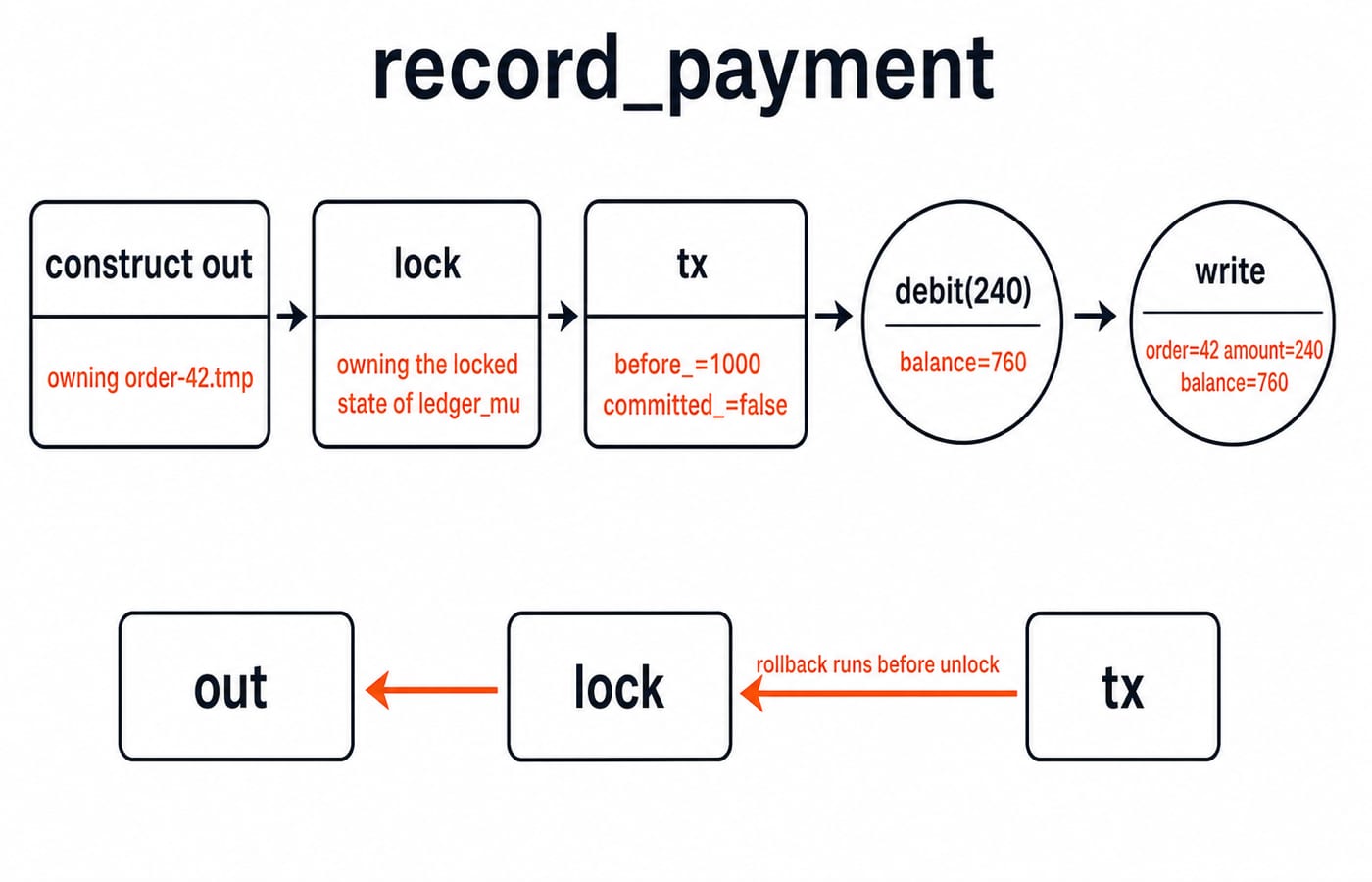
Each exit path follows the same destruction order.
Exit point | Transaction result | Mutex result | File result |
|---|---|---|---|
Open fails before guards | Balance stays | Never locked | Failed stream object destroyed |
Exception after debit, before commit |
| Unlocks after rollback | Closes after unlock |
Success after commit | Balance stays | Unlocks | Closes |
Early return after guards | Rolls back unless already committed | Unlocks after transaction cleanup | Closes last |
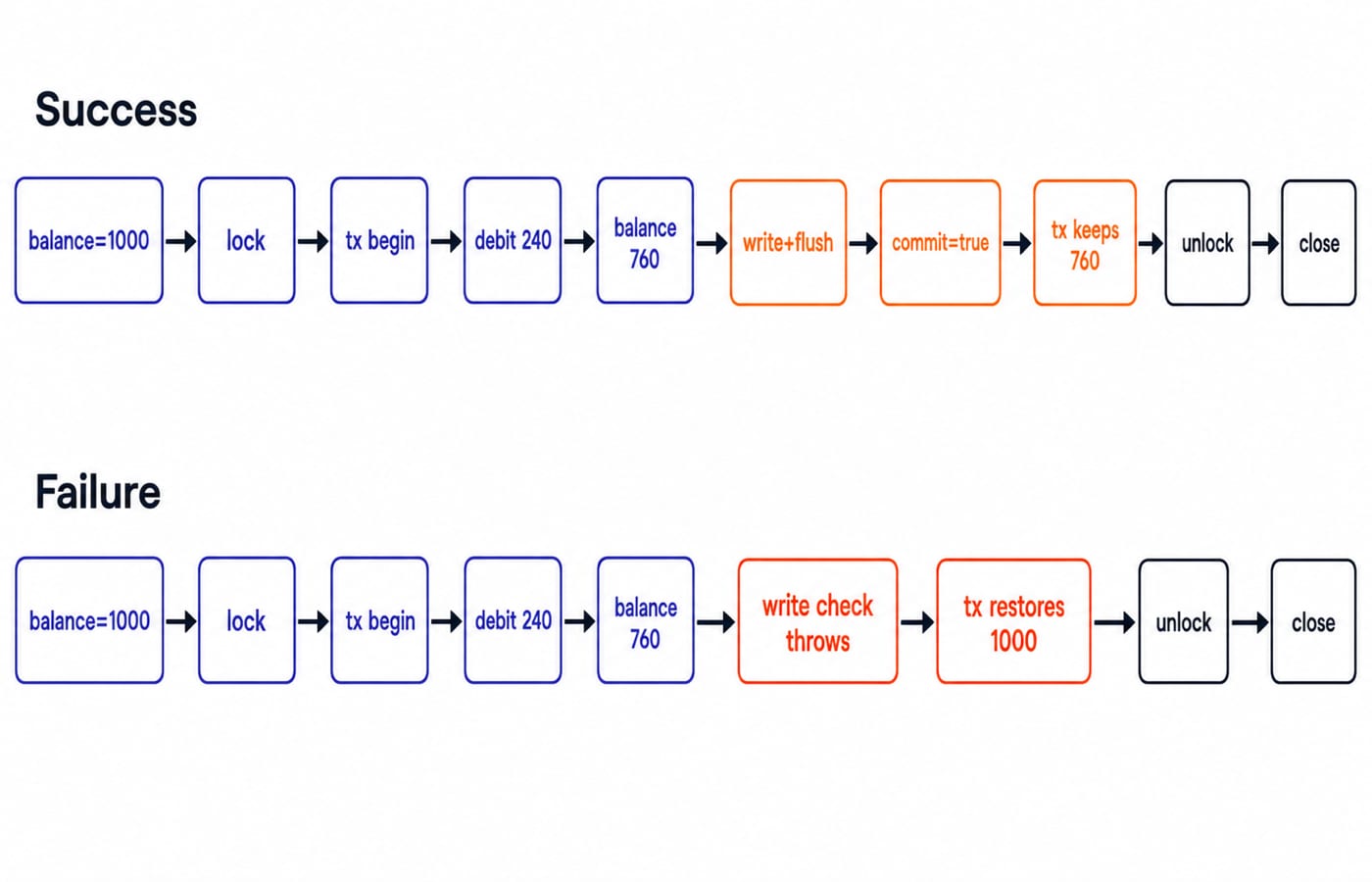
On the exception path, the write check throws. tx sees committed_ == false and restores before_, so 760 becomes 1000. Then lock unlocks ledger_mu, and out closes order-42.tmp.
On success, commit() changes the flag, so the destructor keeps 760. The mutex and file still release automatically.
A useful test forces an output failure immediately after tx.debit(240). Catch it, assert ledger.balance == 1000, then acquire ledger_mu with a second std::lock_guard. This tests restoration and lock release, not merely line coverage.
Wrap a raw file handle when no library owner exists
C APIs often return raw handles:
FILE* raw = std::fopen("scores.csv", "w");
if (!raw) return false;
// A later early return can forget std::fclose(raw).
A custom deleter turns the handle into a unique owner:
#include <cstdio>
#include <memory>

struct FileCloser {
    void operator()(FILE* f) const noexcept {
        if (f) std::fclose(f);
    }
};

using FilePtr = std::unique_ptr<FILE, FileCloser>;

FilePtr file(std::fopen("scores.csv", "w"));
if (!file) return false;

int written = std::fprintf(file.get(), "roll=17,score=86\n");
if (written <= 0) return false;
file.get() borrows the handle for std::fprintf; it does not transfer ownership, so the borrower must not call fclose. FilePtr closes the file on every exit. The same distinction runs through Pointers in C: GATE Memory Diagrams, where a pointer names a resource without owning its release.
Compose owners carefully with scope, order and moves
Construction is out, lock, tx; destruction is tx, lock, out. If Transaction tx(ledger) appears before std::lock_guard lock(ledger_mu), the lock is destroyed first. Rollback could mutate the ledger after release. That is a race risk, not a style preference.
Unique owners normally cannot be copied because two owners could release the same resource. Moving FilePtr a into FilePtr b transfers the single FILE* owner. Here a.get() becomes null, and only b may close it. std::lock_guard is neither copyable nor movable.
Use std::unique_ptr or a purpose-built movable wrapper where transfer is meaningful. Do not choose std::shared_ptr merely to postpone deciding who owns the lifetime.
Common RAII traps and their repairs
Scattered cleanup branches:
if (bad) { fclose(f); return; }can miss the next exit path. Create the owner immediately after acquisition and remove manual cleanup branches.Throwing cleanup: a destructor that throws during exception unwinding can terminate the program. Keep the transaction destructor
noexcept, keepcommit()explicit, and report fallible cleanup through an explicit operation when needed.Unchecked output:
std::ofstreamdestruction closes its file but does not replace checkingflush()and stream state.Temporary and reference lifetimes: an unnamed temporary lock can unlock at the semicolon. A reference stored by an owner must not outlive its target.
Moved-from use: after ownership moves, do not use the source as though it still owns the resource.
RAII releases each resource reliably, but it still does not coordinate the file contents and ledger as one atomic transaction.
How interviews and exam questions probe RAII
If objects are constructed as
A,B,C, what is their destruction order?C,B,A.If constructing
Bthrows, what is destroyed? Only the already-constructedA;Bnever finished construction.If
txis constructed afterlock, which cleanup happens first? Transaction rollback happens before mutex unlock.After
FilePtr b = std::move(a), who owns the file?b; for thisunique_ptr,aremains valid but empty.Which lock wrapper should you choose? Use
std::lock_guardwhen the lock lasts to scope end. Usestd::unique_lockwhen you genuinely need deferred or timed locking, a condition variable, or an earlier explicit unlock.
For interview practice in C++ and competitive coding, continue with the Coding for Placements course.
The short version and the next safe step
Acquire a resource directly into an owner.
Give that owner the narrowest correct scope.
Make destruction safe and non-throwing.
Test success, early return and exception paths.
The invariant is simple: failure restores 1000, success retains 760, and both paths unlock the mutex and close the file. The C++ Programming course provides a structured route through programming concepts, MCQs and coding questions, while the Coding and DSA learning path places this ownership pattern in a broader problem-solving path.
Before moving on, refactor one manual open/close or lock/unlock pair into an owner and write one forced-failure test.
Keep learning
Templates in C++: Reusable Parameterized Code with Worked Examples
Learn how one C++ template produces type-specific functions and classes. Follow exact calls, calculations, deduction failures, and practical corrections.
Updated 13 Nov 20266 min readC++
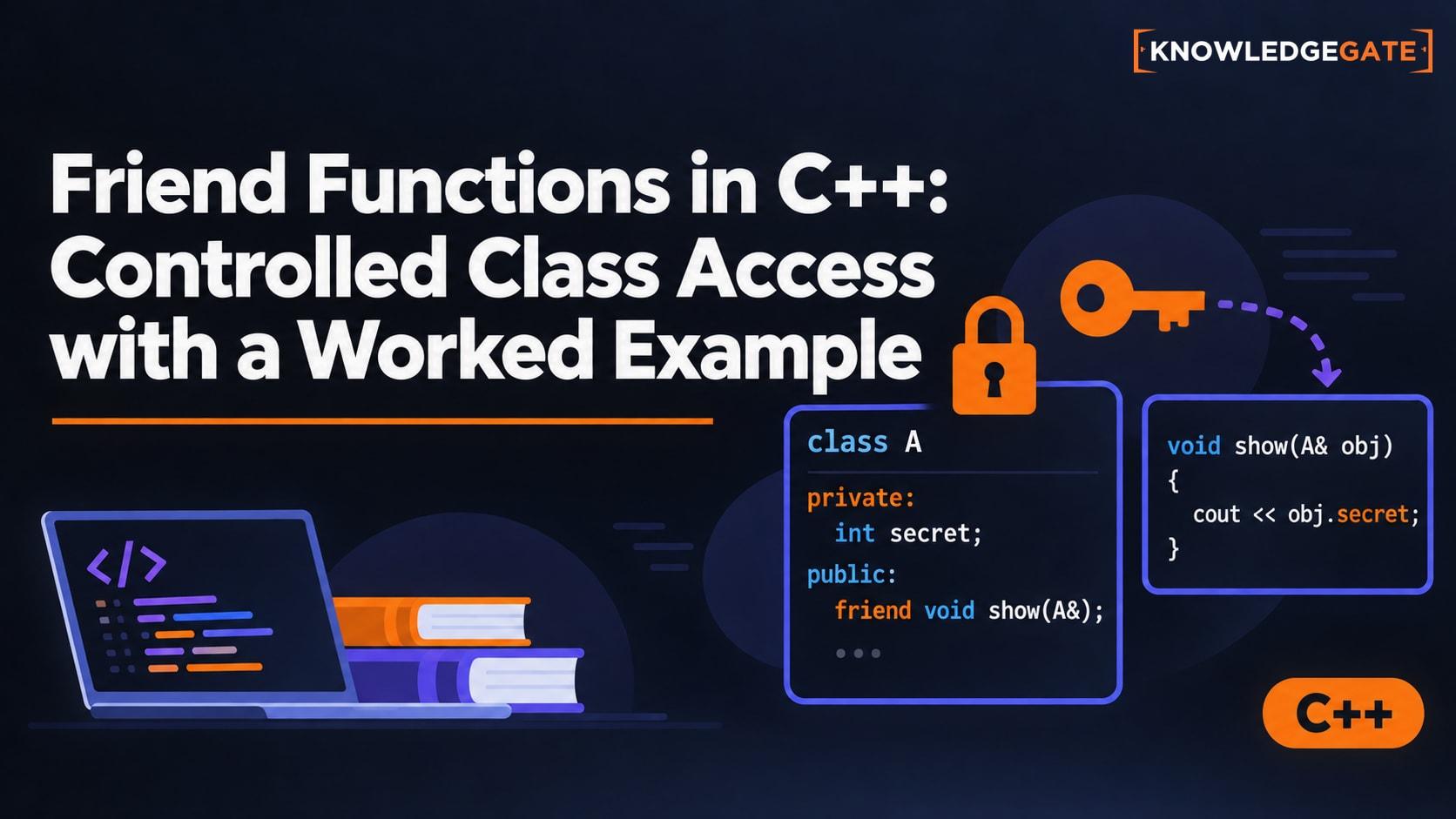
Friend Functions in C++: Controlled Class Access with a Worked Example
See how a non-member friend function can validate and update two Wallet objects while private balances stay hidden from ordinary callers. Includes runnable C++ and an exact trace.
Updated 12 Nov 20265 min readC++
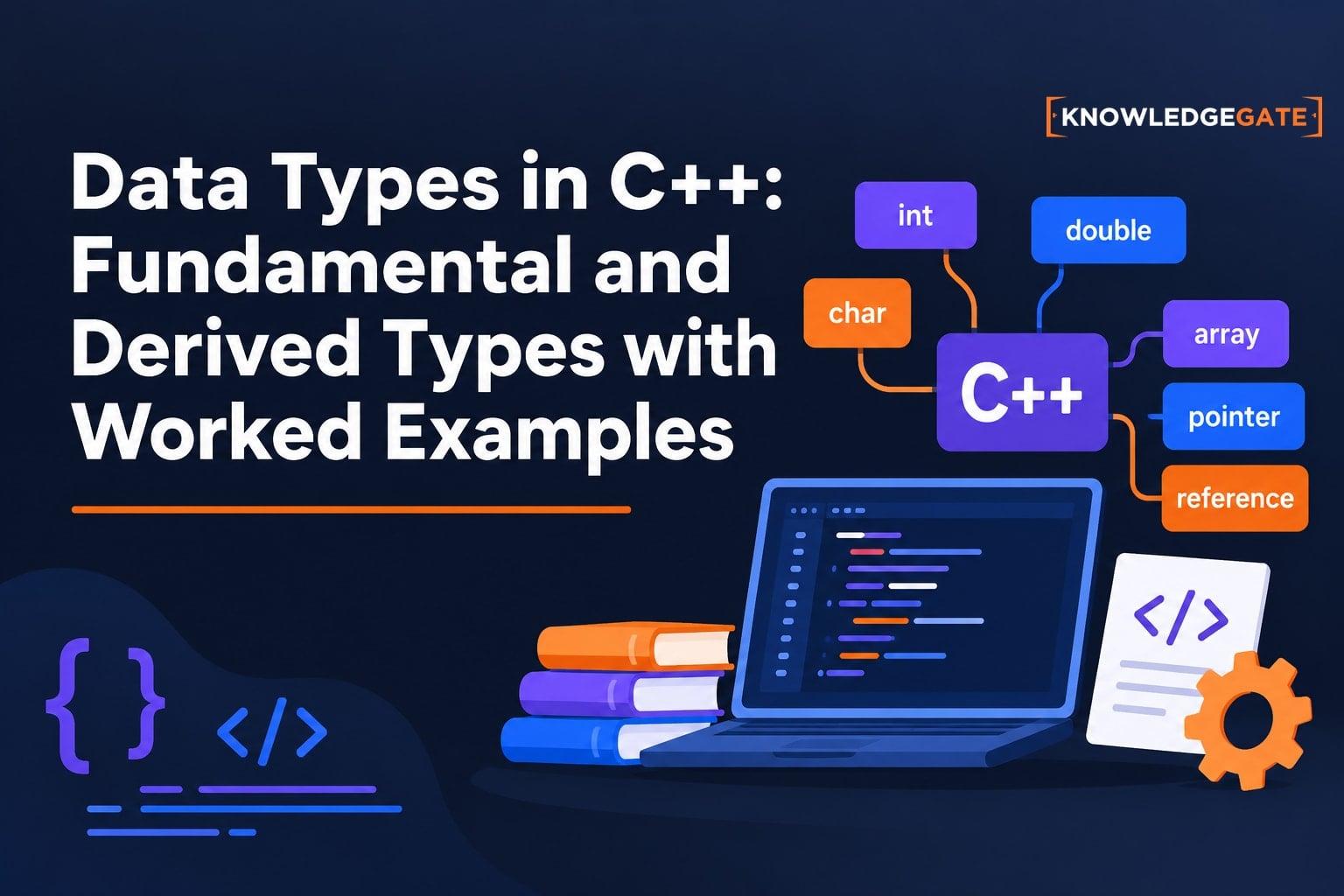
Data Types in C++: Fundamental and Derived Types with Worked Examples
Learn how C++ fundamental types differ from arrays, pointers, references, and function types. Trace one complete program, then test the conversion traps.
Updated 11 Nov 20265 min readC++
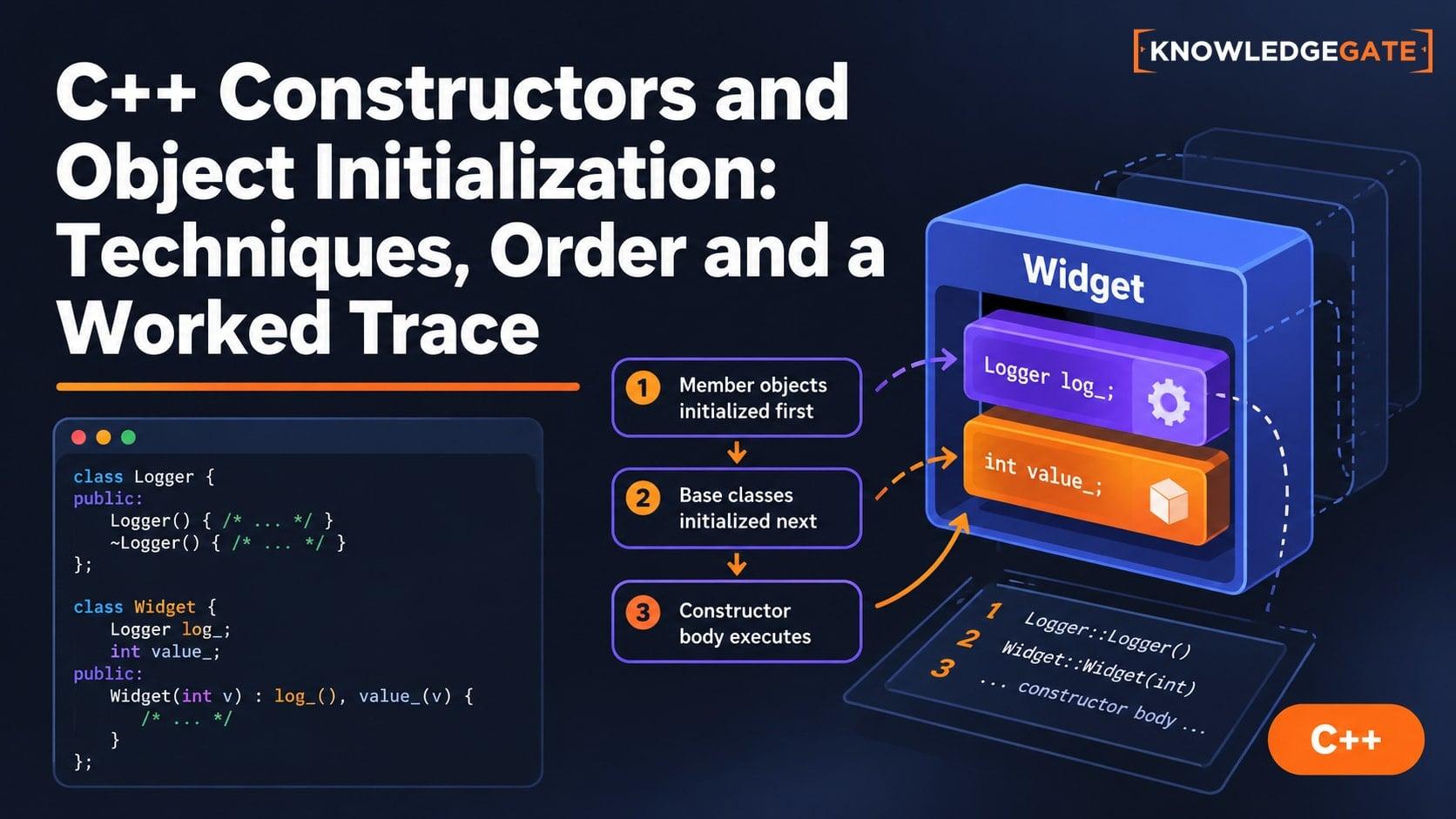
C++ Constructors and Object Initialization: Techniques, Order and a Worked Trace
Learn how C++ chooses default, parameterised, delegating and copy constructors, then trace member states and initialization order through complete code.
Updated 10 Nov 20266 min readC++