

Big Data MCQs: 10 Solved Questions on 5 Vs, HDFS and Analytics
Solve eight Big Data MCQs and two short-answer prompts with clear explanations, worked calculations and a quick method for spotting the most common traps.
KnowledgeGate Team
Exam prep & CS education
Updated 29 Oct 20267 min read
Big Data questions look like vocabulary checks during a timed test, but distractors mix up scale, speed, format, trust, processing mode and storage behaviour. The five Vs alone will not settle batch processing, clustering, replication or HDFS workload fit.
Use the questions to distinguish scale, speed, format, trust, processing mode and storage behaviour. Answer each MCQ before reading its explanation, and sketch four lines for each prompt. For a broader study track afterwards, browse Skill Development Courses.
1. The Big Data concept map to use before solving
Concept | Meaning |
|---|---|
Volume | How much data |
Velocity | How fast data arrives or must be processed |
Variety | Formats and structures |
Veracity | Quality and uncertainty |
Value | Useful outcome |
Structured data | Data following a fixed schema |
Batch processing | Stored data processed on a schedule |
Stream processing | Events processed continuously |
Replication | Copies stored on different nodes |
K-means | Unsupervised clustering |
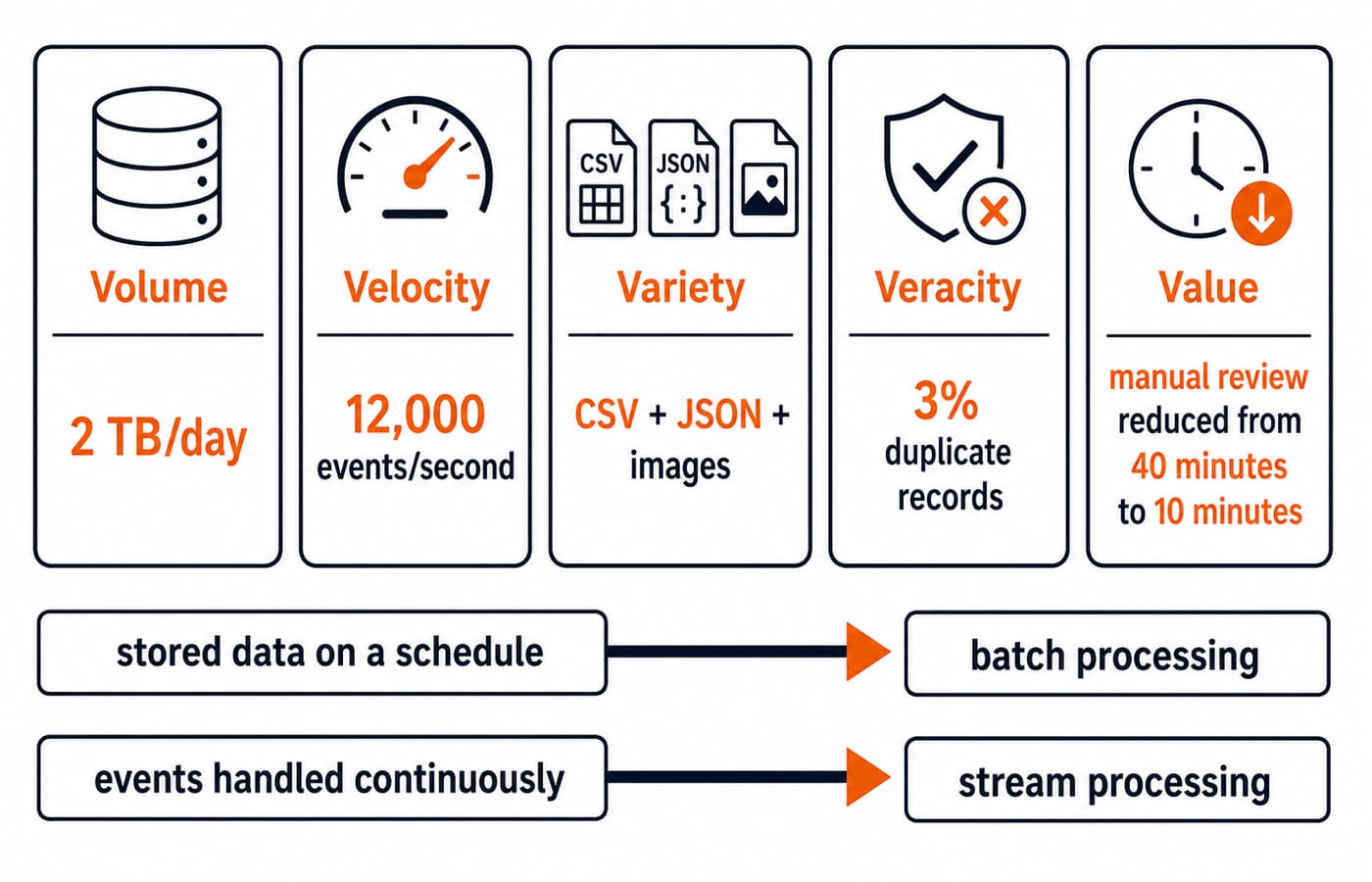
Consider a hypothetical service receiving 2 TB/day, peaking at 12,000 events/second, accepting CSV, JSON and image inputs, finding 3% duplicate records, and using clean output to cut review from 40 minutes to 10 minutes. These are illustrative teaching values, and they map respectively to Volume, Velocity, Variety, Veracity and Value.
Continue the clustering ideas in ML & Data Science.
2. Short-answer Questions 1-2: 5 Vs and data analytics
Question 1
What is Big Data? Explain its characteristics (5 V's).This one is a written answer, so draft four lines of your own before reading on.
Model answer: Big Data means datasets whose scale, arrival rate or complexity makes ordinary single-system handling difficult for the required task. Size alone is not decisive. Volume is the amount, such as 2 TB/day. Velocity is the arrival or processing rate, such as 12,000 events/second. Variety covers formats and structures, here CSV, JSON and images. Veracity concerns quality and uncertainty, illustrated by 3% duplicate records. Value is the useful outcome, here reducing manual review from 40 minutes to 10 minutes. The dashboard therefore ties the five Vs to amount, speed, format, trust and outcome. No single V defines Big Data; the required task, complexity, arrival pattern and available system limits all matter. An exam-ready response should first define Big Data, then explain each characteristic with its clue rather than listing five terms without meaning.
Question 2
What is Data Analytics? Explain its key tool (Python Pandas) and main functions.Again, write four lines of your own before checking the model answer.
Model answer: Data analytics means inspecting, cleaning, transforming and summarising data to answer a question. Pandas is a Python library centred on Series and DataFrame. Useful examples are read_csv(), head(), info(), isna().sum(), fillna(), groupby(), mean() and describe().
Let orders.csv, with columns order_id, city, amount, contain (101, Delhi, 1200), (102, Pune, 800), (103, Delhi, 1500), (104, Pune, missing), (105, Delhi, 900) and (106, Pune, 1000). df.groupby("city")["amount"].mean() skips the missing value. Delhi gives (1200 + 1500 + 900) / 3 = 3600 / 3 = 1200; Pune gives (800 + 1000) / 2 = 1800 / 2 = 900. Filling the missing value with 0 first changes Pune to (800 + 0 + 1000) / 3 = 1800 / 3 = 600. Cleaning choices therefore change the analysis.
3. Big Data MCQs 3-5: velocity, structured data and veracity
Question 3
Which characteristic of Big Data refers to the speed at which data is generated and processed?

A. Volume (मात्रा)
B. Variety (विविधता)
C. Velocity (गति)
D. Veracity (सत्यता)
Answer: C. Velocity (गति). The peak of 12,000 events/second is a rate, so it is Velocity. By contrast, 2 TB/day is Volume, CSV plus JSON plus images show Variety, and 3% duplicates raise Veracity. Records per second, requests per minute and processing delay are speed clues.
Question 4
Which of the following represents structured data?

A. Database table
डेटाबेस टेबल
B. Video file
वीडियो फाइल
C. Image file
इमेज फाइल
D. Audio file
ऑडियो फाइल
Answer: A. Database table / डेटाबेस टेबल. Take fixed columns order_id INT, city VARCHAR(20) and amount DECIMAL(8,2), with row (101, Delhi, 1200.00). Every row follows that schema. Video, image and audio files do not become identical fixed-field rows merely because they have metadata. This does not mean every database value is structured or every media-related dataset is unstructured.
Question 5
Which Big Data characteristic refers to the uncertainty or inconsistency of data?

A. Volume
B. Velocity
C. Variety
D. Veracity
Answer: D. Veracity. In 2,000 records, suppose 120 are duplicates and 40 have no city. With no overlap, 120 + 40 = 160, so 160 / 2000 = 0.08 = 8% are flagged. Consistency and trust mean Veracity. Volume describes the amount, not reliability.
4. Big Data MCQs 6-7: batch processing and K-means
Question 6
Processing large volumes of stored data at regular intervals is known as:

A. Stream Processing
B. Batch Processing
C. Event Processing
D. Parallel Processing
Answer: B. Batch Processing. A 2:00 AM job processes the previous day's 240 GB of stored logs. Four equal workers handle 240 / 4 = 60 GB each. Scheduled, accumulated input is the decisive clue. Processing 12,000 events/second as they arrive is streaming. Parallel work can occur inside either design.
Question 7
Which of the following is an unsupervised learning algorithm?

A. Logistic Regression
B. Linear Regression
C. K-Means Clustering
D. Decision Tree
Answer: C. K-Means Clustering. Supervised methods use labelled targets. K-means groups unlabelled points by distance from centroids.
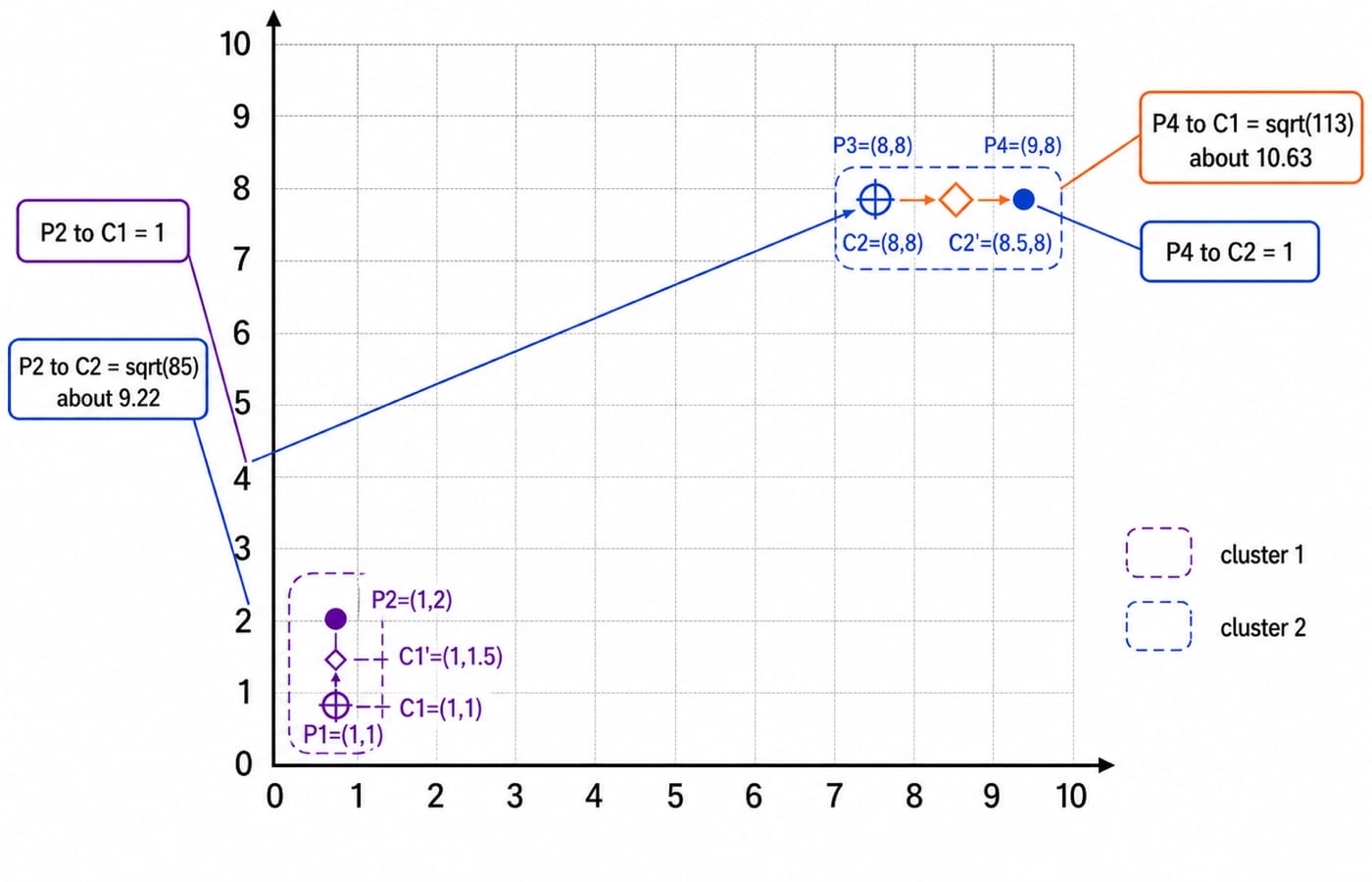
Take P1=(1,1), P2=(1,2), P3=(8,8) and P4=(9,8), initially centred at C1=(1,1) and C2=(8,8). P2 is 1 from C1 and sqrt(85), about 9.22, from C2. P4 is sqrt(113), about 10.63, from C1 and 1 from C2. Assignments are {P1, P2} and {P3, P4}. The new centroids are ((1+1)/2, (1+2)/2) = (1,1.5) and ((8+9)/2, (8+8)/2) = (8.5,8). This is one iteration, not guaranteed completion.
5. Big Data MCQs 8-10: replication, HDFS and 5-V traps
Question 8
Distributed storage systems increase reliability mainly by:

A. Data Compression
B. Data Replication across nodes
C. Sequential Processing
D. Encryption
Answer: B. Data Replication across nodes. With 12 logical blocks and a configured factor of 3, the store maintains 12 x 3 = 36 copies across nodes. If one B7 copy becomes unavailable, another can serve it. Compression saves bytes and encryption protects confidentiality, but neither creates a fallback copy. Three is this example's factor, not a universal setting.
Question 9
Asked in ISRO Computer Science 2023.
Which of the following scenario may not be a good fit for HDFS in Big Data paradigm?

A. HDFS is not suitable for scenarios requiring multiple/simultaneous writes to the same file
B. HDFS is suitable for storing data related to applications requiring low latency data access
C. HDFS is suitable for storing data related to applications requiring high latency data access
D. None of the above
Answer: A. HDFS is not suitable for multiple/simultaneous writes to the same file. Multiple clients writing simultaneously to the same file conflict with the HDFS write model, so option A identifies a poor fit. However, option B calls HDFS suitable for low-latency access even though low-latency random access is not its strength. The distractors are therefore not clean; the key here is A, with that ambiguity noted.
Question 10
Asked in ISRO Computer Science 2025.
Which of the following is not a characteristic of Big Data?

A. Velocity
B. Visualisation
C. Volume
D. Variety
Answer: B. Visualisation. The five Vs are Volume, Velocity, Variety, Veracity and Value. Visualisation is useful in analytics but is not in that five. Expanded V-lists exist, so this answer follows the stated framework rather than claiming one universal list.
6. The traps these 10 Big Data questions expose
Contrast to test | Questions | Deciding clue |
|---|---|---|
Amount versus rate | Q1, Q3 | TB is amount; events/second is rate |
Schema versus file format | Q4 | Declared fields indicate structure |
Quality versus quantity | Q5 | Missing or duplicate values affect trust |
Stored schedule versus continuous arrival | Q6 | Nightly logs are batch; live events are stream |
Labelled prediction versus grouping | Q7 | K-means needs no target labels |
Storage and conventions | Q8-Q10 | Copies aid reliability; same-file writes challenge HDFS; five Vs control Q10 |
Use this 45-second routine:
Circle
TB/dayandevents/second.Mark stored/arriving input and labelled/unlabelled data.
Separate replication from encryption.
Circle
not,may notandsame file.For Q9-style flaws, explain ambiguity before using the key.
For more fixed-schema practice, use DBMS MCQs.
7. Big Data MCQs: the next practice step
Redo Questions 3, 5, 6, 7, 8 and 9. Then reconstruct the dashboard mapping: 2 TB/day, 12,000 events/second, CSV plus JSON plus images, 3% duplicates, and review cut from 40 to 10 minutes.
The short version is to classify amount, speed, format, trust, useful outcome, processing schedule, labels or failure tolerance. This often removes distractors. Retest until you can name the deciding clue without hesitation. Continue AI study with Artificial Intelligence (AI), or broader preparation with NTA-UGC-NET Paper 1.
Keep learning

Big Data Systems for GATE CS: CAP Theorem, Sharding and MapReduce with Worked Examples
See what changes when a database spreads across machines. Build a clear mental model of shards, replicas, CAP choices, quorums, MapReduce and NoSQL.
Updated 31 Aug 20266 min readDBMS

Data Manipulation Micro-Operations MCQs: 10 Solved Questions with Explanations
Solve 10 micro-operations MCQs with step-by-step explanations of shifts, ALU behaviour, register logic, Booth recoding and control width.
Updated 29 Oct 20267 min readComputer Organization MCQs
Graph MCQs: 10 solved questions on representations, BFS, DFS and connectivity
Graph solved MCQs with explanations: 10 GATE PYQs on the adjacency matrix and list, BFS and DFS traversals, running times, connected components and SCCs.
Updated 29 Oct 20267 min read289 viewsData Structures MCQs

Asymptotic Notations Interview Questions and Answers: Big-O, Omega and Theta with Worked Examples
Prepare for Big-O, Omega and Theta questions with proof-ready answers, exact loop and recurrence traces, and a method for avoiding common interview traps.
Updated 24 Oct 20266 min readInterview Corner