

Arrays and Pointers in C Formula Sheet: Address Rules and Revision Notes
Revise C arrays and pointers through compact identities, exact address traces, operator parsing, decay traps, and a practical retrieval routine.
KnowledgeGate Team
Exam prep & CS education
Updated 12 Nov 20266 min read
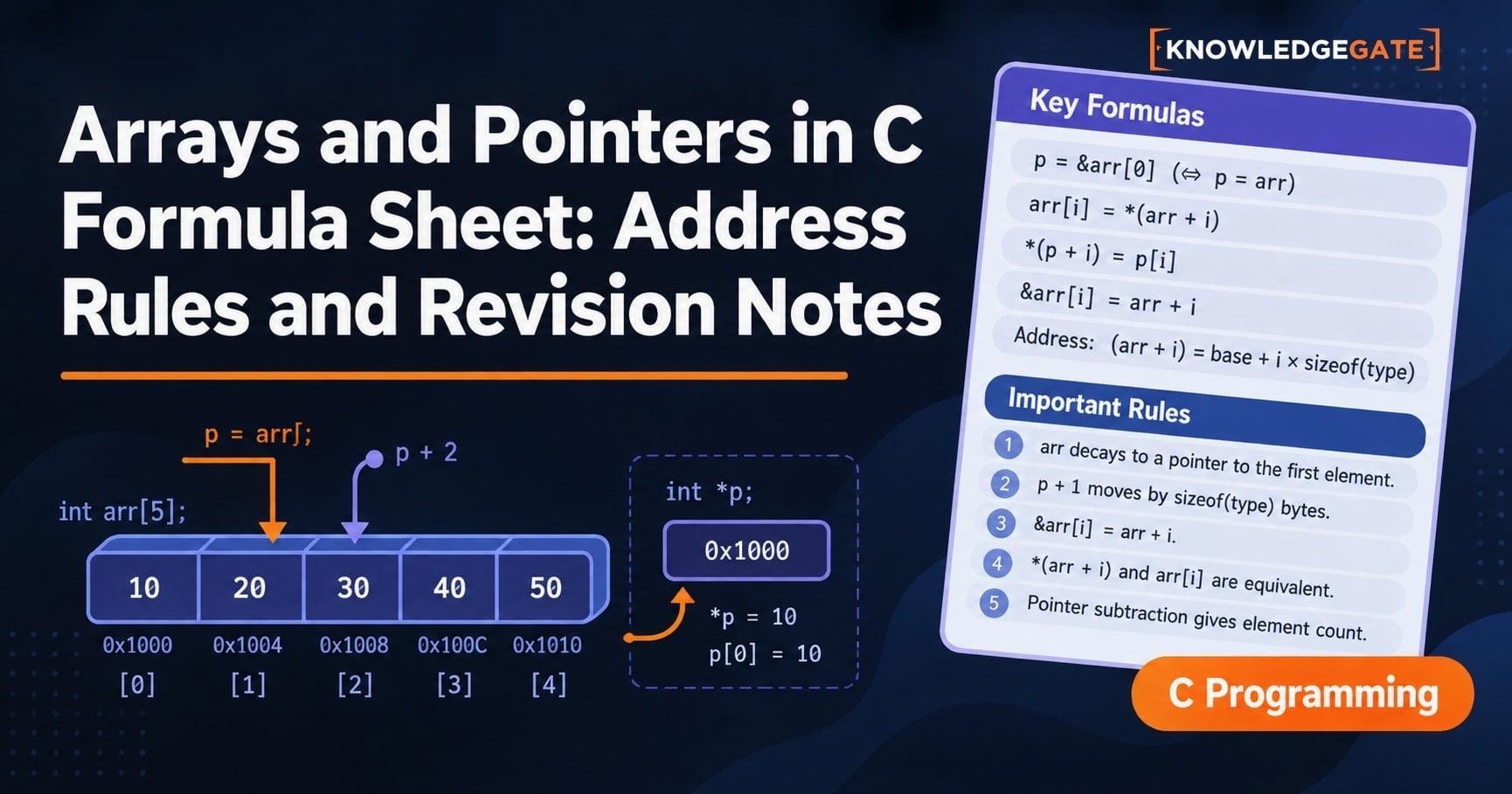
Array notation and pointer notation often produce the same numerical address, which makes revision deceptive. Their types, strides and legal operations are still different, so a familiar-looking expression can hide an invalid step. Use CS Fundamentals as the broader subject route. The key retrieval rules are one-dimensional and two-dimensional address formulas, pointer precedence, and boundary checks; rebuild them from the traces instead of memorising isolated symbols.
1. Arrays in C: the five identities worth memorising
Start with:
int a[5] = {7, 11, 13, 17, 19};N = sizeof a / sizeof a[0], with valid indices0throughN-1. Use it only on a complete array.a[i] = *(a + i)and&a[i] = a + i. Use these when syntax mixes subscripting, addresses and dereferencing.For a pointer
pinto the array,p[i] = *(p + i). Use it to expand pointer subscripting before tracing.
In most expressions, a converts to a pointer to its first element. It stays an array under sizeof and unary &. The name is not a modifiable lvalue, so a++ and a = p are invalid. The earlier Arrays and Pointers in C: Memory, Arithmetic, Traps owns the first-pass memory model, 2D derivation and precedence walkthrough; this sheet keeps the compact identities and revision checks.
2. Pointer arithmetic in C: scale by the pointed-to type
The teaching formula is address(p + k) = address(p) + k * sizeof(*p). Use it when converting an element offset into a byte address.
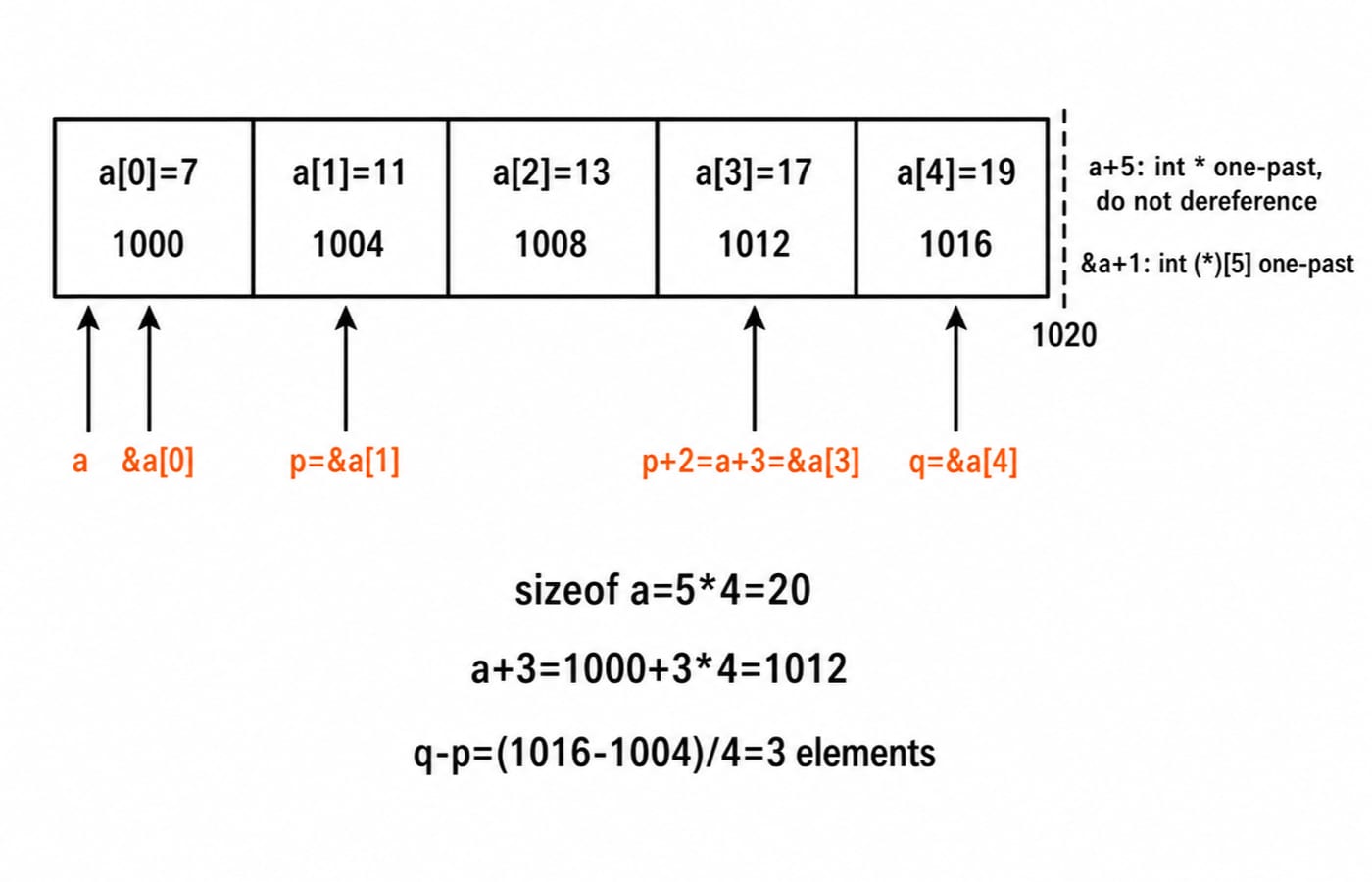
If p = &a[i], then p + k = &a[i+k] within the same array or at its one-past position. You may form and compare one-past, but never dereference it. Apply this bound rule before reading an address.
If q = &a[j] and p = &a[i] share an array, q - p = j - i. Use subtraction to count elements, not bytes; the result is ptrdiff_t. Unrelated arrays define no such distance.
An int * advances by one int, while an int (*)[5] advances by one complete five-int row. Parse the pointed-to type before tracing an offset.
3. Arrays and pointers worked example: one base address, eight results
Assume the invented model sizeof(int) = 4 bytes and base B = 1000. Round addresses make scaling visible. The earlier Relationship Between Arrays and Pointers in C owns the conceptual type distinction and its single-base memory strip; this sheet uses a separate five-value trace to make the formulas and operator checks retrievable.
int a[5] = {7, 11, 13, 17, 19};
int *p = &a[1];
int *q = &a[4];
Result | Step-by-step calculation |
|---|---|
Array size |
|
Element count |
|
|
|
| Address |
|
|
|
|
|
|
|
|
Use it to keep the base consistent. a + 5 is int *; &a + 1 is int (*)[5]. Both equal 1020 here, with strides 4 and 20 bytes. Equal addresses do not erase types.
4. Two-dimensional arrays in C: row-major formula and address trace
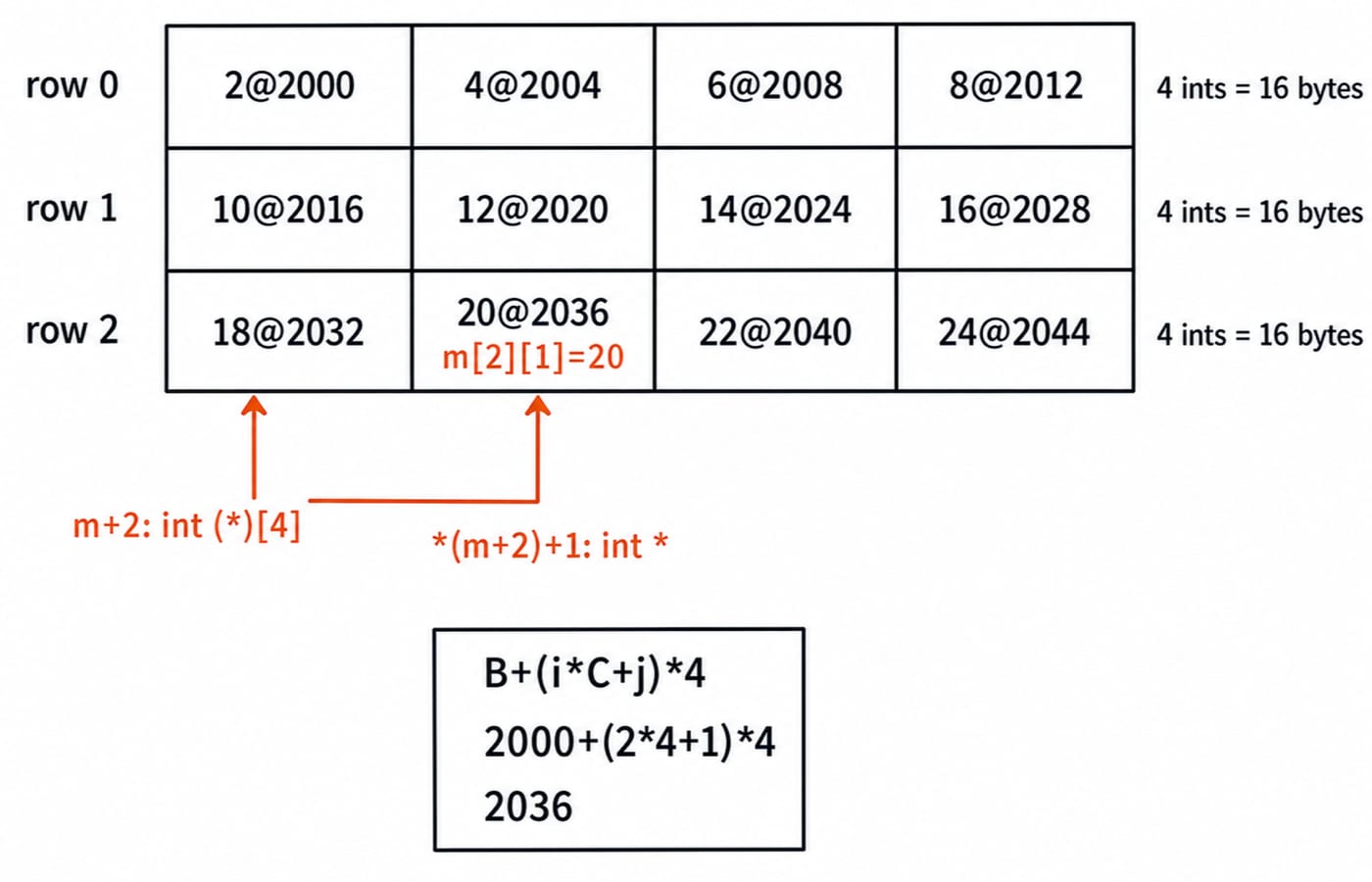
Take int m[3][4] = {{2,4,6,8}, {10,12,14,16}, {18,20,22,24}};. Assume base B = 2000, sizeof(int) = 4, rows R = 3 and columns C = 4.
For valid zero-based indices, &m[i][j] = B + (i * C + j) * sizeof(int). Use this formula to flatten a row-major position into its element offset. Therefore:
&m[2][1] = 2000 + (2 * 4 + 1) * 4 = 2000 + 36 = 2036, and m[2][1] = 20.
Now trace the types. m converts to int (*)[4]. Thus m + 2 reaches row 2 at 2000 + 2 * 16 = 2032. Then *(m + 2) converts to an int * at 2032; adding 1 reaches 2036. Hence m[2][1] = *(*(m + 2) + 1) = 20. Use this expansion when a 2D subscript is mixed with pointer notation.
In void f(int m[][4]), the parameter adjusts to int (*m)[4]. The trailing dimension remains because the compiler needs the four-column row stride.
5. Pointer expressions in C: parse four operators before tracing them
Reset this fresh state before each independent case:
int a[5] = {7, 11, 13, 17, 19};
int *p = &a[1];
int x;
Expression | Parenthesised form |
|
| Array change |
|---|---|---|---|---|
|
|
|
| None |
|
|
|
|
|
|
|
|
| None |
|
|
|
|
|
Parenthesise postfix and prefix operators first, then separate pointer movement from pointee modification. In *p++, postfix ++ moves the pointer after reading its old pointee. In (*p)++ and ++*p, the pointer stays fixed while the pointee changes. Never infer a result from visual proximity.
6. Arrays and pointers traps: decay, declarations, bounds and lifetime
In a separate 64-bit model, sizeof(int *) = 8 and sizeof(int) = 4. void f(int a[5]) adjusts to int *a; inside, sizeof a / sizeof a[0] = 8 / 4 = 2, not caller length 5. The earlier Arrays and Strings in C: Decay, sizeof and 2D Addresses owns string sentinels, sizeof comparisons and the full row-major derivation; this sheet keeps the compact decay formula beside its declaration and lifetime traps.
Read from the identifier outwards. int *ap[5] is an array of five pointers to int. int (*pa)[5] = &a is one pointer to an array of five int; under the earlier model, pa + 1 advances 20 bytes.
Trap | Result | Correction |
|---|---|---|
Dereference | Out of bounds | Never dereference one-past |
Subtract unrelated pointers | No valid distance | Use one array only |
Dereference null, uninitialised or dangling pointers | Invalid access | Point to a live object |
Modify through | String-literal modification | Use |
Assign one array to another | Invalid whole-array assignment | Copy elements explicitly |
7. GATE arrays and pointers questions: a 90-second solving method
Common practice-question forms ask you to compute an element address, distinguish an array from a pointer or pointer-to-array, expand a subscript, trace pre-increment and post-increment, calculate a row-major address, check a bound, or identify an invalid dereference or lifetime error.
Use this six-step routine:
Write every exact type.
Mark whether array-to-pointer conversion occurs.
Record base
B, element sizew, row width and valid bounds.Expand
x[i]to*(x + i).Parenthesise
++,--and*before tracing state.Reject a one-past dereference, unrelated-pointer subtraction, null access or dangling access before calculating output.
KnowledgeGate's C Programming > Arrays & Pointers question bank provides practice depth; it is not evidence of exam weightage, frequency or any official pattern. The scheduled Arrays and Pointers in C: 7 GATE Mistakes That Cost Marks owns the seven error-first corrections; this sheet stays with formulas, derivations and a compact operator table.
8. Arrays and pointers revision notes: the short version and next step
Subscripting is pointer addition followed by dereference.
Pointer arithmetic scales by the pointed-to type.
Pointer subtraction counts elements within one array.
A one-past pointer may be formed, but not dereferenced.
sizeofsees a real array only before parameter adjustment.A 2D array decays to a pointer to its first row.
In ten minutes, rebuild the five-cell map from 1000. Recover 1012, 1020 and q - p = 3, then recompute m[2][1] at 2036 unseen. For broader study, continue with the C Language course.
Keep learning
Relationship Between Arrays and Pointers in C: Decay, Address Arithmetic and a Worked Memory Trace
See why an array is not a pointer, even when their displayed addresses match. Trace decay, pointer movement, sizeof, function parameters and bounds through one C array.
Updated 30 Oct 20265 min read146 viewsC Programming & Data Structures
C Fundamentals Formula Sheet for GATE CS: Rules, Traces and Revision Notes
Revise the C rules that most often change an answer. Use compact tables, worked traces, address formulas, memory notes, and a practical error checklist.
Updated 19 Nov 20266 min readC Programming & Data Structures
Storage Classes, Structures and Enums in C: Formula Sheet with Worked Revision
Revise C declarations through three separate axes, then test them with a two-call trace, a byte-layout calculation and an enum sequence.
Updated 17 Nov 20266 min readC Programming & Data Structures

DMA, Macros, Scoping and File Handling in C: Formula Sheet with Worked Revision Notes
Build a compact C revision sheet for dynamic memory, macros, scope, linkage, storage duration and file streams. Four worked checks connect each rule to an exact result.
Updated 15 Nov 20266 min readC Programming & Data Structures