Algorithm Basics MCQs: 12 Solved Questions with Explanations
Solve 12 algorithm basics MCQs from teaching, PSU and placement papers, with clear answers, traps, efficiency checks and step-by-step traces.
KnowledgeGate Team
Exam prep & CS education
Updated 27 Jul 20267 min read73 views
Algorithm basics look easy until a definition, a comparison operator or a recursive call catches you out. The right frame turns most of them into 30-second questions. The 12 previous-year questions here come from DSSSB, HTET, BPSC, RSSB and Bihar STET teaching papers, from ISRO, and from the Infosys, Accenture and Hexaware placement rounds.
What these exams actually ask from algorithm basics
Questions fall into three buckets: algorithm definitions and properties, flowcharts and control constructs, or efficiency and simple traces. Teaching-recruitment papers lean on the first two, where one word such as finiteness or selection decides the mark. ISRO and the placement rounds push into the third, where recognising the answer is not enough and you have to run the lines yourself.
Traces are where the clock goes, so if pseudocode output questions are the ones you lose, work through Infosys Pseudocode Questions: 17 Solved Traces and Traps alongside this set.
Defining an algorithm: 4 solved questions
Q1. A step-by-step solution
HTET 2023: "Step by step description of how to arrive at a solution to a given problem is known as:"
(A) Algorithm
(B) Plan
(C) ASCII Code
(D) UNICODE
Answer: (A) Algorithm
An algorithm is a step-by-step procedure for solving a problem. A plan may be informal, while an algorithm is finite and unambiguous. You can practise this question on the solved page.
Q2. The property that guarantees termination
DSSSB 2018: "Which of the following properties ensures that an algorithm must always terminate after a finite number of steps?"
(A) Effectiveness
(B) Definiteness
(C) Finiteness
(D) Output
Answer: (C) Finiteness
The five classic properties are input, output, definiteness, finiteness and effectiveness. Finiteness guarantees termination after a limited number of steps, while definiteness, the strongest trap here, means that every step is unambiguous. You can practise this question on the solved page.
Q3. True statements about algorithms
DSSSB 2021: "Which of the following statement(s) is/are true about Algorithm? I. It is step by step solution of problem. II. It is difficult to debug. III. It is not dependent on the programming language."
(A) I and II
(B) II and III
(C) I and III
(D) I, II and III
Answer: (C) I and III
Statements I and III are true because an algorithm is language-independent. Statement II is false: algorithms are easier to debug than code because there is no syntax noise. Settling II eliminates every option containing it. You can practise this question on the solved page.
Q4. What a computer program consists of
BPSC 2023: "A computer program consists of"
(A) system flowchart
(B) program flowchart
(C) algorithms written in computer language
(D) More than one of the above
(E) None of the above
Answer: (C) algorithms written in computer language
A program is an algorithm expressed in a computer language. Flowcharts are design artefacts, not the program, so option D is also incorrect. State PSC papers may have five options; read them all. You can practise this question on the solved page.
Flowcharts and control constructs: 2 solved questions
Q5. Pictorial representation
HTET 2023: "Pictorial representation of an algorithm is called as:"
(A) Image
(B) Picture
(C) Flowchart
(D) Pseudocode
Answer: (C) Flowchart
A flowchart is the pictorial representation of an algorithm. Pseudocode is the textual alternative, which is the only contrast needed to reject the strongest wrong option. You can practise this question on the solved page.
Q6. Selection in an everyday scenario
RSSB 2023: "A child has to cross road and reach the school opposite to his house. The child looks on right and left before crossing the road. On observing that no vehicle is coming, he crosses the road and reaches school. What action of algorithm is represented by the child in the above situation?"
(A) Input
(B) Output
(C) Selection
(D) Repetition
Answer: (C) Selection
The condition "no vehicle coming?" controls whether the child crosses, so this is selection, like if-else. Looking left and right is the input that feeds the condition, and repetition would need that check to run in a loop. You can practise this question on the solved page.
Measuring efficiency: 4 solved questions
Q7. The two resources that matter
DSSSB 2021: "Efficiency of an algorithm is measured in terms of _____."
(A) Memory and processor speed
(B) Time and space
(C) Response time and completion time
(D) Data and space
Answer: (B) Time and space
Algorithmic efficiency is described through time complexity and space complexity. Processor speed belongs to the hardware, so option A does not measure the algorithm independently of the machine. You can practise this question on the solved page.
Q8. What algorithm analysis measures
Bihar STET 2025: "Algorithm analysis is primarily concerned with:"
(A) Determining the best algorithm for a specific problem
(B) Measuring the time and space efficiency of an algorithm
(C) Creating new algorithms from scratch
(D) Solving algorithmic problems using any available approach
Answer: (B) Measuring the time and space efficiency of an algorithm
Analysis measures how one algorithm's time and space requirements grow with the input. Choosing the best algorithm, option A, can be a consequence of comparing analyses, but it is not the primary act of analysis itself. You can practise this question on the solved page.
Q9. Bit-field width for values from 0 to n
ISRO 2018: "If a variable can take only integral values from 0 to n, where n is an integer, then the variable can be represented as a bit-field whose width is (the log in the answers are to the base 2, and [log n] means the floor of log n)"
(A) [log(n)] + 1 bits
(B) [log(n-1)] + 1 bits
(C) [log(n+1)] + 1 bits
(D) None of the above
Answer: (A) [log(n)] + 1 bits
The range 0 to n contains n + 1 distinct values. For n = 100, floor(log2 100) = 6 because 2^6 = 64 <= 100 < 128 = 2^7, so the width is 6 + 1 = 7 bits; 7 bits provide 128 states for 101 values, while 6 bits provide only 64. As a sanity check, n = 7 needs 3 bits, giving exactly 8 states for 0 through 7, and n = 8 needs 4 bits for 9 states. These capacity checks rule out the nearby log expressions. You can practise this question on the solved page.
Q10. Recursive versus iterative linear search
Hexaware 2024: "Is the space consumed by linear search (recursive) and linear search (iterative) the same?"
(A) No, recursive algorithm consumes more space
(B) No, recursive algorithm consumes less space
(C) Yes
(D) Nothing can be said
Answer: (A) No, recursive algorithm consumes more space
Recursive linear search can build n stack frames, giving O(n) auxiliary space, while the iterative version uses O(1) auxiliary space. Their time complexity can be the same, but option C ignores the extra call stack, which is exactly what the question tests. You can practise this question on the solved page.
Pseudocode tracing under time pressure: 2 solved questions
Q11. Equality inside a comparison
Accenture 2024: "What will be the output of the following pseudocode? SET x TO 5, SET y TO 5, IF x >= y THEN OUTPUT \"x is greater than or equal to y\" ELSE OUTPUT \"x is less than y\" END IF"
(A) x is greater than or equal to y
(B) x is less than y
(C) 5
(D) Error
Answer: (A) x is greater than or equal to y
The condition 5 >= 5 is true because >= includes equality. Option B comes from reading the operator as >, so slow down at the comparison even when the values look trivial. You can practise this question on the solved page.
Q12. A recursion trace on the way down and up
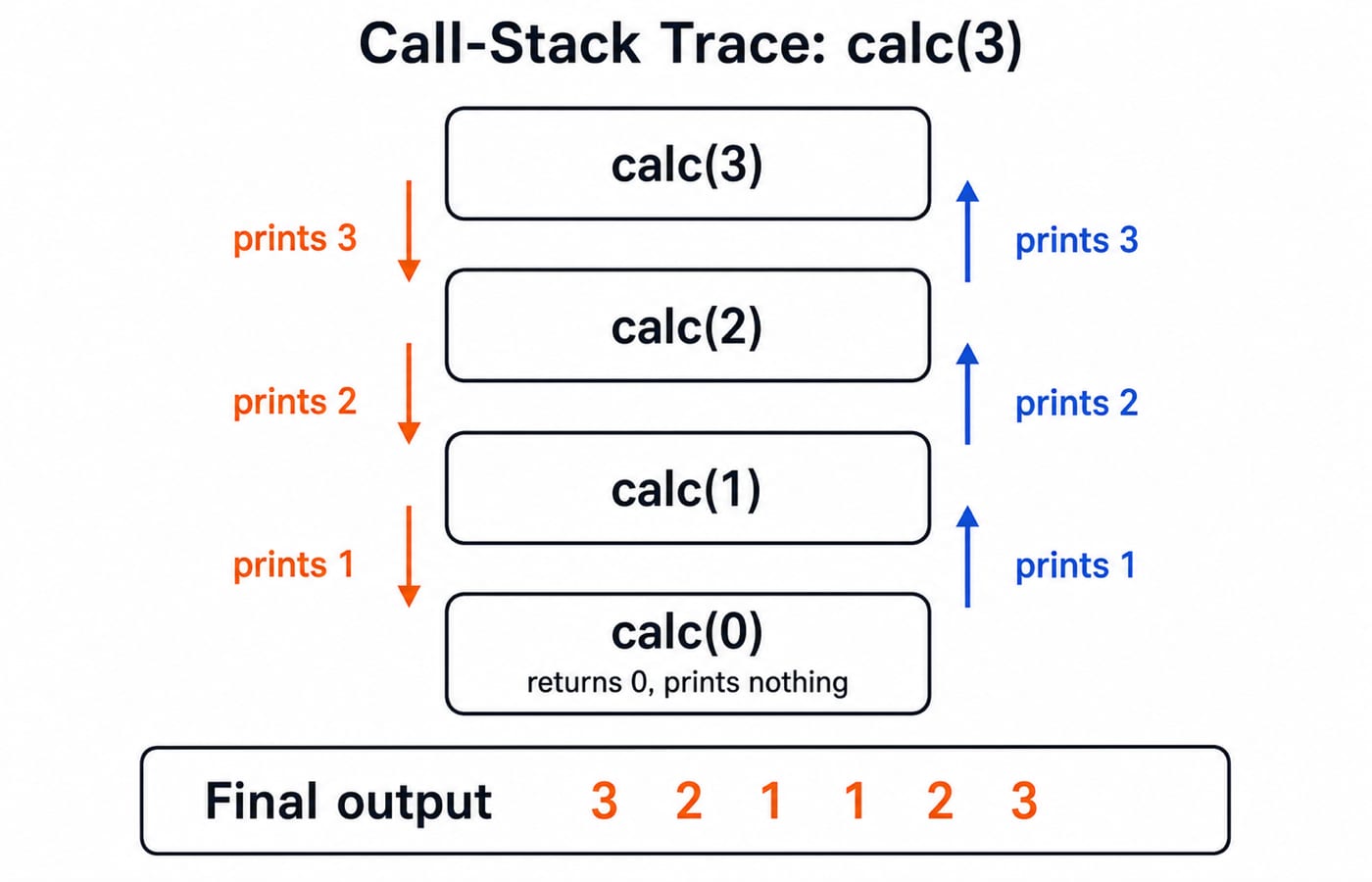
Infosys 2024: "What will be the output of the following pseudocode when n = 3? Integer calc(Integer n): if (n <= 0) return 0; if (n < 1) return 1; Print n; calc(n-1); Print n; End function calc"
(A) 1 2 3
(B) 3 2 1 0
(C) 3 2 1 1 2 3
(D) Compiler error
Answer: (C) 3 2 1 1 2 3
calc(3) prints 3 and calls calc(2); calc(2) prints 2 and calls calc(1); calc(1) prints 1 and calls calc(0); calc(0) hits n <= 0 and returns 0 without printing, so the second guard, n < 1, can never fire. Unwinding then prints 1, 2, 3 from the pending second Print in each frame, giving 3 2 1 1 2 3. Option B wrongly prints the base value and misses those pending statements. Anything printed after a recursive call comes out in reverse order on the way back up. You can practise this question on the solved page.
The pattern behind all 12
The details change, but the fast check for each bucket stays stable:
Bucket | What it tests | The 5-second check |
|---|---|---|
Definitions | Meaning and properties | Recall input, output, definiteness, finiteness and effectiveness |
Flowcharts and constructs | Mapping a representation or scenario | Choose input, output, selection or repetition |
Efficiency | Resource growth | Check both time and space, never hardware speed |
Traces | Execution order | Run line by line and mark statements after recursion |
Strong candidates do not drop these marks. Asymptotic notation and recurrences build on this foundation. Continue with Data Structures MCQs for the next solved set.
The short version and where to practise next
These 12 solved PYQs span teaching, PSU and placement papers. KnowledgeGate's question bank carries about 45 questions on algorithm basics and analysis, each with a worked solution page.
For topic-wise mocks and full-length practice, use the GATE Test Series. To build concepts from scratch for placement tests, follow CS Fundamentals for Placements by Sanchit Sir. Find more guides and solved sets under Coding & CS Fundamentals.
Keep learning
Computer Graphics Applications and Core Components MCQs: 12 Solved Questions with Explanations
Solve 12 published computer graphics questions, then use the explanations and worked calculations to strengthen the distinctions that make each answer clear.
17 Sep 20267 min readAlgorithms MCQs
Matrix Chain Order MCQs: 12 Solved GATE and UGC NET Questions with Explanations
Solve Matrix Chain Multiplication questions by applying one cost rule, comparing valid groupings, and filling the dynamic-programming table without arithmetic slips.
Updated 15 Sep 20267 min readAlgorithms MCQs
Substitution Method MCQs: 12 Solved GATE and ISRO Questions with Explanations
Work through 12 published GATE and ISRO PYQs on subtract-and-conquer, geometric growth, square-root recurrences, recursive code, and asymptotic matching.
Updated 14 Sep 20268 min readAlgorithms MCQs
Recursion Tree Method MCQs: 12 Solved Questions with Explanations
Solve 12 recursion tree MCQs covering exponential trees, uneven splits, harmonic level sums, square-root arguments, and exact recurrence forms.
Updated 13 Sep 20267 min readAlgorithms MCQs