P,Q,R and S are four types of dangerous microbes recently found in a human…
2011
P,Q,R and S are four types of dangerous microbes recently found in a human habitat. The area of each circle with its diameter printed in brackets represents the growth of a single microbe surviving human immunity system within 24 hours of entering the body. The danger to human beings varies proportionately with the toxicity, potency and growth attributed to a microbe shown in the figure below:
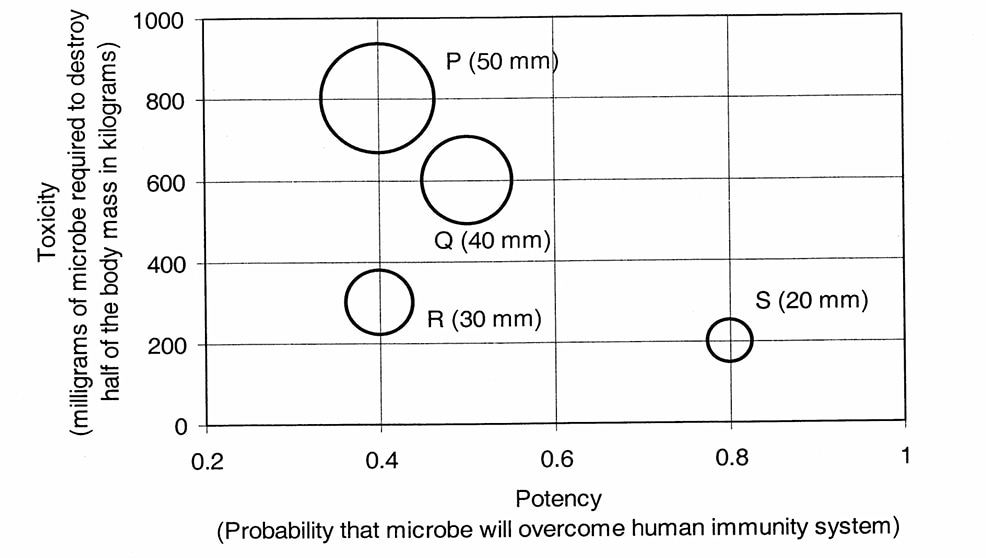
A pharmaceutical company is contemplating the development of a vaccine against the most dangerous microbe. Which microbe should the company target in its first attempt?
- A.
P
- B.
Q
- C.
R
- D.
S
Attempted by 71 students.
Show answer & explanation
Correct answer: D
Approach: The danger of a microbe depends on its toxicity, potency and growth. The plot gives the milligrams required to cause damage (higher milligrams means lower inherent toxicity), potency (probability of overcoming immunity), and the circle diameter indicates growth (area ∝ diameter^2). To compare microbes consistently, use a danger score proportional to (potency × growth area) and inversely proportional to the mg required. So danger score ∝ (potency × area) / (mg required).
P: potency ≈ 0.5; diameter = 50 → area ∝ 50² = 2500; mg required ≈ 900. Danger ≈ 0.5 × 2500 / 900 ≈ 1.39.
Q: potency ≈ 0.5; diameter = 40 → area ∝ 40² = 1600; mg required ≈ 600. Danger ≈ 0.5 × 1600 / 600 ≈ 1.33.
R: potency ≈ 0.4; diameter = 30 → area ∝ 30² = 900; mg required ≈ 300. Danger ≈ 0.4 × 900 / 300 = 1.20.
S: potency ≈ 0.8; diameter = 20 → area ∝ 20² = 400; mg required ≈ 200. Danger ≈ 0.8 × 400 / 200 = 1.60.
Conclusion: The microbe S has the highest danger score (≈ 1.60). Therefore the company should target S in its first vaccine development attempt.