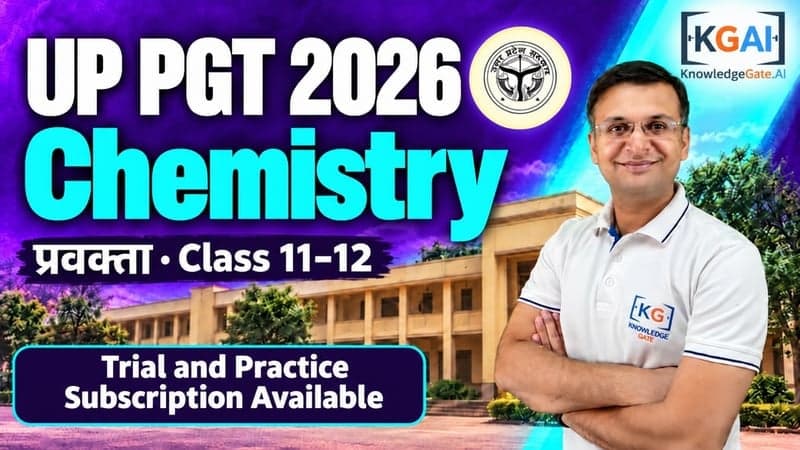
UP PGT Chemistry 2026 (प्रवक्ता)
रसायन विज्ञान / Chemistry — Complete Course
Need help choosing this course?
Our counsellor will help with pricing, syllabus, and enrollment.
About UP PGT Chemistry 2026 (प्रवक्ता)
UPESSC PGT Chemistry 2026: 185 पद। GK 30 + विषय 90 MCQ, 360 अंक, 2 घंटे, +3/−1। परीक्षा 15–16 दिसंबर। विषयवार अभ्यास; मॉक जल्द आ रहे हैं।
Compare UP PGT Chemistry 2026 (प्रवक्ता) with all courses📌 UPESSC PGT (प्रवक्ता) 2026 — रसायन विज्ञान विज्ञापन संख्या 06/2026 के अंतर्गत Chemistry के 185 पद । Teaching Exams (Classes 9–12) समूह में विषय की स्नातकोत्तर-स्तरीय तैयारी और सामान्य ज्ञान का टॉपिक-वार MCQ अभ्यास। 📝 परीक्षा योजना — धारा 9(a) एक लिखित पेपर: 120 MCQ / 360 अंक / 2 घंटे । सामान्य ज्ञान: 30 प्रश्न / 90 अंक (25%) ; संबंधित विषय: 90 प्रश्न / 270 अंक (75%) । सही उत्तर पर +3 , गलत उत्तर पर −1 अंक । परीक्षा 15–16 दिसंबर 2026 ; लिखित परीक्षा के बाद 40 अंकों का साक्षात्कार । अलग भाषा या teaching-aptitude खंड नहीं है। 📘 कोर्स का दायरा भौतिक, अकार्बनिक, कार्बनिक, जैव-अणु/बहुलक और नाभिकीय रसायन। सामान्य ज्ञान: भारतीय इतिहास, राजव्यवस्था, अर्थव्यवस्था, भूगोल, समसामयिकी, सामान्य विज्ञान और उत्तर प्रदेश विशेष। उपलब्ध प्रकाशित बैंक का अभ्यास; आधारभूत विषयों से स्नातकोत्तर concepts तक। सामग्री की उपलब्धता और syllabus-fit के अनुसार कवरेज सीमित हो सकती है। पूर्ण पिछले वर्ष के पेपर और मॉक टेस्ट — जल्द आ रहे हैं । English: UPESSC PGT (प्रवक्ता) Chemistry 2026, Advt 06/2026: 185 subject posts. One written paper: 120 MCQs, 360 marks, 2 hours; GK 30/90, subject 90/270; +3 correct, −1 wrong. Exam: 15–16 December 2026; interview: 40 marks afterward. No separate language or teaching-aptitude section. Topic-wise practice uses available suitable material; full previous-paper tests and mocks are coming soon. 💳 Plans Trial Course: 5 practice questions daily and one Question Battle daily. Practice Course: Unlimited Practice questions. Unlimited Question Battles, plus Progress Monitor, Leaderboard and Course Captains.
Select your plan
Choose trial access or unlock unlimited practice
| Included features | Trial Course | Practice Course |
|---|---|---|
| PYQs | 5 per day | Unlimited |
| Practice questions | 5 per day | Unlimited |
| Question Battles | 1 per day | Unlimited |
| Mock tests | Up to 1 test | All tests |
| Progress Monitor | No | Yes |
| Leaderboard | No | Yes |
| Syllabus Hotspots | Yes | Yes |
| Goal Slider | Yes | Yes |
| Course Captains | No | Yes |
| Price | ₹0 | ₹9950% OFF |
What you get
- Validity
- Until 31 Mar 2027
Course Curriculum
Atomic Structure and Bonding / परमाणु संरचना और रासायनिक बंधन
- परमाणु संरचना एवं नाभिकीय रसायन
- Periodic Classification and Chemical Bonding
- द्रव्य एवं रसायन विज्ञान की मूल अवधारणाएँ
- Quantum Physics and Relativity
- Atoms, Nuclei and Astrophysics
States of Matter and Thermodynamics / पदार्थ की अवस्थाएँ और ऊष्मागतिकी
- द्रव्य एवं रसायन विज्ञान की मूल अवधारणाएँ
- States of Matter and Solutions
- Thermal and Statistical Physics
Equilibria, Electrochemistry and Kinetics / साम्य, वैद्युत रसायन और गतिकी
- Physical & Chemical Changes, Combustion, Fuels
- Chemical and Phase Equilibria
- Redox Reactions and Electrochemistry
- Chemical Kinetics and Surface Chemistry
- द्रव्य एवं रसायन विज्ञान की मूल अवधारणाएँ
- States of Matter and Solutions
- हाइड्रोकार्बन, हैलोऐल्केन एवं हैलोऐरीन
- विज्ञान शिक्षणशास्त्र
Inorganic and Coordination Chemistry / अकार्बनिक और समन्वय रसायन
- धातुकर्म, s-ब्लॉक एवं p-ब्लॉक तत्व
- Main-group and Periodic Chemistry
- d- and f-Block Elements and Coordination Compounds
- द्रव्य एवं रसायन विज्ञान की मूल अवधारणाएँ
- Analytical Chemistry and Spectroscopy
Organic Structure and Mechanisms / कार्बनिक संरचना और अभिक्रिया क्रियाविधि
- हाइड्रोकार्बन, हैलोऐल्केन एवं हैलोऐरीन
- Organic Chemistry: Basic Principles and Isomerism
- Organic Reaction Mechanisms
Hydrocarbons and Functional Groups / हाइड्रोकार्बन और क्रियात्मक समूह
- Organic Compounds Containing Oxygen and Nitrogen
Biomolecules and Polymers / जैव-अणु और बहुलक
- खेत फसल उत्पादन
- Biomolecules, Polymers and Everyday Chemistry
- Plant Protection
- Animal Husbandry and Dairy Science
- Clinical Nutrition and Diet Therapy
Nuclear Chemistry / नाभिकीय रसायन
General Knowledge / सामान्य ज्ञान — 30 Questions (Fixed)
- भारतीय राष्ट्रीय आंदोलन एवं स्वतंत्र भारत
- भारतीय संविधान
- भारतीय अर्थव्यवस्था
- भारत का भौतिक पर्यावरण
- Scientific Achievements and Research
- ऊष्मागतिकी एवं साम्यावस्था
- कोशिका: संरचना एवं कार्य
- Environment
- खेल एवं क्रीड़ाएँ
- Current Affairs
- State-Specific General Knowledge
- Agronomy and Farming Systems
- Agrometeorology
- Plant Breeding and Seed Technology
- Agricultural Economics and Extension
- Indian Mural Painting
- Indian Architecture, Temple Sculpture and Bronzes
- Art Criticism, Art Writing and Art Institutions
- Evolution
- Biotechnology
- Consumer Behaviour and Demand
- National Income Accounting
- मुद्रा एवं बैंकिंग
- Inflation and Monetary Policy
- Public Finance and Government Budget
- International Economics
- Economic Growth and Development
- Cultural and Language Awareness
- राष्ट्रीय पहचान और महत्वपूर्ण दिवस
- Books and Publications
- Awards and Personalities
- Defence and Security Awareness
- Geography as a Discipline and Geographical Thought
- Atmosphere and Climate
- जैवमंडल, मृदा एवं पर्यावरण
- Natural Hazards and Disasters
- जनसंख्या, मानव विकास एवं सांस्कृतिक भूगोल
- Human Settlements
- संसाधन, कृषि, खनिज एवं ऊर्जा
- Industries, Services, Transport and Trade
- प्रादेशिक एवं राजनीतिक भूगोल
- Prehistoric Cultures and the Harappan Civilisation
- Delhi Sultanate and the Deccan Kingdoms
- भक्ति एवं सूफी आंदोलन
- Mughal Empire and the Marathas
- Food Science, Processing and Food Safety
- Resource and Household Management
- Olympic Movement, Sports Bodies and Awards
- संघ सरकार
- Public Administration and Governance
- International Relations: Theories and Concepts
- समकालीन विश्व राजनीति
- Society, Community and Social Groups
- Social Stratification and Inequality
- Social Problems and Welfare
- शिक्षा का अर्थ, उद्देश्य एवं दर्शन
- शिक्षा, समाज एवं जेंडर
- Teaching Methods and Approaches
- Teaching Aids and Educational Technology
- Teacher: Qualities, Professional Ethics and Development
- Assessment and Evaluation
- Curriculum, Arts and Co-curricular Areas
- Education of Children with Disabilities
- Guidance and Counselling
- Growth and Development
- भक्तिकाल
- आधुनिक हिंदी कविता
- हिंदी गद्य साहित्य
- लेखन, पत्रकारिता और प्रयोजनमूलक हिंदी
- अपठित बोध
- Literary Forms and Devices
- History of English Literature
- Digital India and Online Services
- Communication Contexts and Media
- Mathematics Pedagogy
- वैदिकसाहित्यं धर्मशास्त्रं संस्कृतिश्च
- पृथ्वी: उत्पत्ति, आंतरिक संरचना एवं विवर्तनिकी
- Geomorphic Processes and Landforms
- Hydrosphere: Oceans
- Maps, Remote Sensing and Geographical Techniques
- Introduction to Economics
- Production and Costs
- बाज़ार के रूप एवं कीमत निर्धारण
- Determination of Income and Employment
- Statistics for Economics
- Measurement and Mathematical Methods
- गति और गति के नियम
- कार्य, ऊर्जा, शक्ति और घूर्णी गति
- Gravitation
- Mechanical Properties of Matter
- Oscillations and Mechanical Waves
- Electrostatics and Current Electricity
- Magnetism, Induction and Alternating Current
- विद्युतचुम्बकीय तरंगें और विकिरण
- Optics and Photonics
- Political Science and the State
- राजनीतिक मूल्य और लोकतंत्र
- Political Ideologies
- World Political Thought
- Indian Political Thought
- Comparative Politics
- संघवाद, राज्य और स्थानीय शासन
- भारतीय राजनीति और जनभागीदारी
- India's Foreign Policy
- जीव जगत एवं जैविक वर्गीकरण
- Plant Physiology
- मानव कार्यिकी
- वंशागति तथा विविधता के सिद्धांत
- Molecular Basis of Inheritance
- Biology in Human Welfare
- पारिस्थितिकी एवं पर्यावरण
- Sources and Historiography
- Vedic Age and Religious Movements
- महाजनपद एवं मौर्य साम्राज्य
- Post-Mauryan and Gupta Age
- Harsha and Early Medieval India
- European Arrival, British Expansion and 1857
- औपनिवेशिक शासन, अर्थव्यवस्था एवं समाज सुधार
- Ancient, Medieval and Early Modern World
- Modern and Contemporary World
- समाजशास्त्र का परिचय
- Family, Marriage and Kinship
- Religion, Education, Politics and Economy
- Culture, Socialisation and Social Control
- Rural, Urban and Industrial Society
- Sociological Thinkers
- Modern Sociological Theory
- Indian Society and Population
- Social Change and Development
- सामाजिक आंदोलन
- Soil Science
- Plant Nutrition, Manures and Fertilizers
- Irrigation and Agricultural Engineering
- Fruit Science and Orchard Management
- Vegetables and Specialty Crops
- Floriculture, Landscaping and Protected Cultivation
- Anatomy and Physiology
- Kinesiology and Biomechanics
- Sports Psychology, Growth and Sociology
- Sports Training and Physical Fitness
- Sports Medicine, Injuries and Rehabilitation
- Athletics (Track and Field)
- Sports Management and Tournaments
- Physical Education Pedagogy and Inclusion
- Test, Measurement and Evaluation
- Food and Nutrients
- Nutrition Processes and Meal Planning
- Public Nutrition, Health and First Aid
- Textile Science and Indian Textiles
- Extension Education and Development Communication
- Self, Personality and Stress
- Fundamentals, Media and Techniques of Art
- Prehistoric and Indus Valley Art
- Buddhist, Jain and Hindu Art
- Indian Miniature Painting Schools
- Modern Indian Art
- Folk Art and Crafts
- World Art: Prehistory to Romanticism
- Modern Western Art
- Printmaking
- Applied Art and Visual Communication
- Indian and Western Aesthetics
- Fundamentals of Dance
- History of Indian Dance and Treatises
- Kathak: History and Gharanas
- Kathak: Technique and Compositions
- Bharatanatyam
- Other Classical Dance Forms
- Folk and Contemporary Dance
- Thaat and Raga Classification
- Time Theory of Ragas
- Vocal Forms and Styles
- Musical Instruments
- Gharanas and Musicians
- Carnatic Music
- Foundations of Indian Philosophy
- Charvaka, Jaina and Buddhist Philosophy
- Samkhya-Yoga Philosophy
- Mimamsa and Vedanta Philosophy
- Contemporary Indian Philosophy
- Modern Western Philosophy: Descartes to Hume
- Ethics
- भारतीय नीतिशास्त्र
- Alphabet and Number Test
- Analogy and Classification
- Mathematical Operations and Missing Numbers
- Calendar and Clock
- Venn Diagrams, Syllogism and Inequalities
- Statement-Based Reasoning
- Non-Verbal Reasoning
- Profit, Loss and Discount
- Time, Speed and Distance
- Data Interpretation
- Cost and Management Accounting
- Business Foundations and Entrepreneurship
- Principles and Functions of Management
- Business Finance, Banking and Financial Markets
- Educational Policies, Acts and Administration
- Number Systems and Number Theory
- Euclidean Geometry and Mensuration
- Solid State Physics and Electronics
- Simplification, Indices and Surds
- Ratio and Proportion
- Percentage
- Depreciation, Final Accounts and Computerised Accounting
- Trade, Marketing and Consumer Protection
- हिंदी कथा साहित्य
- हिंदी नाटक और कथेतर गद्य
- Biochemistry and Bioenergetics
- Food, Nutrition & Components of Food
- Teaching-Learning Process and Classroom Management
- Non-chordate Diversity
- Plant Morphology and Anatomy
- Animal Reproduction and Development
- Socialisation and Gender
- Algae, Fungi and Lichens
- Bryophytes, Pteridophytes and Gymnosperms
- Non-chordate Diversity
- Chordate Diversity
- Plant Morphology and Anatomy
- Angiosperm Systematics
- Animal Tissues and Comparative Anatomy
- Plant Reproduction and Embryology
- Animal Reproduction and Development
- Neurobiology, Endocrinology and Movement
- Applied Zoology
- History — Indian National Movement (1857–1947)
- Probability
- Indian Constitutional Foundations
- Polity — Constitution, Preamble, Fundamental Rights & Duties, DPSP
- Geography — Earth, Globe, Maps, Latitudes-Longitudes
- Geography — World (continents, countries, oceans)
- Indian Government and Federalism
- Local Self-Government
- Political Processes and Society
- Statistics
- Health, Diseases, Microorganisms & Hygiene
- Economic Botany
- Plant Pathology
- Photosynthesis and Plant Metabolism
- Plant Growth and Development
- Plants — Nutrition, Transport, Reproduction
- व्यक्तिगत भिन्नताएँ, क्षमताएँ और व्यक्तित्व
- Teaching Methods
- Society, Law & Ethics
मॉक टेस्ट / Mock Tests
Instructors
Sanchit Jain
Latest from the Blog
Factors Affecting Teaching for Teaching Exams: Complete Notes and Worked Classroom Example
Learn to classify teacher, learner, material, method, classroom and wider-context factors, then apply them to a complete classroom diagnosis.
Updated 1 Nov 20265 min readCTET & UPTET

Methods of Teaching for Teaching Exams: Complete Notes, Worked Lesson, and Exam Traps
Learn how lecture, demonstration, inquiry, project, flipped, blended, and cooperative methods differ. Then apply them in a worked lesson and exam elimination routine.
Updated 30 Oct 20266 min readCTET & UPTET

Evaluation, Assessment and Measurement for Teaching Exams: Concepts, Types and Worked Examples
Learn how a score becomes evidence and then a teaching decision through clear distinctions, classroom cycles, an eight-learner quiz, and exam-style traps.
Updated 27 Oct 20265 min readCTET & UPTET
Frequently Asked Questions
यह Plus course Chemistry की रसायन विज्ञान की अवधारणाएँ, reactions और numerical practice को exam-focused तरीके से समझने, practice करने और revision करने में मदद करता है। शुरुआत basic concepts से करें और फिर प्रश्न-अभ्यास बढ़ाएँ।
UPESSC PGT written paper का pattern और subject scope आधिकारिक notification से मिलाएँ। eligibility और परीक्षा-नियमों के लिए UPESSC की latest सूचना ही मान्य रखें।
हाँ, course में पिछले प्रश्नपत्रों और mock practice के जरिए अपना revision जाँच सकते हैं। हर practice set के बाद गलतियों को नोट करके दोबारा हल करना उपयोगी रहेगा।
Plus ₹99 में unlimited questions और Notes/PDF download मिलते हैं। Access 31 मार्च 2027 तक valid है।
UP PGT Chemistry की तैयारी में रसायन विज्ञान की अवधारणाएँ, reactions और numerical practice को पहले समझें, फिर PYQ और mock practice से speed जाँचें। official syllabus और notification को अपनी अंतिम checklist रखें।
KnowledgeGate offers dedicated Computer Science preparation courses and test series for several state and central teaching recruitments, including DSSSB, TPSC, RSSB, UPPSC, UP LT, MPPSC, KVS, NVS, EMRS, BPSC, and HPSC. Each exam has its own course built around that board's specific syllabus and pattern. Since every recruiting body sets its own eligibility and exam structure, it is best to open the specific exam page for the recruitment you are preparing for rather than relying on one general computer science course.
The courses under this category are structured around each exam's syllabus, so they work both for candidates preparing full-time and for those already teaching or working who are studying alongside their job. Recorded, structured content lets you go through the syllabus at your own pace, and where a test series is included, you can use it to check your preparation whenever it suits your schedule.
For the exams that have dedicated courses on KnowledgeGate — DSSSB, TPSC, RSSB, UPPSC, UP LT, MPPSC, BPSC, and HPSC — the courses are structured around that exam's computer science syllabus, and most are paired with a separate test series for practice. What exactly is included can vary by exam, so check the individual exam page for the specific course and test series available for that recruitment.
The course is structured as a syllabus-based preparation programme that can be worked through at your own pace via recorded content. This makes it usable both for candidates preparing full-time for UPPSC Polytechnic Lecturer recruitment and for those currently working who are studying alongside their job.
The course for either level is meant to build up the syllabus in a structured way first; the corresponding test series (BCI or SCI) is then meant for practicing under exam conditions once you have gone through the relevant topics. Using both together is how the two are designed to complement each other.
What Our Students Say
Real results, in our students' own words.