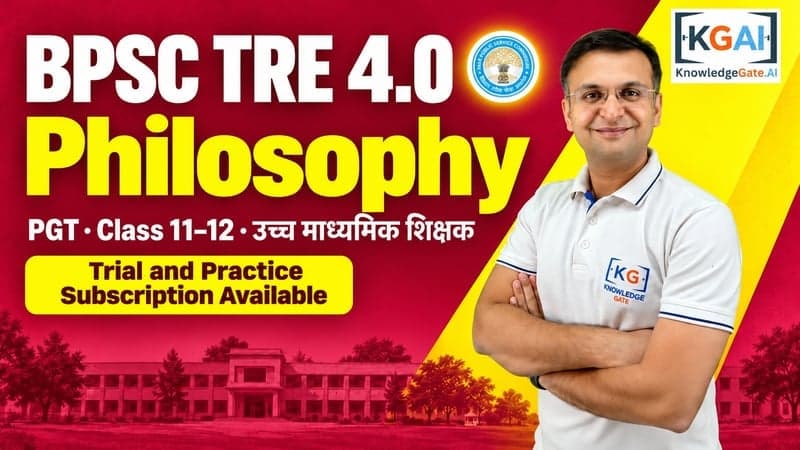
BPSC TRE 4.0 PGT Philosophy (कक्षा 11–12)
दर्शनशास्त्र / Philosophy — Complete Course
Need help choosing this course?
Our counsellor will help with pricing, syllabus, and enrollment.
About BPSC TRE 4.0 PGT Philosophy (कक्षा 11–12)
BPSC TRE 4.0 PGT Philosophy 2026: 80 पद। विषय, भाषा और GS का MCQ अभ्यास। 150 प्रश्नों की तैयारी; पिछले पेपर और मॉक जल्द आ रहे हैं।
Compare BPSC TRE 4.0 PGT Philosophy (कक्षा 11–12) with all courses📌 BPSC TRE 4.0 — वरिष्ठ माध्यमिक शिक्षक (कक्षा 11–12): दर्शनशास्त्र विज्ञापन 15/2026 तथा 29 सितंबर 2026 के शुद्धिपत्र के अनुसार दर्शनशास्त्र के 80 पद । विषय की PGT स्तर की इकाइयों और साझा भाषा/सामान्य अध्ययन का टॉपिक-वार MCQ अभ्यास। 📝 पेपर ढाँचा 150 MCQ, 150 अंक; 2 घंटे 30 मिनट : भाषा 30 + सामान्य अध्ययन 40 + विषय 80। भाषा qualifying: अनिवार्य English 8 + हिंदी/उर्दू/बांग्ला में से एक भाषा 22 ; न्यूनतम 30% (9/30) । मेरिट: GS + विषय, 120 अंक । सही उत्तर +1 , गलत या पूरी तरह खाली उत्तर −⅓ ; प्रश्न छोड़ने के लिए विकल्प E । 📘 अभ्यास की इकाइयाँ दर्शन का स्वरूप, शाखाएँ एवं विधियाँ; तर्कशास्त्र, अनुमान एवं तर्कदोष; भारतीय दर्शन: बौद्ध, जैन, चार्वाक एवं षड्दर्शन; आधुनिक भारतीय दर्शन; प्राचीन एवं मध्यकालीन पाश्चात्य दर्शन; आधुनिक पाश्चात्य दर्शन; ज्ञानमीमांसा, आत्मा एवं तत्त्वमीमांसा; नीतिशास्त्र, मूल्य एवं धर्म दर्शन। भाषा में व्याकरण, शब्दावली और बोध; GS में सामान्य विज्ञान, GK-समसामयिकी, बिहार विशेष और गणित-तर्क। पूर्ण पिछले वर्ष के पेपर और मॉक टेस्ट — जल्द आ रहे हैं । English: PGT Philosophy, Classes 11–12: 80 posts under Advt 15/2026 and the 29 September corrigendum. Unit-wise subject, Language and GS MCQ practice; full previous-paper tests and mocks coming soon. 💳 Plans Trial Course: 5 PYQs and 5 practice questions daily, one Question Battle daily and one mock test. Practice Course: Unlimited PYQs and Practice questions. Unlimited Question Battles, all mock tests, Progress Monitor, Leaderboard and Course Captains.
Select your plan
Choose trial access or unlock unlimited practice
| Included features | Trial Course | Practice Course |
|---|---|---|
| PYQs | 5 per day | Unlimited |
| Practice questions | 5 per day | Unlimited |
| Question Battles | 1 per day | Unlimited |
| Mock tests | Up to 1 test | All tests |
| Progress Monitor | No | Yes |
| Leaderboard | No | Yes |
| Syllabus Hotspots | Yes | Yes |
| Goal Slider | Yes | Yes |
| Course Captains | No | Yes |
| Price | ₹0 | ₹9950% OFF |
What you get
- Validity
- Until 30 Jun 2027
Course Curriculum
Section 1 | भाषा (हिंदी) / Language (Hindi)
- भाषा, लिपि और वर्ण
- वर्तनी, वर्ण-विन्यास, अनुस्वार, अनुनासिक, चंद्रबिंदु और ‘र’ के रूप
- संज्ञा और सर्वनाम
- पद-भेद और रूप-विकार
- लिंग, वचन, पुरुष और कारक
- काल, वाच्य, वाक्य और वाक्य-भेद
- संधि
- समास
- पर्यायवाची शब्द
- सामान्य अशुद्धियाँ
- शब्द-भंडार
- अपठित बोध
- संज्ञानात्मक और रचनावादी अधिगम
- वर्णमाला
- शब्द-विचार और शब्द-रचना
- वाक्य-विचार
- काव्यशास्त्र
- आधुनिक हिंदी कविता
Section 1 | Language (English)
- Vocabulary
- Noun
- Subject Verb Agreement (Verb Noun Agreement)
- Adjectives
- Verbs and Tenses
- Pronoun
- Verb
- Adverb
- Prepositions and Conjunctions
- Parts of Speech
- Determiner
- Conjunction
- Modals
- Transformation of Sentences
- Direct and Indirect Speech
- Sentence Correction (Error Correction)
- Sentence Completion (Fill in the blanks)
- Sentence Construction
- Sentence Structure and Common Errors
- Reading Comprehension
- Cloze Test (Cloze Passage)
- Phonetics and Linguistics
Section 1 | বাংলা ভাষা / Language (Bengali) — 22 Questions (Fixed)
- শব্দার্থ, বাগধারা ও ভাষাশুদ্ধি
- বাক্য ও বাচ্য
- শব্দগঠন ও শব্দভান্ডার
- অনুবাদ, বোধপরীক্ষণ ও রচনা
- ধ্বনি, ধ্বনিপরিবর্তন ও সন্ধি
- পদপ্রকরণ
- কারক ও বিভক্তি
- সমাস
- বাংলা ভাষার ইতিহাস ও উপভাষা
- আধুনিক বাংলা কবিতা
- বাংলা কথাসাহিত্য
- বাংলা গদ্য, প্রবন্ধ ও নাটক
Section 2 | Primary Maths & Reasoning / प्राथमिक गणित एवं तर्कशक्ति
- Ratio and Proportion
- Divisibility Rules
- Mixture and Alligation
- Permutation and Combination
- Percentage
- Number System
- HCF and LCM
- अनुक्रम, श्रेणी और संयोजन
- Simplification, Indices and Surds
- Algebra
- Probability
- Profit, Loss and Discount
- Simple and Compound Interest
- Average
- Time and Work
- Time, Speed and Distance
- Solid Mensuration
- Age Problems
- Arithmetic
- Mathematical Operations and Missing Numbers
- Series / श्रेणी
- Coding-Decoding / कूट लेखन एवं कूट वाचन
- Syllogisms
- Blood Relations
- Direction and Distance
- Venn Diagrams, Syllogism and Inequalities
- Analogy and Classification
- Order and Ranking
- Non-Verbal Reasoning
- Trigonometry
- Seating Arrangement and Puzzles
- Analytical Reasoning (Counting Figures Reasoning)
- Calendar and Clock
- Clock
- Cubes, Dice and Figure Counting
- Inequality
- Polynomials, Equations and Complex Numbers
- वास्तविक और सम्मिश्र विश्लेषण
- Alphabet and Number Test
- Data Sufficiency and Decision Making
- Data Interpretation
- Trigonometry
- Plane Mensuration
Section 2 | General Awareness (GK + Current Affairs) / सामान्य जागरूकता (GK + समसामयिकी)
- भारतीय संविधान
- Scientific Achievements and Research
- कोशिका: संरचना एवं कार्य
- State-Specific General Knowledge
- ऊष्मागतिकी एवं साम्यावस्था
- भारतीय राष्ट्रीय आंदोलन एवं स्वतंत्र भारत
- भारत का भौतिक पर्यावरण
- भारतीय अर्थव्यवस्था
- Environment
- Current Affairs
- खेल एवं क्रीड़ाएँ
- Teaching Aids and Educational Technology
- Assessment and Evaluation
- Geography as a Discipline and Geographical Thought
- Atmosphere and Climate
- जैवमंडल, मृदा एवं पर्यावरण
- Natural Hazards and Disasters
- जनसंख्या, मानव विकास एवं सांस्कृतिक भूगोल
- Human Settlements
- संसाधन, कृषि, खनिज एवं ऊर्जा
- Consumer Behaviour and Demand
- National Income Accounting
- मुद्रा एवं बैंकिंग
- Public Finance and Government Budget
- Periodic Classification and Chemical Bonding
- d- and f-Block Elements and Coordination Compounds
- Organic Chemistry: Basic Principles and Isomerism
- Organic Compounds Containing Oxygen and Nitrogen
- Biomolecules, Polymers and Everyday Chemistry
- Mechanical Properties of Matter
- संघ सरकार
- Public Administration and Governance
- Evolution
- Biotechnology
- पारिस्थितिकी एवं पर्यावरण
- भक्ति एवं सूफी आंदोलन
- Mughal Empire and the Marathas
- Society, Community and Social Groups
- Culture, Socialisation and Social Control
- Agronomy and Farming Systems
- Fruit Science and Orchard Management
- Plant Protection
- Indian Mural Painting
- Books and Publications
- Awards and Personalities
- Defence and Security Awareness
- राष्ट्रीय पहचान और महत्वपूर्ण दिवस
Section 3 | Nature, Branches & Methods of Philosophy / दर्शन का स्वरूप, शाखाएँ एवं विधियाँ
- Foundations of Indian Philosophy
- General Concepts of Philosophy
Section 3 | Logic, Inference & Fallacies / तर्कशास्त्र, अनुमान एवं तर्कदोष
- Logic
- Nyaya-Vaisheshika Philosophy
Section 3 | Indian Philosophy: Buddhist, Jain, Materialist & Classical Schools
- Charvaka, Jaina and Buddhist Philosophy
- Nyaya-Vaisheshika Philosophy
- Samkhya-Yoga Philosophy
- Mimamsa and Vedanta Philosophy
Section 3 | Modern Indian Philosophy / आधुनिक भारतीय दर्शन
- Contemporary Indian Philosophy
Section 3 | Ancient & Medieval Western Philosophy / प्राचीन एवं मध्यकालीन पाश्चात्य दर्शन
- Ancient Greek Philosophy
- Philosophy of Religion
Section 3 | Modern Western Philosophy / आधुनिक पाश्चात्य दर्शन
- Modern Western Philosophy: Descartes to Hume
- Kant and Later Western Philosophy
Section 3 | Epistemology, Self & Metaphysics / ज्ञानमीमांसा, आत्मा एवं तत्त्वमीमांसा
- General Concepts of Philosophy
Section 3 | Ethics, Values & Philosophy of Religion / नीतिशास्त्र, मूल्य एवं धर्म दर्शन
- Ethics
- Philosophy of Religion
- भारतीय नीतिशास्त्र
- Social and Political Philosophy
Instructors
Sanchit Jain
Latest from the Blog
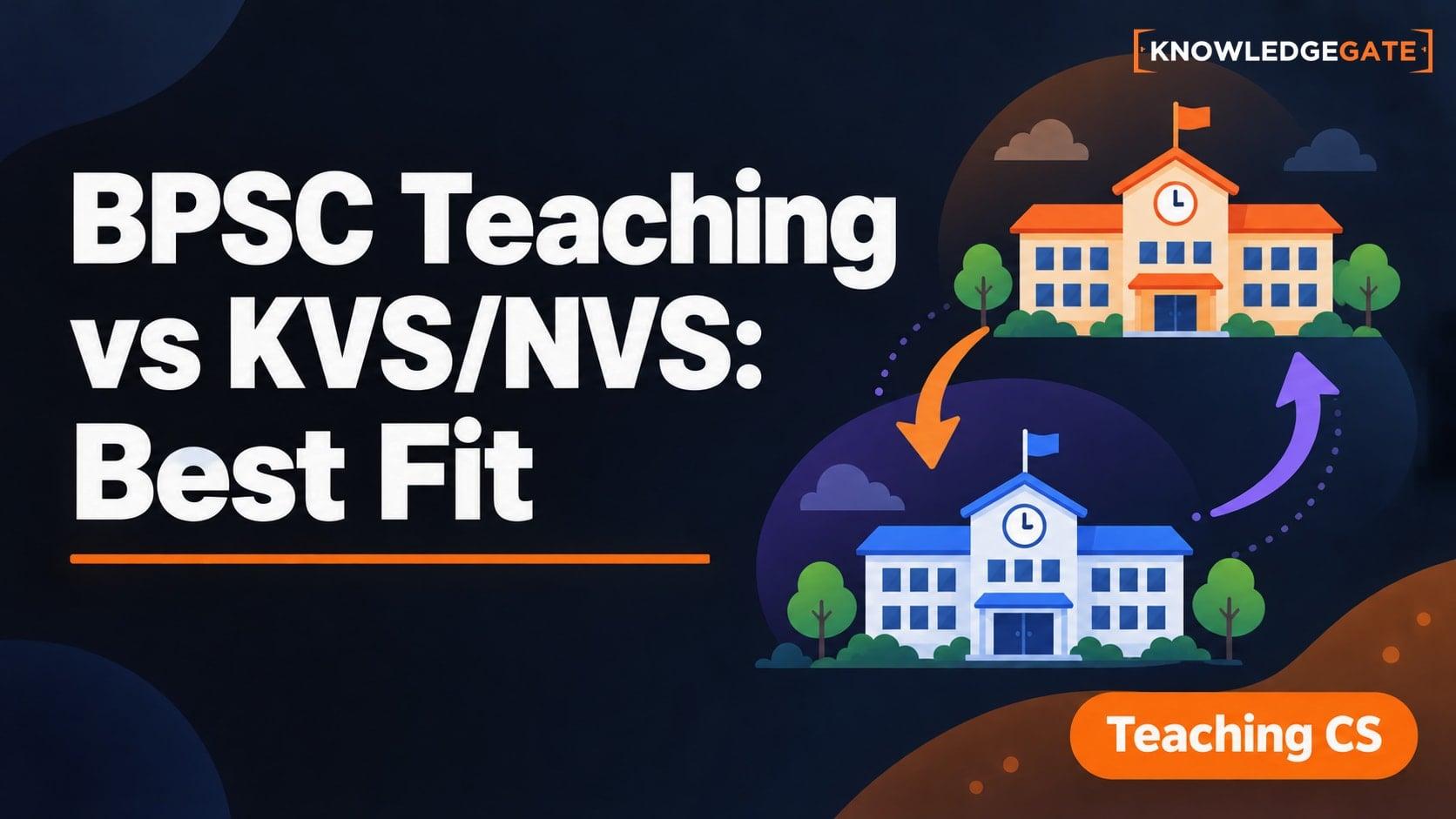
BPSC Teaching vs KVS/NVS: Bihar Posting, Transfers and Best Fit
Choose by document fit, mobility and work context, not by the recruiting body's name. Compare the Bihar state cadre against central-school postings and score the routes against your own constraints.
Updated 29 Oct 20266 min readBPSC Teaching
BPSC Teaching Eligibility and Exam Structure: A Post-by-Post Notification Check
Build a post-specific BPSC teaching eligibility matrix, test your documents against official wording, and separate notified rules from study planning.
Updated 30 Oct 20266 min readBPSC Teaching
Frequently Asked Questions
BPSC TRE is Bihar's phased teacher recruitment examination, conducted in successive rounds for various teaching posts, including Computer Science. TRE 4.0 refers to a specific recruitment phase; each phase is its own exam cycle, so the KnowledgeGate BPSC TRE 4.0 course is built specifically around the requirements of this phase.
The BPSC TRE 4.0 course is a structured and exam-focused preparation course designed for aspirants aiming to secure teaching posts in Bihar government schools, covering the relevant Computer Science syllabus for this recruitment phase in a systematic order. It is paired with the BPSC TRE 4.0 Test Series, so learners can move from working through the syllabus to practicing under conditions closer to the actual exam.
Yes, KnowledgeGate offers the BPSC TRE 4.0 Test Series, a structured and exam-focused practice programme designed for aspirants preparing for the BPSC TRE 4.0 recruitment, meant to be used alongside or after the main course. Working through the course first and then the test series is a reasonable way to move from covering the Computer Science syllabus for this phase to practicing under exam-like conditions.
The BPSC TRE 4.0 course is a recorded, structured programme, which means it can generally be studied at your own pace. This makes it workable for candidates who are already teaching or working and preparing for TRE 4.0 alongside their existing commitments.
A common approach is to go through the BPSC TRE 4.0 course to build up the Computer Science syllabus for this recruitment phase, then use the BPSC TRE 4.0 Test Series to practice and gauge your preparation closer to the exam.
KnowledgeGate offers dedicated Computer Science preparation courses and test series for several state and central teaching recruitments, including DSSSB, TPSC, RSSB, UPPSC, UP LT, MPPSC, KVS, NVS, EMRS, BPSC, and HPSC. Each exam has its own course built around that board's specific syllabus and pattern. Since every recruiting body sets its own eligibility and exam structure, it is best to open the specific exam page for the recruitment you are preparing for rather than relying on one general computer science course.
The courses under this category are structured around each exam's syllabus, so they work both for candidates preparing full-time and for those already teaching or working who are studying alongside their job. Recorded, structured content lets you go through the syllabus at your own pace, and where a test series is included, you can use it to check your preparation whenever it suits your schedule.
For the exams that have dedicated courses on KnowledgeGate — DSSSB, TPSC, RSSB, UPPSC, UP LT, MPPSC, BPSC, and HPSC — the courses are structured around that exam's computer science syllabus, and most are paired with a separate test series for practice. What exactly is included can vary by exam, so check the individual exam page for the specific course and test series available for that recruitment.
The course is structured as a syllabus-based preparation programme that can be worked through at your own pace via recorded content. This makes it usable both for candidates preparing full-time for UPPSC Polytechnic Lecturer recruitment and for those currently working who are studying alongside their job.
The course for either level is meant to build up the syllabus in a structured way first; the corresponding test series (BCI or SCI) is then meant for practicing under exam conditions once you have gone through the relevant topics. Using both together is how the two are designed to complement each other.
What Our Students Say
Real results, in our students' own words.