

Minimal Cover (Canonical Cover) MCQs: 10 Solved DBMS Questions
Solve 10 minimal and canonical cover questions step by step, including MCQs, an MSQ and a NAT on decomposition, redundancy and irreducible FD sets.
KnowledgeGate Team
Exam prep & CS education
Updated 2 Nov 20267 min read78 views
Equivalent sets of functional dependencies are not necessarily minimal. Most mistakes come from skipping one of three separate tests: split the right side, remove an extraneous left-side attribute, then remove a redundant dependency. Work through 10 solved questions: eight MCQs, one MSQ and one NAT. Attempt each item and write the relevant closure before reading its explanation. The companion post Functional Dependencies and Armstrong's Axioms MCQs explains definitions, inference rules, and closure implications. Here, the focus is reducing dependency sets to minimal covers. Use the Minimal Cover (Canonical Cover) PYQ Questions lesson for further practice on Questions 1, 3, 4, 5, 9 and 10. It contains over 10 questions on minimal and canonical cover, while Questions 2, 6, 7 and 8 come from the cited exams.
1. Minimal cover algorithm: the three tests before the MCQs
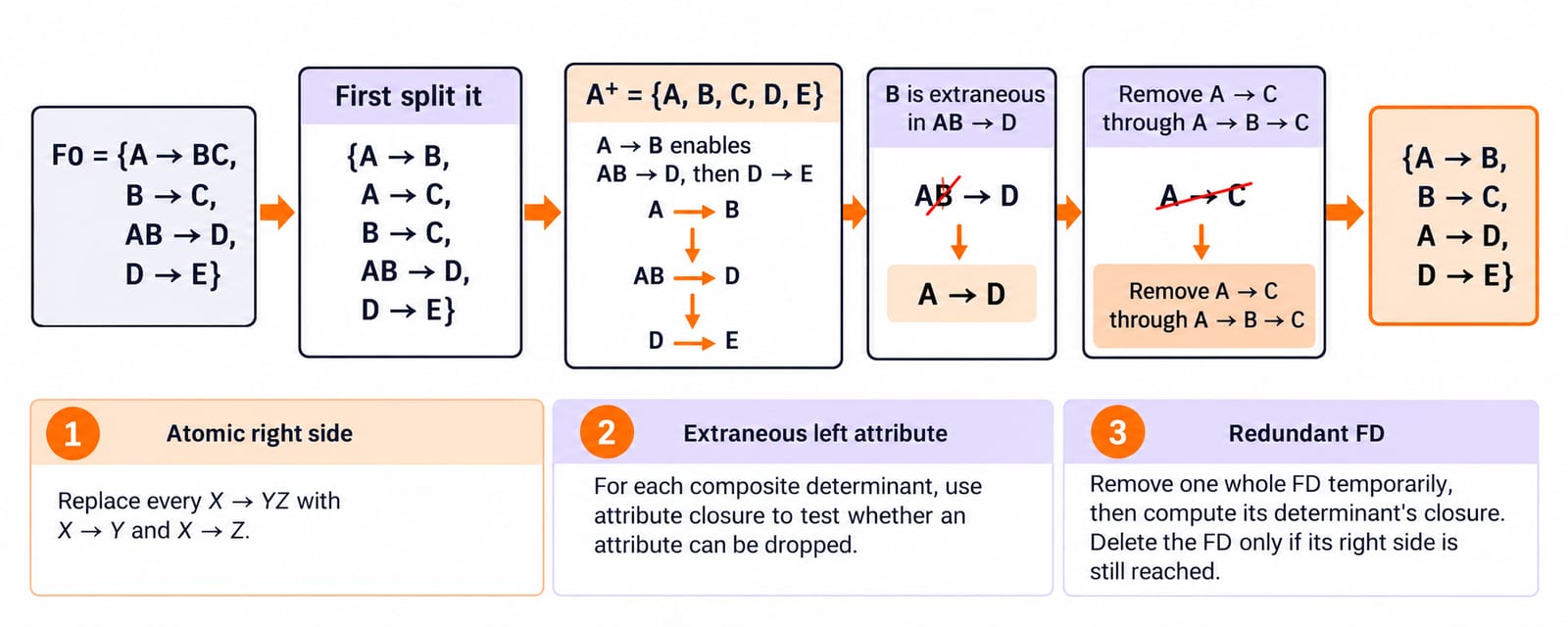
Test | What to do |
|---|---|
Atomic right side | Replace every |
Extraneous left attribute | For each composite determinant, use attribute closure to test whether an attribute can be dropped. |
Redundant FD | Remove one whole FD temporarily, then compute its determinant's closure. Delete the FD only if its right side is still reached. |
Keep right sides atomic while calculating. Union same-left dependencies only for final display.
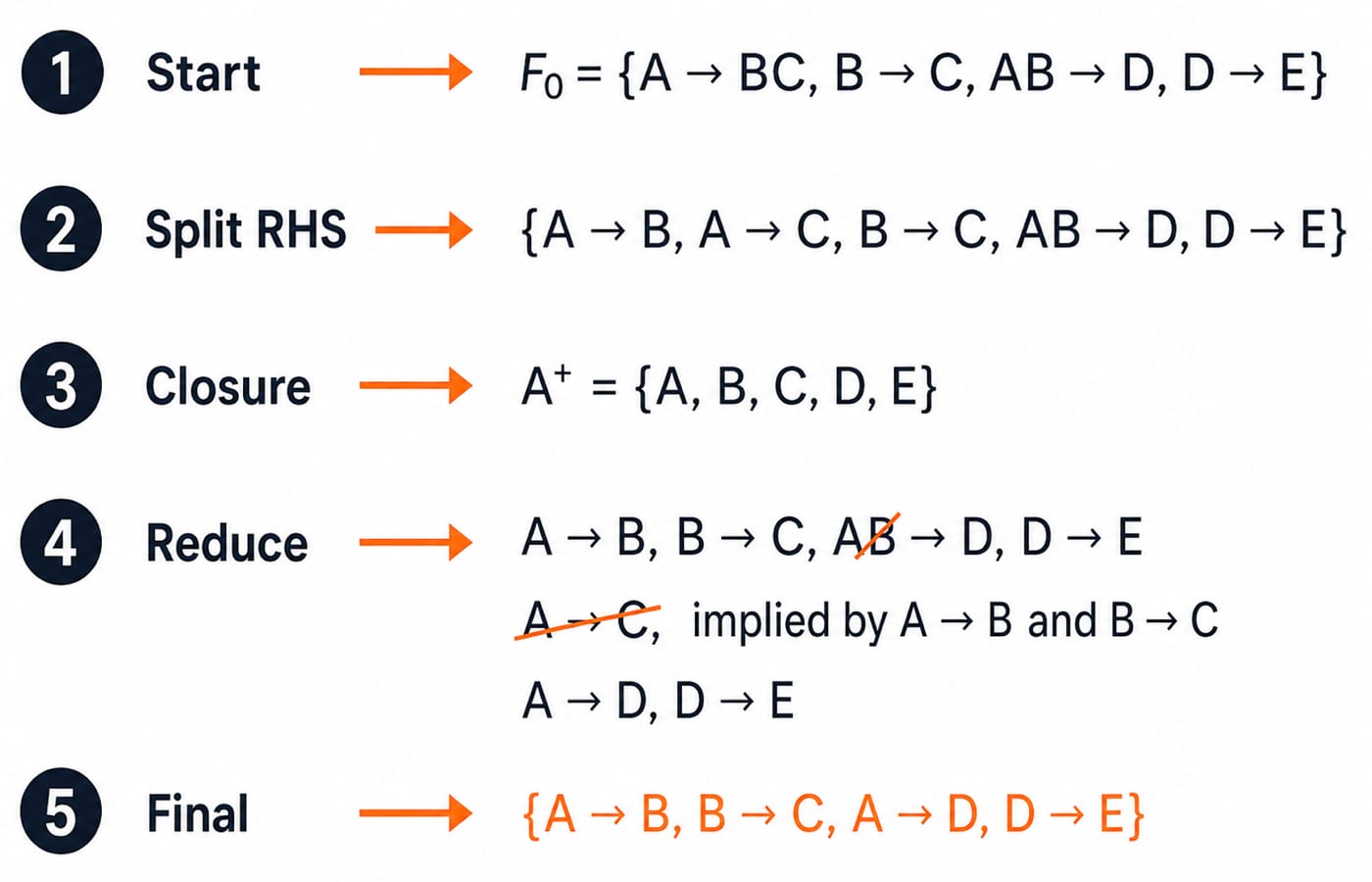
Calibrate with F0 = {A → BC, B → C, AB → D, D → E}. First split it:
{A → B, A → C, B → C, AB → D, D → E}
Here A+ = {A, B, C, D, E}: A → B enables AB → D, then D → E. Thus B is extraneous in AB → D, giving A → D. Remove A → C through A → B → C. The result is {A → B, B → C, A → D, D → E}. Without any remaining FD, its determinant cannot reach its right side.
2. Minimal cover MCQs 1-2: decomposition and redundant dependencies
Question 1
Consider a relation X(PQR) with the set of FD's [P→QR, Q→R, P→Q, PQ→R]
What is number of FD present in minimal [canonical] cover?
(a) 1
(b) 2
(c) 3
(d) 4
Answer: (b) 2.
Split P→QR. Remove P→R through P→Q→R, and remove PQ→R through Q→R. The cover {P→Q, Q→R} has two FDs.
Question 2
Consider the following set of functional dependencies on the schema (A, B, C). A → BC, B → C, A → B, AB → C. Then the canonical cover for this set is -
(UPPSC Polytechnic Lecturer 2021)
(a) A → BC and B → C
(b) A → BC and A → B
(c) A → BC and AB → C
(d) A → B and B → C
Answer: (d) A → B and B → C.
Split A→BC. The FD AB→C is redundant through B→C; A→C is redundant through A→B→C. The two stated FDs remain.
3. Minimal cover MCQs 3-4: essential FDs and extraneous left-side attributes
Question 3
In the following relation R(ABCDEF) which of the following FD must be present in the minimal cover?
{A->BCDEF, BC->ADEF, B->F, D->E, A->D}
(a) A->B
(b) A->F
(c) A->D
(d) D->F
Answer: (a) A->B.
After splitting, A→B is essential because A+ cannot otherwise acquire B. The paths A→B→F and A→BC→D make A→F and A→D removable. The original set does not imply D→F. One cover is {A→B, A→C, BC→A, BC→D, B→F, D→E}.
Question 4
Consider the relation R(A, B, D) that satisfies the following FDs:
B→A
D→A
AB→D
What is the canonical cover for the FD set?
(a) B→A, D→A, B→D
(b) B→D, D→A
(c) B→A, B→D
(d) none of the above
Answer: (b) B→D, D→A.
The closure B+ gains A, activating AB→D; therefore A is extraneous and the FD becomes B→D. Now B→A is redundant through B→D→A, leaving the two necessary FDs in option (b).
4. Canonical cover MCQs 5-6: complete reduction chains
Question 5
Consider the following relation R(A, B, C, D, E, F, G) and set of functional dependencies.
F = {BCD → A, BC → E, A → F, F → G, C → D, A → G}
Which of the following is the minimal cover of F?
(a) {BC → A, BC → E, A → F, C → D, A → G}
(b) {BC → A, B → E, A → F, F → G, C → D}
(c) {BC → A, BC → E, A → F, F → G, C → D}
(d) {BC → A, BC → E, A → F, C → D}
Answer: (c) {BC → A, BC → E, A → F, F → G, C → D}.
Since C→D, BC+ activates BCD→A, reducing it to BC→A. Remove A→G through A→F→G. Keep F→G because F+ otherwise misses G.
Question 6
An organization needs to maintain database having five attributes
A, B, C, D, E
. These attributes are functionally dependent on each other for which functionality dependency set
F
is given as:
F:{A→BC,D→E,BC→D,A→D}
. Consider a universal relation
R(A, B, C, D, E)
with functional dependency set
F
. Also all attributes are simple and take atomic values only.
MInimal cover
F′
of functional dependency set
F
is
(a) F′={A→B,A→C,BC→D,D→E}
(b) F′={A→BC,B→D,D→E}
(c) F′={A→B,A→C,A→D,D→E}
(d) F′={A→B,A→C,B→D,C→D,D→E}
Answer: (a) F′={A→B,A→C,BC→D,D→E}.
Split A→BC. Neither B nor C is extraneous in BC→D. The FD A→D is redundant because A reaches both B and C, then D; D→E stays essential.
5. Minimal cover MCQs 7-8: irreducible equivalents and reduced determinants
Question 7
The following functional dependencies hold true for the relational schema {V, W, X, Y, Z}:
V → W
VW → X
Y → VX
Y → Z
Which of the following is irreducible equivalent for this set of functional dependencies?
(a) V → W; V → X; Y → V; Y → Z
(b) V → W; W → X; Y → V; Y → Z
(c) V → W; V → X; Y → V; Y → X; Y → Z
(d) V → W; W → X; Y → V; Y → X; Y → Z
Answer: (a) V → W; V → X; Y → V; Y → Z.
Split Y→VX. Since V→W, reduce VW→X to V→X. Then Y→X is redundant through Y→V→X. The original set does not imply the other options' W→X.
Question 8
Let R (ABCDEFGH) be a relation schema and F be the set of dependencies F = {A→B,ABCD→E,EF→G,EF→H and ACDF→EG}. The minimal cover of a set of functional dependencies is
(a) A→B,ACD→E,EF→G, and EF→H
(b) A→B,ACD→E,EF→G,EF→H and ACDF→G
(c) A→B,ACD→E,EF→G,EF→H and ACDF→E
(d) A→B,ABCD→E,EF→H and EF→G
Answer: (a) A→B, ACD→E, EF→G, EF→H.
Split ACDF→EG. Since A→B, reduce ABCD→E to ACD→E. Now ACDF→E follows by augmentation, and ACDF→G follows through ACD→E and EF→G. Remove both.
A trustworthy minimal cover matters before dependency-preservation or normal-form work. Normalization in DBMS: 1NF to BCNF Rules, Worked Example shows the next use of the reduced set.
6. Minimal cover MSQ and NAT 9-10: representation and non-uniqueness
Question 9
Which of the following FDs belong to minimal cover of the FD set {A->BC, CD->E, E->C, D->AEH, ABH->BD, DH-> BC}?
(a) A->BC
(b) E->C
(c) D->AEH
(d) AH->D
The options use unioned display notation, but the calculation must begin with atomic right sides.
Answer: (a), (b), (c) and (d).
A minimal atomic set is {A→B, A→C, E→C, D→A, D→E, D→H, AH→D}. The FD CD→E follows from D→E; ABH→D reduces to AH→D through A→B; both DH dependencies follow through D→A→BC. Unioning gives {A→BC, E→C, D→AEH, AH→D}, so all four belong.
Question 10
Consider a relation R(P,Q,R,S,T,U,V) with the set of following functional dependencies: {PR→V, S→TV, QR→S, RV→QS, PRS→Q, RT→PV}
The number of different minimal covers possible are _________
This is a numerical-answer question, so there are no options.
Answer: 4.
Atomize S→TV, RV→QS and RT→PV. The four irreducible covers are:
Cover | Irreducible atomic set | How the omitted FDs return |
|---|---|---|
1 |
|
|
2 |
|
|
3 |
|
|
4 |
|
|
Each row derives every omitted original FD. Removing any retained FD breaks a required derivation, so all four rows are irreducible. The answer is 4.
7. Minimal cover exam traps and the next revision step
Trap | Fix |
|---|---|
Composite right side | Split first. |
Attribute dropped without proof | Show its closure. |
FD retained during its redundancy test | Remove it temporarily. |
Equivalent mistaken for minimal | Run all three tests. |
Minimal cover assumed unique | Recall Question 10. |
Grouped confused with atomic notation | Atomize, minimise, then union. |
Questions 1-2 test decomposition and redundancy, 3-4 necessity and extraneous attributes, 5-8 full reductions, and 9-10 notation and non-uniqueness. Redo only the missed group.
For a wider gap, use the Database Management System course. If only this topic is weak, return to the lesson hub and write each closure.
The short version: atomize first, prove each left-side reduction with closure, and test every full FD only after temporarily removing it.
Keep learning

Relational Model and Functional Dependencies in DBMS: Keys, Closure and Minimal Cover
Build keys, closures and a minimal cover from one seven-attribute enrolment relation. Then use the same dependencies to explain redundancy and decomposition.
Updated 30 Oct 20265 min read60 viewsDBMS

Concurrency Control MCQs: 10 Solved DBMS Questions with Explanations
Test each option before reading the answer. These 10 DBMS questions build from conflict rules and anomalies to serializability, locks, and deadlock freedom.
Updated 29 Oct 20267 min read65 viewsDBMS MCQs

DBMS Concurrency Problems MCQs: 10 Solved Questions with Explanations
Ten DBMS concurrency questions with worked values, operation orders, lock rules and concise explanations.
Updated 29 Oct 20268 min readDBMS MCQs
Graph Covering: Line and Vertex Covers, Independent Sets, Minimal vs Minimum, Maximal vs Maximum
Carry one six-vertex path through vertex covers, independent sets, edge covers and matchings. Exact witnesses show why local irreducibility is not global optimality.
Updated 3 Nov 20266 min readEngineering Mathematics