Backtracking Technique MCQs: Solved PYQs on N-Queens, Hamiltonian Cycle and Subset Sum
Attempt seven previous-year Backtracking Technique MCQs before checking the solutions. Then revise five descriptive questions with compact model-answer frameworks.
KnowledgeGate Team
Exam prep & CS education
Updated 22 Jul 20268 min read
Backtracking is a scoring, low-effort topic when you are preparing computer science for a teaching-recruitment or state PSC exam such as DSSSB, UPPSC, RSSB, TPSC, BPSC or STET. Examiners repeatedly return to the same ideas: the definition, classic applications, N-Queens facts and Hamiltonian cycles. Seven previous-year MCQs, each carrying the exam and year it was asked in, work through exactly those ideas, and five long-form prompts extend them into descriptive papers. Attempt each MCQ before reading its answer.
1. What backtracking actually is: three classification MCQs
Backtracking builds a solution one decision at a time. It tests whether the current partial solution is feasible and undoes the latest decision when a constraint fails. These three questions check whether you can separate that process from divide and conquer.
Q1. Which of the following is a feature of the Backtracking algorithm? (TPSC Programmer 2025)
(a) It always finds the optimal solution
(b) It builds a solution incrementally and removes those solutions that are not feasible
(c) It requires sorting to find the solution
(d) It is used for divide-and-conquer strategies
Answer: (b). Incremental candidate construction followed by abandoning infeasible partial solutions is the definition of backtracking. The method can find a valid solution when one exists, but it does not automatically guarantee the optimal solution. Sorting is not required, and divide and conquer is a different algorithmic paradigm.
Q2. Which of the following is not a backtracking algorithm? (RSSB 2018)
(a) Knight tour problem
(b) N-queen problem
(c) Towers of Hanoi
(d) M-coloring problem
Answer: (c). Towers of Hanoi uses recursion with a fixed sequence of moves. It does not try a candidate, discover a dead end and undo the choice. Knight tour, N-queen and M-coloring all explore choices and backtrack when a choice cannot lead to a solution. Practise it again in the RSSB 2018 question inside the Backtracking module.
Q3. Which of the following algorithm does not use divide and conquer strategy? (UPPSC Polytechnic Lecturer 2022)
(a) Merge sort
(b) Quick sort
(c) Binary sort and Stressian Multiplication
(d) Travelling Salesperson Problem (TSP)
Answer: (d). Merge sort, quick sort and the pair in option (c), read as binary search and Strassen multiplication, divide a problem into smaller independent parts. TSP has overlapping subproblems and is commonly approached using dynamic programming or backtracking. Option (c) carries the paper's own spelling. Work through the UPPSC 2022 question inside the Backtracking module.
2. DFS: the traversal engine behind backtracking
Backtracking is depth-first search over a state-space tree. It follows one branch until that branch succeeds or becomes impossible, then returns to the latest choice point.
Q4. Which of the following best describes the working mechanism of the Depth First Search (DFS) algorithm in graph traversal? (Beltron Programmer 2025, Shift 1)
(a) DFS follows a level-by-level approach using a queue.
(b) DFS visits all vertices at the same level before going deeper.
(c) DFS always identifies the shortest path first.
(d) DFS explores as far as possible along each branch before backtracking.
Answer: (d). A stack, either explicit or supplied by recursion, drives DFS. The level-by-level statements describe breadth-first search. BFS finds shortest paths in unweighted graphs, while DFS does not promise that result. That last option states the control loop exactly: go as deep as the branch allows, then step back one choice and try the next. N-Queens, graph coloring and Hamiltonian cycle search all run on it.
3. N-Queens: the poster problem
N-Queens supplies recycled backtracking facts: the puzzle's first solver, small-board solution counts and the safety test. That test is one line. A queen may go at (row, col) only if no earlier queen holds that column, and no earlier queen has the same row minus column or the same row plus column, which is how both diagonals are ruled out in a single comparison.
Q5. Who published the first solution of the eight queens puzzle? (BPSC 2024)
(a) Franz Nauck
(b) Max Bezzel
(c) Friedrich
(d) More than one of the above
(e) None of the above
Answer: (a). Max Bezzel posed the puzzle in 1848. Franz Nauck published the first complete solution set in 1850. The trap is the difference between posing the puzzle and first solving it. Attempt the BPSC 2024 question inside the Backtracking module.
Q6. Which of the following statements is correct about n-queen problem? (DSSSB 2022)
(a) 3-queen problem has 1 solution.
(b) 4-queen problem has 3 solutions.
(c) 5-queen problem has 2 solutions.
(d) 6-queen problem has 4 solutions.
Answer: (d). The actual counts are 0 solutions for n = 3, 2 for n = 4, 10 for n = 5 and 4 for n = 6. Only option (d) matches. The memorable feature is the drop from 10 solutions at n = 5 to 4 at n = 6. Drill the counts against the DSSSB 2022 question inside the Backtracking module.
4. Hamiltonian cycle by backtracking
A Hamiltonian cycle passes through every vertex exactly once and closes back on its starting vertex. Do not confuse it with an Euler cycle, which must instead use every edge exactly once. No efficient test for the existence of a Hamiltonian cycle is known, which is why backtracking is the standard approach taught for it.
Q7. What is the primary goal of the Backtracking approach in solving the Hamiltonian Cycle problem? (Bihar STET 2025)
(a) To find a cycle with the fewest edges
(b) To find a cycle with the lowest weight
(c) To find a cycle that visits every vertex exactly once
(d) To find a cycle with the maximum number of edges
Answer: (c). A Hamiltonian cycle visits every vertex exactly once and returns to the starting vertex. Lowest-weight language belongs to TSP variants, while the edge-count options do not define this problem. The algorithm extends a path by one adjacent, unvisited vertex at a time. It backtracks when no extension is possible and checks for a closing edge to the start after all vertices are present.
5. The long-form five: descriptive backtracking questions
Descriptive papers ask for the same five things in slightly different words. Each skeleton below is the shape of a full-marks answer: definition, method, a worked example, then applications and limits. Use it to organise a response quickly.
L1. "What is Backtracking? Explain the concept of Backtracking and its applications with suitable examples."
Define backtracking as incremental solution construction with an undo step whenever a constraint makes the partial answer infeasible. Applications include N-Queens, Sudoku solving, maze solving, permutations and combinations, and graph coloring. Its advantage is early pruning of invalid paths. Its limitation is potentially exponential running time for large inputs.
L2. "Explain the N-Queen Problem using the Backtracking technique. Discuss its algorithm, working principle, applications, advantages, and limitations with a suitable example."
Place one queen in each row. A position is safe only if no earlier queen shares its column or either diagonal. If a row has no safe column, return to the previous row and move that queen. For the 4-Queen board, one valid placement is (row 1, col 2), (row 2, col 4), (row 3, col 1), (row 4, col 3), written as (2, 4, 1, 3). Its mirror, (3, 1, 4, 2), is the only other solution, so n = 4 has exactly 2 solutions. It models constraint satisfaction and conflict-free placement. The method handles constraints cleanly, but its search can be exponential.
L3. "Explain the Hamiltonian Cycle using the Backtracking technique. Discuss its working principle, algorithm, applications, advantages, and limitations."
Build the path vertex by vertex. Add a vertex only when it is unvisited and adjacent to the previous vertex. After including every vertex, check whether the last vertex connects to the start. If a check fails, remove the latest vertex and try another. Applications include route planning, circuit design and logistics. The limitation is high time complexity on dense or large graphs.
L4. "What is Graph Coloring? Explain its types and applications."
Graph coloring assigns colors while enforcing a proper-coloring constraint. Cover vertex coloring, edge coloring and face coloring. Define the chromatic number χ(G) as the minimum number of colors needed for a proper vertex coloring, and mention the Four Color Theorem for planar graphs. Applications include timetable scheduling, compiler register allocation, map coloring and Sudoku.
L5. "What is the Sum of Subset problem? Explain with an example."
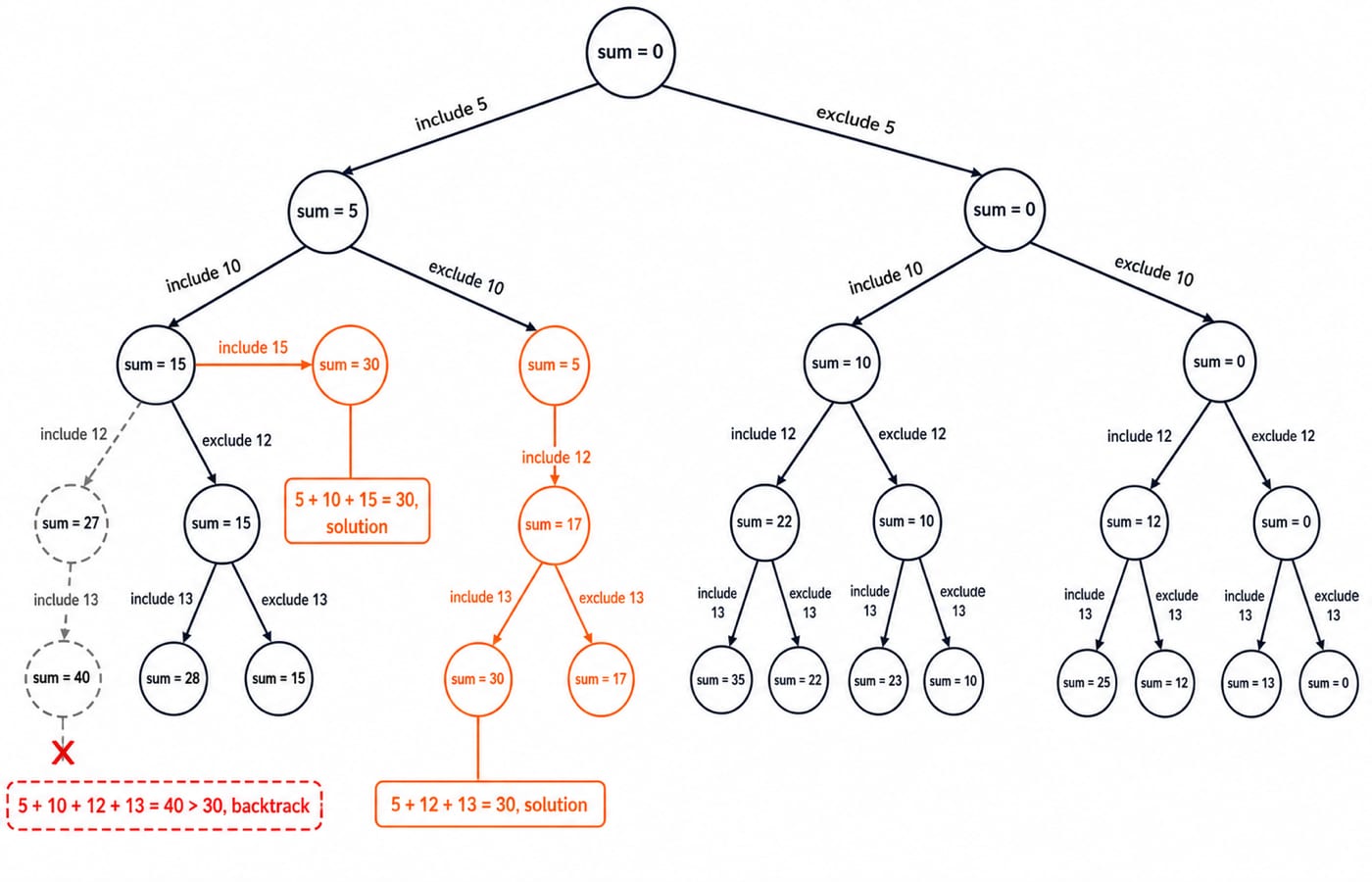
Given a set and a target, find subsets whose elements total that target. For S = {5, 10, 12, 13, 15, 18} and target 30, {5, 12, 13} works because 5 + 12 + 13 = 30. Another valid answer is {5, 10, 15}, because 5 + 10 + 15 = 30, and so is {12, 18}. Those three are the only subsets of S that total 30. During a positive-integer search, prune a branch once its partial sum exceeds 30. For example, 5 + 10 + 12 + 13 = 40, so that branch cannot return to 30.
6. How exams test the backtracking technique
The pattern across these seven is easy to state. Q1 to Q3 ask classification, Q4 asks the DFS mechanism, Q5 and Q6 test N-Queens facts, and Q7 asks the goal of a named problem. Descriptive papers return to the five broad prompts almost word for word.
Build one fact table. Put N-Queens, knight tour, M-coloring, subset sum and Hamiltonian cycle under backtracking. Put Towers of Hanoi and merge sort under not backtracking. Then connect each named problem to its feasibility check.
Marks, question counts and negative-marking rules differ across DSSSB, UPPSC, RSSB, TPSC, BPSC and STET, and they move between cycles. Take those numbers from the commission's current official notification, never from a summary.
For the wider practice method, read why PYQs beat question banks. For another solved set, continue with Binary Tree and BST MCQs.
7. The short version and the next step
Backtracking builds incrementally and undoes a choice on failure. It is DFS over a state-space tree. Towers of Hanoi is the standard not-backtracking distractor. Memorise the N-Queens counts 0, 2, 10 and 4 for n = 3, 4, 5 and 6. In positive-number subset sum, prune a branch after its sum crosses the target.
For full computer science coverage, continue inside the UP LT Grade Assistant Teacher 2025 course, which covers the Advanced Algorithms unit this topic sits in. Delhi aspirants can prepare the common section through the DSSSB Section A complete course. Use the Govt Teaching Jobs category to map the topic to the exam you are writing.
Keep learning

Computer Graphics Applications and Core Components MCQs: 12 Solved Questions with Explanations
Solve 12 published computer graphics questions, then use the explanations and worked calculations to strengthen the distinctions that make each answer clear.
17 Sep 20267 min readAlgorithms MCQs
Matrix Chain Order MCQs: 12 Solved GATE and UGC NET Questions with Explanations
Solve Matrix Chain Multiplication questions by applying one cost rule, comparing valid groupings, and filling the dynamic-programming table without arithmetic slips.
Updated 15 Sep 20267 min readAlgorithms MCQs
Substitution Method MCQs: 12 Solved GATE and ISRO Questions with Explanations
Work through 12 published GATE and ISRO PYQs on subtract-and-conquer, geometric growth, square-root recurrences, recursive code, and asymptotic matching.
Updated 14 Sep 20268 min readAlgorithms MCQs
Recursion Tree Method MCQs: 12 Solved Questions with Explanations
Solve 12 recursion tree MCQs covering exponential trees, uneven splits, harmonic level sums, square-root arguments, and exact recurrence forms.
Updated 13 Sep 20267 min readAlgorithms MCQs