Attributes and SDT Types MCQs: 12 Solved Questions with Explanations
Test attribute direction, S-attributed and L-attributed definitions, evaluation order and declaration typing across 12 solved MCQs, six of them GATE previous-year questions.
KnowledgeGate Team
Exam prep & CS education
10 Aug 20269 min read
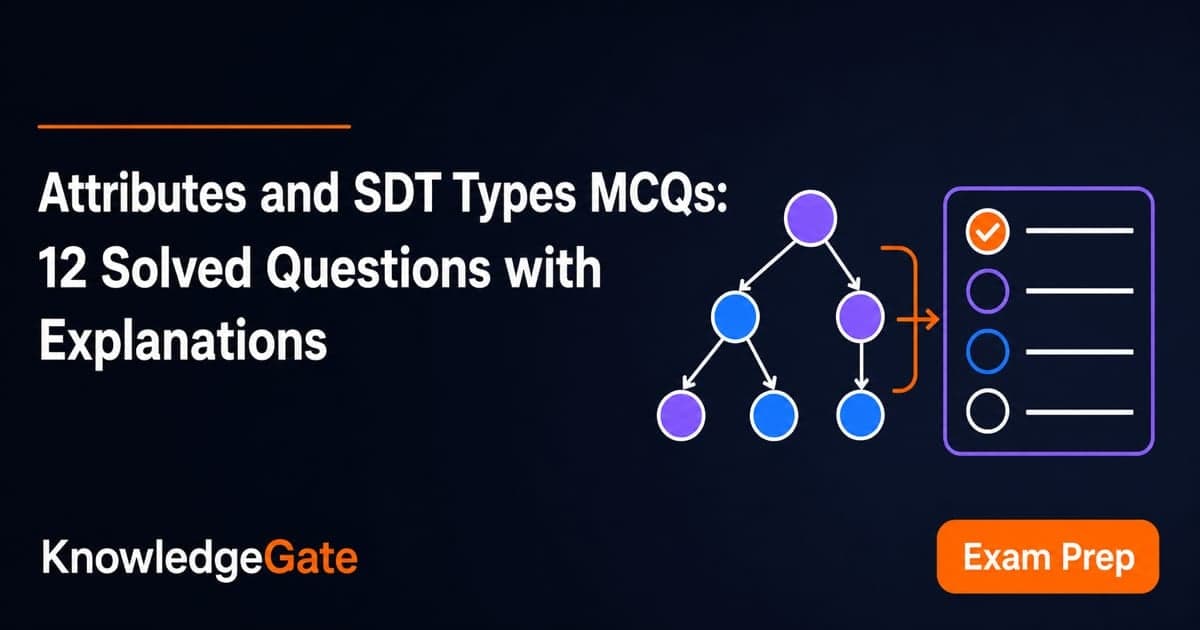
Memorising the words synthesized and inherited is not enough when a semantic rule quietly reads a right sibling. These 12 MCQs, six of them GATE previous-year questions from 2003 to 2026, all turn on one move: find the symbol being assigned, then find where its value comes from.
Attributes and SDT types: use dependency direction before attempting an MCQ
A synthesized attribute reads the node's children; an inherited attribute reads its parent or a sibling. A right-sibling read is still inherited, but the definition stops being L-attributed: a left-to-right pass cannot resolve it.
S-attributed means synthesized only. L-attributed also permits parent and left-sibling sources, so S-attributed implies L-attributed, not conversely. See Compiler Design MCQs and GATE CS Exam Preparation.
Synthesized and inherited attribute MCQs
Question 1
Consider the following statements:
S1: The value of a synthesized attribute at a node is computed from the value of the attribute at the children of that node.
S2: The value of inherited attribute at a node is computed from the value of the attribute at the children of that node.
Which of the following is true?
A. S1 is true
B. S2 is true
C. S1 is false
D. S1 and S2 are false
Answer: A.
S1 correctly defines a synthesized attribute as one computed from the children. S2 is false: an inherited attribute reads the parent or siblings, never the children. A is correct.
Question 2
Consider the SDD
P -> Q R { Q.val = R.val }
A -> * B C { A.val = B.val × C.val }
Which of the following is true?
A. Q.val is synthesized attribute and A.val is inherited attribute.
B. Q.val is synthesized attribute but A.val is not an inherited attribute.
C. Q.val is inherited attribute but A.val is not a synthesized attribute.
D. Q.val is inherited attribute and A.val is synthesized attribute.
Answer: D.
Q.val is assigned from its sibling R, so it is inherited, ruling out A and B; A.val is computed from its children, so it is synthesized. Only D fits.
Question 3
Consider the following productions with semantic actions:
S -> A + B { S.val = A.val + B.val }
A -> a { A.val = a }
B -> b { B.val = b }
Select the wrong option.
A. The given SDT has synthesized attributes.
B. The given SDT is L-attributed.
C. The given SDT can be evaluated by a bottom-up parser.
D. The given SDT has inherited attributes.
Answer: D.
Every action assigns the left-hand-side attribute from its own children or terminals, so the definition is S-attributed, hence L-attributed and bottom-up evaluable. A, B and C are true; D is the wrong statement.
S-attributed and L-attributed classification MCQs
Question 4
Consider the SDT.
S1: P -> Q + R { P.val = Q.val + R.val }
S2: P -> Q . R { P.val = Q.val * R.val and Q.val = R.val }
Which of the given option is correct w.r.t the above SDT?
A. S1 is L attributed but S2 is not L-attributed.
B. S1 is S attributed and S2 is L-attributed.
C. Both S1 and S2 are S attributed.
D. None of the above
Answer: A.
S1 computes P.val from its children, so it is S-attributed and hence L-attributed. In S2, Q.val depends on its right sibling R, so S2 is not L-attributed: exactly option A.
Question 5
Consider the following SDD:
T -> F T₁ { F.val = T₁.val }
T₂ -> * A T₃ { T₂.val = T₃.val × A.val }
Which of the following is true?
A. This SDD follows S-attributed definition.
B. This SDD follows both S-attributed as well as L-attributed definition.
C. This SDD follows L-attributed definition.
D. None of the above
Answer: D.
F.val is set from T₁, F's right sibling, so it is inherited from the right. The SDD is neither S-attributed nor L-attributed, so A, B and C all fail, leaving D.
Question 6
Consider the SDT.
S -> P Q { S.a = P.a + Q.a }
P -> Q R { Q.a = R.a }
R -> id { R.a = id }
Which of the given option is correct:
A. Given SDT is L-attributed
B. Attribute “a” is inherited only
C. Attribute “a” is synthesized only
D. None of these
Answer: D.
S.a and R.a are synthesized, but Q.a = R.a makes Q depend on its right sibling R. So a is neither synthesized-only nor inherited-only, and that dependency also breaks L-attribution, leaving D.
Evaluation order and declaration-type PYQs
Review Syntax-Directed Translation and Code Optimization before attempting these evaluation-order PYQs.
Question 7
GATE 2003
In a bottom-up evaluation of a syntax directed definition, inherited attributes can
A. always be evaluated
B. be evaluated only if the definition is L-attributed
C. be evaluated only if the definition has synthesized attributes
D. never be evaluated
Answer: B.
Reductions compute synthesized attributes naturally, but inherited attributes need parent or left-sibling values first, which a bottom-up evaluator can honour only for an L-attributed definition. A and D are false absolutes, and C names the wrong condition.
Question 8
GATE 2019
Consider the following grammar and the semantic actions to support the inherited type declaration attributes. Let X₁, X₂, X₃, X₄, X₅, and X₆ be the placeholders for the non-terminals D, T, L or L₁ in the following table:
Production rule | Semantic action |
|---|---|
|
|
|
|
|
|
|
|
|
|
Which one of the following are the appropriate choices for X₁, X₂, X₃ and X₄?
A. X₁ = L , X₂ = T, X₃ = L₁, X₄ = L
B. X₁ = T , X₂ = L, X₃ = L₁, X₄ = T
C. X₁ = L , X₂ = L, X₃ = L₁, X₄ = T
D. X₁ = T , X₂ = L, X₃ = T, X₄ = L₁
Answer: A.
In D -> T L the type flows from T into the list, so X₁ = L and X₂ = T. Down the list, X₃ = L₁ and X₄ = L copy the type along, and addType records each identifier: for float x, y both get float, option A.
Question 9
GATE 2020
Consider the productions A -> P Q and A -> X Y. Each of the five non-terminals A, P, Q, X, and Y has two attributes: s is a synthesized attribute, and i is an inherited attribute. Consider the following rules.
Rule 1 : P.i = A.i + 2, Q.i = P.i + A.i, and A.s = P.s + Q.s
Rule 2 : X.i = A.i + Y.s, and Y.i = X.s + A.i
Which one of the following is TRUE ?
A. Both Rule 1 and Rule 2 are L - attributed
B. Only Rule 1 is L - attributed
C. Only Rule 2 is L - attributed
D. Neither Rule 1 nor Rule 2 is L - attributed
Answer: B.
In Rule 1 every value flows from the parent or a left sibling. Take A.i = 4: P.i = 4 + 2 = 6, and Q.i = 6 + 4 = 10, so each input exists before it is needed. Rule 2 makes X.i depend on the right-sibling value Y.s, which a left-to-right pass cannot supply, so only Rule 1 qualifies.
Advanced attribute-grammar classification PYQs
Question 10
GATE 2024 Set 2
Which of the following statements is/are FALSE?
A. An attribute grammar is a syntax-directed definition (SDD) in which the functions in the semantic rules have no side effects
B. The attributes in a L-attributed definition cannot always be evaluated in a depth-first order
C. Synthesized attributes can be evaluated by a bottom-up parser as the input is parsed
D. All L-attributed definitions based on LR(1) grammar can be evaluated using a bottom-up parsing strategy
Answers: B and D.
A and C are true: semantic rules have no side effects, and bottom-up parsers compute synthesized attributes while parsing. B is false because an L-attributed definition always allows a left-to-right depth-first evaluation; D is false because LR(1) does not guarantee bottom-up evaluation of inherited attributes.
Question 11
GATE 2025 Set 2
Given the following syntax directed translation rules:
Rule 1: R -> A B { B.i = R.i - 1; A.i = B.i; R.i = A.i + 1; }
Rule 2: P -> C D { P.i = C.i + D.i; D.i = C.i + 2; }
Rule 3: Q -> E F { Q.i = E.i + F.i; }
Which ONE is the CORRECT option among the following?
A. Rule 1 is S-attributed and L-attributed; Rule 2 is S-attributed and not L-attributed; Rule 3 is neither S-attributed nor L-attributed
B. Rule 1 is neither S-attributed nor L-attributed; Rule 2 is S-attributed and L-attributed; Rule 3 is S-attributed and L-attributed
C. Rule 1 is neither S-attributed nor L-attributed; Rule 2 is not S-attributed and is L-attributed; Rule 3 is S-attributed and L-attributed
D. Rule 1 is S-attributed and not L-attributed; Rule 2 is not S-attributed and is L-attributed; Rule 3 is S-attributed and L-attributed
Answer: C.
Rule 1 makes A.i depend on its right sibling B: neither S-attributed nor L-attributed. Rule 2 gives D.i only a left-sibling dependency: L-attributed, not S-attributed. Rule 3 computes Q.i from children alone: both, so C is correct.
Question 12
GATE 2026 Set 1
Consider the following two syntax-directed definitions SDD1 and SDD2 for type declarations.
SDD1 grammar G1 | SDD1 semantic rules | SDD2 grammar G2 | SDD2 semantic rules |
|---|---|---|---|
|
|
|
|
|
|
|
|
|
|
|
|
|
|
|
|
|
|
D is the start symbol, and int, float and id are the three terminals. The non-terminal V₁ is the same as V and the non-terminal D₁ is the same as D. Here, the subscript is used to differentiate the grammar symbols on the two sides of a production. The function put updates the symbol table with the type information for an identifier. Let P and Q be the languages specified by grammars G1 and G2, respectively.
Which of the following statements is/are true?
A. The languages P and Q are the same
B. SDD2 is S-attributed and contains only synthesized attributes
C. SDD1 is L-attributed and contains only inherited attributes
D. The specifications of SDD1 and SDD2 are such that the same entries get added to the symbol table
Answers: A, B and D.
Both grammars describe the same declarations, so P and Q match (A) and identical entries reach the symbol table (D), and SDD2 uses synthesized attributes only (B). C fails: SDD1 is L-attributed but not limited to inherited attributes.
Attributes and SDT Types MCQ traps and exam patterns
Question pattern | Fast test | Questions |
|---|---|---|
Direction | Inspect the assigned symbol | Q1-Q3 |
S versus L | Find right-side assignments and right-sibling dependencies | Q4-Q6, Q11 |
Evaluation | Check when each value exists | Q7, Q9, Q10 |
Declarations | Follow one type | Q8, Q12 |
Three traps produce most of the wrong answers here. A name classifies nothing: the attribute called a in Question 6 is synthesized in two rules and inherited in a third, so both “inherited only” and “synthesized only” fail. S-attributed implies L-attributed and never the reverse, so an option reading “S-attributed and not L-attributed” (Question 11, option D) can be struck unread. And a right-sibling read breaks L-attribution while remaining a legal SDD, which is why Questions 5 and 6 land on “None of the above”. Redo Questions 4, 9 and 11 with dependency arrows drawn on the parse tree.
Attributes and SDT Types: the short version and next step
The short version: classify by the assigned symbol, hunt right-sibling dependencies, check when each value exists, and follow one declaration's type down the chain. Use GATE Guidance by Sanchit Sir for concepts, or GATE Test Series for timed practice.
Keep learning
Phases of Compiler MCQs: 12 Solved Questions with Explanations
Solve 12 compiler-phase MCQs and learn why each answer is correct through a source-to-target trace, phase handoffs and a quick trap checklist.
3 Sep 20268 min read66 viewsCompiler Design MCQs
Normal Forms & BNF MCQs: 10 Solved Grammar Questions with Explanations
Solve ten exam-standard grammar questions on CNF, GNF, BNF notation, derivation counts, parse trees and conversion bounds, with every answer worked step by step.
Updated 1 Sep 20268 min readCompiler Design MCQs
LALR(1) Parser and State Merging MCQs: 12 Solved Questions
Solve 12 published LALR(1) MCQs with fresh explanations, from parser hierarchy and state counts to LR(1) core merging, conflicts and grammar classification.
Updated 30 Aug 20267 min readCompiler Design MCQs
Operator Precedence MCQs: 10 Solved Grammar and Parse-Tree Questions
Solve 10 published Operator Precedence questions on grammar rules, precedence, associativity, parser facts, and expression trees, with fresh explanations.
Updated 29 Aug 20267 min readCompiler Design MCQs