A sender (S) transmits a signal, which can be one of the two kinds: H and L…

2021

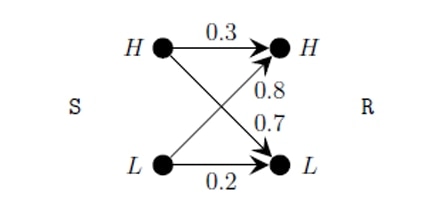
A sender (S) transmits a signal, which can be one of the two kinds: H and L with probabilities 0.1 and 0.9 respectively, to a receiver (R) In the graph below, the weight of edge (u,v) is the probability of receiving v when u is transmitted, where u,v∈{H,L}. For example, the probability that the received signal is L

If the received signal is H, the probability that the transmitted signal was H (rounded to 2 decimal places) is __________.

Answer: 0.04We need to compute the probability that the transmitted signal was H given that the received signal is H, using Bayes' theorem. Read the probabilities from…

Attempted by 6 students.

Show answer & explanation

Correct answer: 0.04

We need to compute the probability that the transmitted signal was H given that the received signal is H, using Bayes' theorem.

  1. Read the probabilities from the diagram:

    P(transmitted H) = 0.1, P(transmitted L) = 0.9; P(received H | transmitted H) = 0.3; P(received H | transmitted L) = 0.8.

  2. Compute the total probability of receiving H:

    P(received H) = 0.3 × 0.1 + 0.8 × 0.9 = 0.03 + 0.72 = 0.75.

  3. Apply Bayes' theorem to get the posterior:

    P(transmitted H | received H) = (0.3 × 0.1) / 0.75 = 0.03 / 0.75 = 0.04.

Final answer: Rounded to two decimal places, the probability is 0.04.

Brief intuition: Although the channel often outputs H when L is sent, L is much more likely to be sent in the first place, so observing H is still more likely to have come from a transmitted L; hence the posterior probability that H was transmitted is small.

Explore the full course: Gate Guidance By Sanchit Sir

Loading lesson…