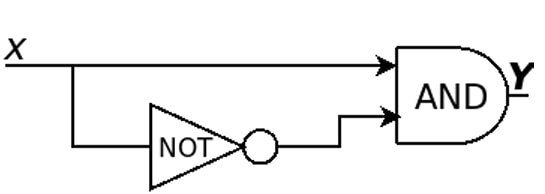
Consider the circuit shown below where the gates may have propagation delays.…
2024
Consider the circuit shown below where the gates may have propagation delays. Assume that all signal transitions occur instantaneously and that wires have no delays. Which of the following statements about the circuit is/are CORRECT?.

- A.
With no propagation delays, the output 𝒀 is always logic Zero
- B.
With no propagation delays, the output 𝒀 is always logic One
- C.
With propagation delays, the output 𝒀 can have a transient logic One after 𝑿 transitions from logic Zero to logic One
- D.
With propagation delays, the output 𝒀 can have a transient logic Zero after 𝑿 transitions from logic One to logic Zero
Attempted by 1098 students.
Show answer & explanation
Correct answer: A, C
Key insight: the two inputs to the AND are X and NOT X, so under instantaneous gate response they are always complements and X AND (NOT X) = 0.
No propagation delays: Both AND inputs change together and remain complementary, therefore the AND output Y is always logic 0.
With propagation delays (hazard explanation):
When X goes 0 → 1: The direct AND input becomes 1 immediately, but the inverter output remains 1 for the inverter's propagation delay. During that brief interval both AND inputs can be 1, so Y can glitch to 1 until the inverter output falls to 0.
When X goes 1 → 0: The direct input becomes 0 immediately and the inverter output stays 0 until it rises to 1. Throughout the transition at least one AND input is 0, so Y remains 0 (no transient low pulse is produced because the output was already 0).
Conclusion: The statement that Y is always 0 with no gate delays is correct. With gate delays, a transient 1 can occur when X rises from 0 to 1, but there is no new transient 0 when X falls from 1 to 0.
A video solution is available for this question — log in and enroll to watch it.