Match each addressing mode in List I with a data element or an element of a…

2026

Match each addressing mode in List I with a data element or an element of a data structure (in a high-level language) in List II:
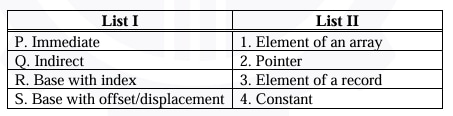
image.png

  1. A.

    P–4, Q–3, R–1, S–2

  2. B.

    P–4, Q–2, R–1, S–3

  3. C.

    P–1, Q–4, R–3, S–2

  4. D.

    P–2, Q–3, R–1, S–4

Attempted by 404 students.

Show answer & explanation

Correct answer: B

To solve this matching question, we need to understand the typical use cases for each addressing mode in high-level programming contexts.

1. Immediate Mode (P): In this mode, the operand is a constant value specified directly within the instruction itself. Therefore, it corresponds to a Constant (4).

2. Indirect Mode (Q): Here, the address field contains the address of the operand, which is stored in a memory location. This is commonly used to access Pointers (2).

3. Base with Index (R): This mode uses a base register and an index register. The base register holds the starting address, and the index register holds the offset. This is typically used to access an Element of an array (1).

4. Base with Offset/Displacement (S): This mode uses a base register and a displacement value. The base register points to the start of a data structure, and the offset points to a specific field. This is used to access an Element of a record (3).

Matching these: P-4, Q-2, R-1, S-3.

Explore the full course: Gate Guidance By Sanchit Sir