

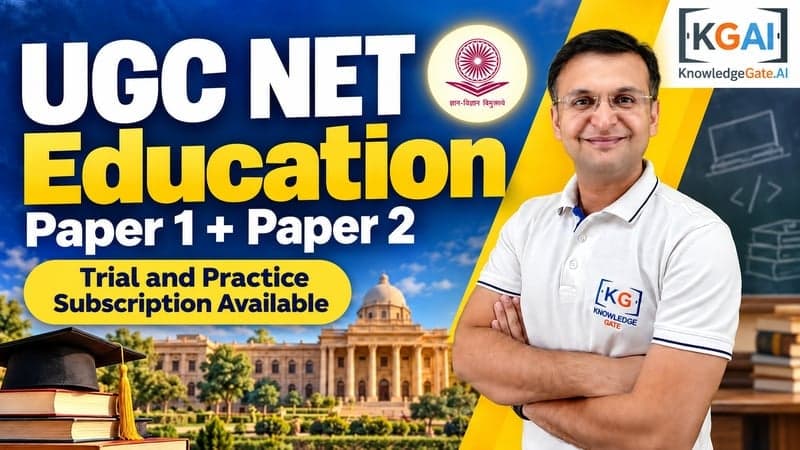
UGC NET Education (Paper 1 + Paper 2)
(Complete Course)
Need help choosing this course?
Our counsellor will help with pricing, syllabus, and enrollment.
About UGC NET Education (Paper 1 + Paper 2)
UGC NET Education (शिक्षाशास्त्र) Paper 1 + Paper 2: NTA PYQs with solutions, Syllabus Hotspots and Goal Slider. Plus plan till Dec 2026 or Jun 2027.
Compare UGC NET Education (Paper 1 + Paper 2) with all courses🎯 UGC NET Education — Paper 1 + Paper 2, एक ही course में Videos से concept समझ आता है, पर सिर्फ videos देखने से selection नहीं होता। Competition बहुत ज़्यादा है। KnowledgeGate कुछ simple ideas पर बना है, जो आपको आगे रखते हैं: 🤖 Platform आपकी कैसे मदद करता है Goal Slider: अपनी category के लिए target score set करें, और रोज़ का exact plan पाएँ: कितने प्रश्न, कौन-से topics, कितनी difficulty। Syllabus Hotspots: real PYQ data से देखें कि NTA कौन-से units और topics सबसे ज़्यादा पूछता है, ताकि ज़रूरी चीज़ पहले पढ़ें। Progress Monitor: topic-wise देखें कि आपके marks कहाँ कट रहे हैं। Leaderboard: देखें कि बाकी NET aspirants के बीच आप कहाँ खड़े हैं। Battles: live प्रश्नों पर दूसरे aspirants से मुकाबला करें। Community: साथी NET aspirants के साथ discuss करें और मिलकर तैयारी करें। One-to-one chat: अपने doubts सीधे पूछें। Course Captain: एक mentor, जो आपकी तैयारी को track पर रखता है। यह क्यों ज़रूरी है: ज़्यादातर coaching institutes आज भी education में technology का इस्तेमाल नहीं कर रहे; वे पुराने, outdated system पर चल रहे हैं। 📚 Course में क्या है Paper 1 (Teaching & Research Aptitude): सभी 10 units, 5,600+ PYQs, solutions के साथ। Paper 2 (Education): UGC syllabus के सभी 10 units, genuine NTA PYQs के साथ (हर हफ़्ते नए papers जुड़ रहे हैं)। दूसरे NET cycles और exams से practice, source tag के साथ। 📝 UGC NET एक नज़र में एक CBT · Paper 1: 50 प्रश्न (100 अंक) · Paper 2: 100 प्रश्न (200 अंक) · 3 घंटे · कोई negative marking नहीं · Dec 2026 के forms खुले हैं। 💳 Plans Trial Course: 5 PYQs and 5 practice questions daily, one Question Battle daily and one mock test. Practice Course: Unlimited PYQs and Practice questions. Unlimited Question Battles, all mock tests, Progress Monitor, Leaderboard and Course Captains. 31 Dec 2026 या 30 Jun 2027 तक valid
Select your plan
Choose trial access or unlock unlimited practice
| Included features | Trial Course | Practice Course |
|---|---|---|
| PYQs | 5 per day | Unlimited |
| Practice questions | 5 per day | Unlimited |
| Question Battles | 1 per day | Unlimited |
| Mock tests | Up to 1 test | All tests |
| Progress Monitor | No | Yes |
| Leaderboard | No | Yes |
| Syllabus Hotspots | Yes | Yes |
| Goal Slider | Yes | Yes |
| Course Captains | No | Yes |
| Price | ₹0 | ₹19950% OFF |
What you get
- Validity
- Until 31 Dec 2026
Course Curriculum
Paper - 1 | Unit - 1 | Teaching Aptitude
- Concept and Objectives of Teaching
- Levels of Teaching
- Learner's Characteristics
- Learning: Nature and Theories
- Cognition, Memory and Metacognition
- Factors Affecting Teaching
- Effective Teaching and the Teacher
- Instructional Objectives and Lesson Planning
- Methods of Teaching
- Offline and Online Teaching Methods
- Teaching Support System
- Evaluation Systems
Paper - 1 | Unit - 2 | Research Aptitude
- Research: Meaning, Features and Scientific Method
- Research Paradigms and Approaches
- Types of Research
- Variables and Measurement
- Methods of Research
- Steps of Research
- Sampling
- Tools and Methods of Data Collection
- Data Analysis and Statistics in Research
- Thesis and Article Writing
- Application of ICT in Research
- Research Ethics
Paper - 1 | Unit - 3 | Comprehension
- Literal Comprehension
- Vocabulary and Language in Context
- Inferential Comprehension
- Critical Comprehension
Paper - 1 | Unit - 4 | Communication
- Communication: Meaning, Nature and Process
- Types and Levels of Communication
- Verbal and Non-verbal Communication
- Semiotics and Meaning
- Models and Theories of Communication
- Effective Communication
- Barriers to Communication
- Classroom Communication
- Mass Media: Types and Evolution
- Mass Media and Society
- Digital and New Media
Paper - 1 | Unit - 5 | Mathematical Reasoning and Aptitude
- Number System and Simplification
- Algebra and Ages
- Percentage
- Ratio, Proportion, Partnership and Mixtures
- Averages
- Profit, Loss and Discount
- Simple and Compound Interest
- Time and Work
- Speed, Time and Distance
- Mensuration and Geometry
- Permutation, Combination and Probability
- Series
- Coding-Decoding
- Relationships, Directions and Ranking
- Arrangements, Puzzles, Clock and Calendar
Paper - 1 | Unit - 6 | Logical Reasoning
- Structure and Forms of Arguments
- Language and Categorical Propositions
- Categorical Syllogism and Fallacies
- Deductive, Inductive and Analogical Reasoning
- Venn Diagrams
- Indian Logic: Pramanas, Anumana and Hetvabhasa
- Philosophical Logic: Aristotle, Kant and Vaisheshika
Paper - 1 | Unit - 7 | Data Interpretation
- Data and Graphical Representation
- Data Interpretation: Tables
Paper - 1 | Unit - 8 | Information and Communication Technology
- Computer Fundamentals and Hardware
- Memory, Storage and Data Representation
- Computer Software
- Office Applications
- Multimedia and File Formats
- Computer Networks
- Internet and World Wide Web
- Email and Online Communication
- Cyber Security
- Digital Ethics, IPR and Society
- Cloud and Distributed Computing
- Emerging Technologies
- ICT in Education and Governance
- Cyber Threats and Malware Attacks
- Role of Internet and Web Services
- Electronic Data Interchange and E-Commerce
- Internet Fundamentals
- Web Design & Development
- Web Publishing & Hosting
- Emerging Technologies
- Website, Browser & Services
- Protection of Geographical Indications
Paper - 1 | Unit - 9 | People Development and Environment
- Ecosystems and Biodiversity
- Human and Environment Interaction
- Development and Environment
- Natural Resources – Forests, Water and Soil
- Energy Resources
- Air Pollution
- Water Pollution and Treatment
- Noise Pollution
- Waste Management
- Environmental Health and Toxicology
- Climate Change and Global Environmental Issues
- Natural Hazards and Disaster Management
- Indian Environmental Laws and Policies
- International Environmental Agreements
- Environment
- Geography
- Factory and Industry Systems
Paper - 1 | Unit - 10 | Higher Education System
- Education in Ancient India
- Ancient Centres of Higher Learning
- Colonial Education Policies and Commissions
- Colonial Colleges, Universities and Reformers
- Education Commissions and Policies after Independence
- National Education Policy 2020
- Types of Higher Education Institutions
- Learning Programmes and Academic Credits
- Professional, Technical and Skill-Based Education
- Value Education and Environmental Education
- Governance, Administration and Financing
- Regulation, Accreditation and Ranking
- Indian Polity and Governance (Legacy Unit 10)
- Polity
- General Awareness
Full Notes
Paper 2 | Unit 1 | Educational Studies
- Indian Schools of Philosophy
- Western Schools of Philosophy
- Sociological Approaches to Education
- Foundations of Educational Philosophy
- Modern Educational Philosophies
- Education and Culture
- Education and Social Change
- Social Movements
- Indian Educational Thinkers
- Western Educational Thinkers
- National Values in the Constitution
Paper 2 | Unit 2 | History, Politics and Economics of Education
- Educational Policy and Planning Process
- Economics of Education
- Politics and Education
- Education in Pre-Independence India
- Education Commissions of Independent India
- Education Policies and Constitutional Provisions
- Educational Finance and Budgeting
Paper 2 | Unit 3 | Learner and Learning Process
- Growth and Development
- Intelligence
- Thinking, Problem Solving, Metacognition, Creativity
- Cognitive Processes and Cognitive Development
- Personality
- Mental Health and Adjustment
- Learning: Nature, Factors and Motivation
- Behaviourist Theories of Learning
- Cognitive Theories of Learning
- Social Learning and Social Cognition
- Guidance
- Counselling
Paper 2 | Unit 4 | Teacher Education
- Knowledge Base and Reflective Teaching
- In-service Teacher Education
- Teaching Profession and Professionalism
- Nature, Types and Curriculum
- Transactional Approaches
- Models of Teacher Education
- Agencies and Institutions
Paper 2 | Unit 5 | Curriculum Studies
- Models of Curriculum Design
- Curriculum Change and Research
- Concept and Principles of Curriculum
- Foundations of Curriculum Planning
- Curriculum Development: Strategies and Process
- Models of Curriculum Development
- Curriculum Transaction
- Curriculum Evaluation
Paper 2 | Unit 6 | Research in Education
- Educational Research and Scientific Method
- Qualitative Data Analysis
- Qualitative and Mixed-method Designs
- Types and Approaches of Research
- Research Problem, Proposal and Report
- Variables and Hypotheses
- Population and Sampling
- Historical and Descriptive Research
- Experimental Research
- Research Tools and Techniques
- Descriptive Data Analysis
- Correlation and Regression
- Inferential Statistics and Hypothesis Testing
Paper 2 | Unit 7 | Pedagogy, Andragogy and Assessment
- Andragogy
- Assessment: Meaning, Perspectives and Types
- Pedagogy and Pedagogical Analysis
- Organising Teaching: Levels of Teaching
- Objectives, Outcomes and Domains of Learning
- Tests and Score Interpretation
- Assessment and Feedback in Pedagogy
Paper 2 | Unit 8 | Technology in/ for Education
- Educational Technology as a Discipline
- Instructional Design
- Computers in Education and E-learning
- Emerging Trends in E-learning
- ICT in Evaluation, Administration and Research
- Instructional Implications of Learning Theories
- Programmed Instruction
Paper 2 | Unit 9 | Educational Management, Administration and Leadership
- Models of Leadership
- Quality in Education
- Concept, Principles and Functions
- Approaches to Management and Administration
- Planning and Management Techniques
- Organisational Behaviour
- Foundations and Styles of Leadership
- Approaches to Leadership
- Change Management and Cost of Quality
- Quality Assurance Agencies
Paper 2 | Unit 10 | Inclusive Education
- Barriers, Facilitators, Ethics and Research
- Philosophy and Evolution of Inclusion
- Diverse and Disadvantaged Learners
- National Policies and Disability Laws
- International Inclusion and Rights
- Disability Concepts and Classification
- Intellectual, Developmental and Learning Needs
- Physical and Sensory Needs
- Identification and Educational Assessment
- Inclusive Schools and Support Services
- Curriculum and Individualized Instruction
- Assistive and Adaptive Technology
Instructors
Sanchit Jain
Latest from the Blog
UGC NET Paper 1 Higher Education Timeline: Institutions, Commissions, Policies and Digital Initiatives
Turn disconnected Higher Education dates into a classified timeline. Learn the ancient centres, modern bodies, policies and digital initiatives through worked ordering drills.
Updated 3 Sep 20266 min read95 viewsNET Strategy & Updates
UGC NET Paper 1 Mathematical Aptitude: 6-Topic Formula Roadmap
Build Mathematical Aptitude in dependency order, then use worked checks and a 30-minute loop to turn six formula groups into reliable solving habits.
Updated 24 Aug 20266 min read200 viewsNET Strategy & Updates
UGC NET Paper 1 Data Interpretation: Timed Methods for Tables and Charts
Learn a seven-minute practice routine for DI sets. Work through percentages, ratios, tables, line charts and pie charts without losing track of the base or unit.
Updated 22 Aug 20266 min readNET Strategy & Updates
Frequently Asked Questions
UGC NET (Dec 2026 cycle) में Education subject से बैठने वाले aspirants के लिए, चाहे target JRF हो या Assistant Professor। Paper 1 और Paper 2 दोनों एक ही course में हैं।
Paper 1 (Teaching & Research Aptitude) के सभी 10 units, 5,600+ PYQs, solutions के साथ। Paper 2 (Education) के UGC syllabus के सभी 10 units, NTA PYQs के साथ, और हर हफ़्ते नए papers जुड़ रहे हैं। साथ में दूसरे NET cycles और exams से practice, source tag के साथ।
एक CBT, 3 घंटे का। Paper 1 में 50 प्रश्न (100 अंक) और Paper 2 में 100 प्रश्न (200 अंक)। कोई negative marking नहीं है।
Goal Slider आपके target score को रोज़ के plan में बदलता है। Syllabus Hotspots दिखाते हैं कि NTA कौन-से units सबसे ज़्यादा पूछता है। Progress Monitor बताता है कि marks कहाँ कट रहे हैं। Leaderboard और Battles से पता चलता है कि बाकी aspirants के बीच आप कहाँ हैं।
Plus plan दो validity में मिलता है: 31 Dec 2026 तक (Dec 2026 exam के लिए) या 30 Jun 2027 तक (June 2027 exam भी शामिल)। अभी की price इसी page पर दिखती है। Plus में दोनों papers के सारे PYQs और practice प्रश्न, solutions, सारे AI tools, community और आपका Course Captain शामिल हैं।
This is a recruitment conducted by UPPSC for Computer Science Lecturer posts at government polytechnic institutes in Uttar Pradesh. It is a subject-specific exam, so preparation is centred on computer science topics at a level appropriate for a lecturer post rather than general teaching-aptitude content.
MPPSC Assistant Professor recruitment is for college-level teaching posts, so the Computer Science paper is aimed at candidates with an academic background in the subject rather than school-level teaching topics. The KnowledgeGate course is built around this exam's syllabus specifically.
The UPPSC Polytechnic Lecturer 2025 (CS) course is a structured preparation programme designed for aspirants aiming to secure this post, working through the computer science syllabus relevant to the exam. It is paired with the UPPSC Polytechnic Lecturer (Computer Science) Test Series for practice.
The MPPSC Assistant Professor (CS) 2026 course is a structured and comprehensive programme designed by Sanchit Sir for aspirants preparing for this recruitment, following the same exam-focused approach used across KnowledgeGate's other government teaching-exam courses. The MPPSC Assistant Professor (CS) 2026 Test Series that accompanies it is built around the same syllabus, giving aspirants both structured lessons and matching practice from one source.
The UPPSC Polytechnic Lecturer (Computer Science) Test Series is offered as its own course alongside the main UPPSC Polytechnic Lecturer 2025 (CS) course, so check the individual course pages for how each is structured and whether you need one or both for your preparation.
What Our Students Say
Real results, in our students' own words.

Hello mates... I qualified ugc net dec 2025 with the help of the knowledge gate team ... Their plan and support all helped me to make the consistency and discipline during my preparation. The whole team from the operation to the academic put their efforts to solve the problem in the most early way... I'm grateful to be part that i choose this platform for the preparation
 Tushtee .UGC NET Aspirant
My name is Mohtashim Ali. I appeared for UGC-NET June 2026 in Computer Science under the General category. I scored 176 marks and qualified for PhD admission. KnowledgeGate helped me throughout my preparation through its recorded videos, concept-based classes, PYQ practice, notes, tests, doubt support, and easy-to-use learning platform. The concept-based teaching and recorded lectures helped me the most because they made complex Computer Science topics easier to understand and allowed me to learn at my own pace. The PYQ practice also helped me understand the exam pattern better. KnowledgeGate played an important role in my preparation and achieving this result. My advice to other aspirants is to stay consistent, focus on understanding concepts, and practice PYQs regularly. UGC-NET preparation requires patience and proper planning, so it is important to revise regularly and identify your weak areas. I would recommend KnowledgeGate because of its structured content, concept-based teaching, quality study material, and helpful learning platform.
Mohtashim AliUGC NET Qualified
My name is Shivang Sharma. I appeared for UGC-NET June 2026 in Computer Science subject under the general category. I scored 184 marks and qualified for Assistant professor. I prepared for both UGC NET Paper 1 and Paper 2 through Knowledge Gate, and my experience has been really great. I have qualified UGC NET twice, and Knowledge Gate played a very important role in my preparation. The PYQs provided by Knowledge Gate helped me a lot in understanding the actual exam pattern and the type of questions asked. In fact, I found some questions in the actual UGC NET exam that were directly or very closely related to the PYQs I had practiced. I would especially like to appreciate Sanchit Sir for his teaching style. His way of explaining concepts is very clear and easy to understand. Because of his conceptual approach, many topics that initially seemed difficult became much easier for me, and my concepts became strong. The combination of concept clarity, quality lectures, and well-selected PYQs helped me prepare effectively for both Paper 1 and Paper 2.
Shivang SHARMAUGC NET QualifiedRe-engaging with studies after 8 years seemed tough, but KnowledgeGate completely transformed my preparation and in 3 months I gained clarity on concepts I had never understood this well, and the score is far beyond what I had initially expected. The PYQs and course structure were the key game-changers for me.Truly grateful to the entire team
Dawinder SinghUGC NET Qualified
My name is Neha Kaushik. I appeared for UGC-NET 2026 in Computer Science subject under the Unreserved category. I scored 178 marks and qualified for assistant professor. KnowledgeGate helped me through its recorded classes, PYQ practice, notes, tests, doubt and support and easy-to-use learning platform. Sanchit sir live lectures helped me the most because he explains each concept very well and give a clear understanding. It played an important role in my preparation and result. My advice to other aspirants is, i would recommend KnowledgeGate because if u want to qualify JRF or NET then this is the best path.
Neha KaushikUGC NET QualifiedHello, my name is Manisha Kumari. I appeared for UGC-NET June 2026 in Computer Science subject. I scored 170 marks and qualified for Assistant Professor. I am very happy with my result. KnowledgeGate helped me a lot through its concept-based classes, recorded lectures, PYQs, notes, tests and doubt support. The PYQ practice and revision helped me the most. My advice is to stay consistent, focus on concepts, and practice PYQs regularly. I would definitely recommend KnowledgeGate for its simple and effective learning approach with good study material and practice. Thanks!
Manisha kumariUGC NET Qualified