From amongst the figures marked (1), (2), (3) and (4), select the figure which…
2026202320242023
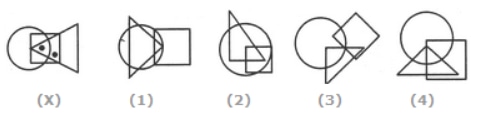
From amongst the figures marked (1), (2), (3) and (4), select the figure which satisfies the same conditions of placement of the dots as in figure (X).
Answer: D. 4 — Concept. In a dot-situation problem a dot is never described by where it sits on the page. A dot is described by the set of shapes that enclose it, so every…
- A.
1
- B.
2
- C.
3
- D.
4
Attempted by 1914 students.
Show answer & explanation
Correct answer: D
Concept. In a dot-situation problem a dot is never described by where it sits on the page. A dot is described by the set of shapes that enclose it, so every dot names one region — the common area of exactly those shapes and no others. Two arrangements agree on a dot only when the second one offers a region made of the very same combination of shapes.
Applying it to figure (X). Figure (X) is built from three shapes: a circle on the left, a square in the middle, and a triangle whose apex points left into the square. Read each dot as a set of enclosing shapes:
The upper dot lies within the circle, within the square and within the triangle at the same time, so it occupies the circle–square–triangle common area.
The lower dot lies within the square and within the triangle while staying beyond the circle’s boundary, so it occupies the square–triangle common area that falls outside the circle.
Requirement. The matching arrangement must therefore offer both of these areas at once: a three-way circle–square–triangle area, and a square–triangle area that lies outside the circle.
Cross-check of the answer figures. Each answer figure is tested against the two required areas:
Answer figure | Square–triangle area outside the circle | Circle–square–triangle area |
|---|---|---|
(1) | absent — the triangle’s apex stops inside the circle, so square and triangle meet only within it | present |
(2) | absent — the square–triangle overlap lies wholly within the large circle | present |
(3) | present — the tilted square and the triangle overlap clear of the circle | absent — the circle never reaches the square–triangle overlap |
(4) | present — the triangle and square overlap below and right of the circle | present — the circle, square and triangle share a central patch |
Result. The figure marked (4) is the single arrangement that supplies both areas, so it alone can carry one dot in the circle–square–triangle common area and the other in the square–triangle area outside the circle, exactly as in figure (X).
Takeaway. Convert every dot into its list of enclosing shapes first, then scan the answer arrangements for those exact lists; comparing pictures as a whole is far slower and far less reliable.
Explore the full course: Tcs Ignite Smart Hiring Test Series