Refer to the representation of two queries in RA below: Identify the correct…
Refer to the representation of two queries in RA below:
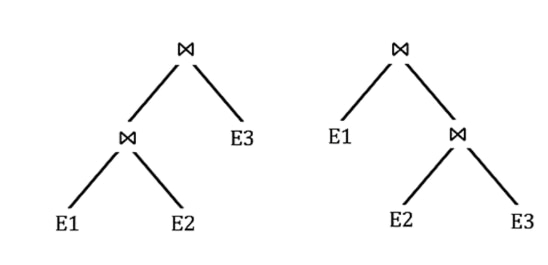
Identify the correct statement.
Answer: D. The queries are equivalent as natural join operations are associative — Answer: (E1 ⋈ E2) ⋈ E3 = E1 ⋈ (E2 ⋈ E3) Reason: The natural join is associative. Grouping of joins does not affect the final set of tuples because natural…
- A.
The queries are not equivalent
- B.
The queries are equivalent as selection operations are associative
- C.
The queries are equivalent as theta join operations are commutative
- D.
The queries are equivalent as natural join operations are associative
Attempted by 216 students.
Show answer & explanation
Correct answer: D
Answer: (E1 ⋈ E2) ⋈ E3 = E1 ⋈ (E2 ⋈ E3)
Reason: The natural join is associative. Grouping of joins does not affect the final set of tuples because natural join returns tuples that agree on all common attributes, and these agreement conditions are unaffected by the order in which pairs of relations are joined.
Key idea: equality checks between attributes are global and do not depend on grouping.
Concrete example:
Let E1(A,B), E2(B,C), E3(C,D). Both (E1 ⋈ E2) ⋈ E3 and E1 ⋈ (E2 ⋈ E3) produce tuples (A,B,C,D) where B and C values agree as required. Neither grouping drops or changes the conditions, so the final result is the same.