Consider the following rules while substituting numbers in the given grid: The…
2025
Consider the following rules while substituting numbers in the given grid:
The numbers substituted in each cell of a particular column must be unique and should add up to the number given in the topmost cell of the corresponding column.
The numbers substituted in each cell of a particular row must be unique and should add up to the number given in the first cell of the corresponding row.
The numbers to be used are from 1 to 9 only.
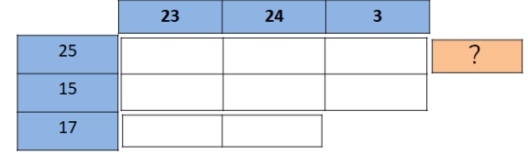
Determine the number that will be present in place of ?
- A.
7
- B.
3
- C.
1
- D.
9
Attempted by 1 students.
Show answer & explanation
Correct answer: A
Concept: In a sum-constrained number grid, every row's cells (other than its row label) must add up to the number shown in that row's label, and every column's cells (other than its column label) must add up to the number shown in that column's label, using unique digits from 1 to 9 within each row and within each column - the same 'no repeated digit, fixed total' rule used in Kakuro-style grids.
Application:
Row 1's label is 25, and the three filled cells in that row already show 9, 8 and 1, which add up to 9 + 8 + 1 = 18.
All four cells in row 1 (the three filled cells plus the orange '?' cell) must add up to 25, so the missing cell equals 25 - 18 = 7.
Checking uniqueness, 7 has not already been used elsewhere in row 1 (9, 8, 1), so it satisfies the rule that no digit repeats within a row.
Cross-check:
Column 1 (target 23): 9 + 6 + 8 = 23.
Column 2 (target 24): 8 + 7 + 9 = 24.
Column 3 (target 3): 1 + 2 = 3.
Row 2 (target 15): 6 + 7 + 2 = 15.
Row 3 (target 17): 8 + 9 = 17.
Every row and column already matches its target using unique digits from 1 to 9, confirming the grid is internally consistent and that the missing value in the orange cell is 7.