Directions: The table given below shows information about total number of…
2023
Directions: The table given below shows information about total number of products sold by five shops (A, B, C, D and E) over three days (Monday, Tuesday and Wednesday). Read the data carefully and answer the question.
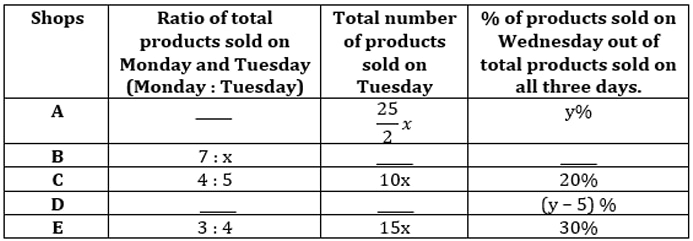
Note: (i) The difference between the total number of products sold by C and E across all three days is 120.
(ii) The total number of products sold by D across all three days is 120.
(iii) Some data are missing; calculate them if required.
In shop A, the ratio of total products sold on Monday to Tuesday is 8 : 5, and the total number of products sold by shop A on Wednesday is 12.5% less than that on Monday. If D sold 40% of its products on Monday, then find the total number of products sold by D on Tuesday.
Answer: D. 36 — ConceptIn a data-interpretation table where each shop's three-day total is split across Monday, Tuesday and Wednesday, the Wednesday figure is given as a…
- A.
40
- B.
48
- C.
42
- D.
36
- E.
24
Attempted by 12 students.
Show answer & explanation
Correct answer: D
Concept
In a data-interpretation table where each shop's three-day total is split across Monday, Tuesday and Wednesday, the Wednesday figure is given as a percentage of that shop's own three-day total. So Monday + Tuesday = (100% - Wednesday%) of the total, and any single day can be found once the total and the other shares are fixed. The unknown multiplier x is pinned by an external relation between two shops' totals, and the percentage unknown y is pinned by one shop whose three actual day-values are fully derivable.
Step 1 - Find the multiplier x
For C: Tuesday = 10x and Monday : Tuesday = 4 : 5, so Monday = (4/5)(10x) = 8x. Then Monday + Tuesday = 18x. Wednesday is 20% of C's total, so 18x is 80% of it: total of C = 18x / 0.8 = 22.5x.
For E: Tuesday = 15x and Monday : Tuesday = 3 : 4, so Monday = (3/4)(15x) = 11.25x. Then Monday + Tuesday = 26.25x. Wednesday is 30% of E's total, so 26.25x is 70% of it: total of E = 26.25x / 0.7 = 37.5x.
Note (i): the gap between C's and E's three-day totals is 120, i.e. 37.5x - 22.5x = 15x = 120, hence x = 8.
Step 2 - Find the percentage y using shop A
A's Tuesday = (25/2)x = 12.5 x 8 = 100, and Monday : Tuesday = 8 : 5, so Monday = (8/5)(100) = 160.
A's Wednesday is 12.5% less than its Monday: Wednesday = 160 x (1 - 0.125) = 140.
A's three-day total = 160 + 100 + 140 = 400, and Wednesday is y% of this total, so y = (140 / 400) x 100 = 35.
Step 3 - Apply to shop D
D's three-day total is given as 120 by Note (ii).
D's Wednesday share is (y - 5)% = (35 - 5)% = 30%, so D's Wednesday = 30% of 120 = 36.
D sold 40% of its products on Monday, so D's Monday = 40% of 120 = 48.
Therefore D's Tuesday = total - Monday - Wednesday = 120 - 48 - 36 = 36.
Cross-check
Adding the three days back for D: 48 (Mon) + 36 (Tue) + 36 (Wed) = 120, which matches the given three-day total, and Monday's 48 is exactly 40% of 120 as stated. The answer is 36.