Consider the following logic circuit whose inputs are functions f₁, f₂, f₃ and…
GATE · 2002 · CS · Question 2 subparts
Consider the following logic circuit whose inputs are functions f₁, f₂, f₃ and whose output is f.
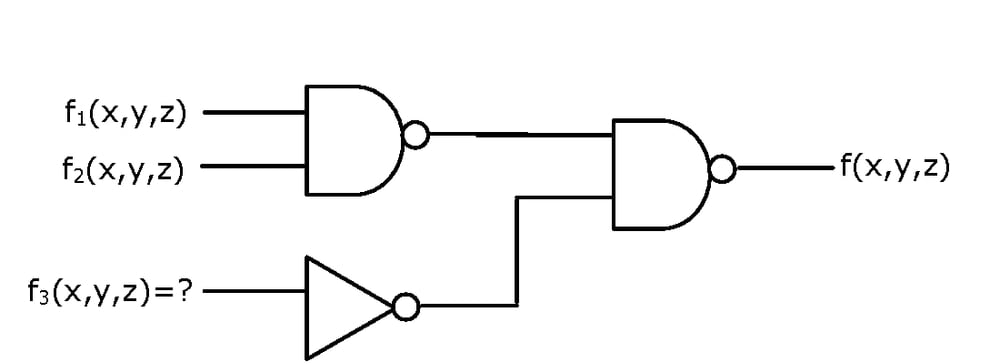
Given that
f1(x, y, z) = ∑(0, 1, 3, 5),
f2(x, y, z) = ∑(6, 7) and
f(x, y, z) = ∑(1, 4, 5),
f₃ is:
- A.
∑(1, 4, 5)
- B.
∑(6, 7)
- C.
∑(0, 1, 3, 5)
- D.
None of these
Attempted by 130 students.
Sign up free to check your answer
Sign up freeLoading lesson…