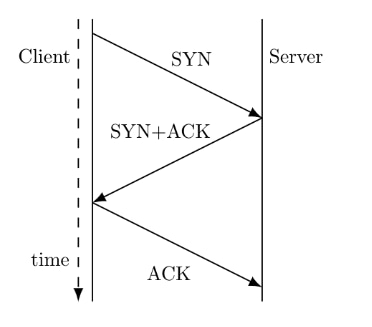
The three way handshake for TCP connection establishment is shown below. Which…
2008
The three way handshake for TCP connection establishment is shown below.

Which of the following statements are TRUE?
(S1) Loss of SYN + ACK from the server will not establish a connection
(S2) Loss of ACK from the client cannot establish the connection
(S3) The server moves LISTEN → SYN_RCVD → SYN_SENT → ESTABLISHED in the state machine on no packet loss
(S4) The server moves LISTEN → SYN_RCVD → ESTABLISHED in the state machine on no packet loss.
- A.
S2 and S3 only
- B.
S1 and S4
- C.
S1 and S3
- D.
S2 and S4
Attempted by 167 students.
Show answer & explanation
Correct answer: B
Answer: S1 and S4 are true; S2 and S3 are false.
Key ideas:
Three-way handshake sequence (no packet loss): client sends SYN → server receives SYN and moves LISTEN → SYN_RCVD and sends SYN+ACK → client receives SYN+ACK and sends ACK → both sides move to ESTABLISHED.
Server state transitions on passive open: LISTEN → SYN_RCVD → ESTABLISHED (it does not go to SYN_SENT, which is a client active-open state).
Statement-by-statement explanation:
S1 (Loss of SYN+ACK from the server will not establish a connection): True. If the client does not receive the SYN+ACK, it will not send the final ACK, so the connection is not established at that time (the server remains in SYN_RCVD and will retransmit).
S2 (Loss of ACK from the client cannot establish the connection): False. The client sends the ACK and moves to ESTABLISHED; if that ACK is lost, the server will retransmit the SYN+ACK and the client will send the ACK again. Thus a lost ACK does not permanently prevent establishment — the connection can still become established via retransmission.
S3 (The server moves LISTEN → SYN_RCVD → SYN_SENT → ESTABLISHED on no packet loss): False. SYN_SENT is the state used by the active opener (client), not the passive opener (server). The server does not enter SYN_SENT in the normal passive-open handshake.
S4 (The server moves LISTEN → SYN_RCVD → ESTABLISHED on no packet loss): True. This matches the standard passive-open state transitions when the handshake completes without loss.
Conclusion: The correct true statements are S1 and S4.
A video solution is available for this question — log in and enroll to watch it.