Two positions of a dice are shown below. If the number '1' is on the top, what…
2023202420242024
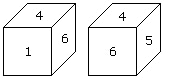
Two positions of a dice are shown below. If the number '1' is on the top, what number will be at the bottom?
Answer: C. 5 — Concept: When two positions of the same die are shown, look for a face that appears in both positions in the same place (a common face). Fixing that common…
- A.
2
- B.
3
- C.
5
- D.
6
Attempted by 45 students.
Show answer & explanation
Correct answer: C
Concept: When two positions of the same die are shown, look for a face that appears in both positions in the same place (a common face). Fixing that common face lets you track how the other four faces rotate together as a single cycle; matching that rotation across the two views tells you exactly which pairs of faces are opposite each other. Opposite faces are the ones that can never appear together in a single view of a cube (only the front-back, left-right, and top-bottom pairs are opposite).
In the first position, the top face is 4, the front face is 1, and the right face is 6.
In the second position, the top face is still 4, the front face is 6, and the right face is 5 - since the top face (4) is common to both positions, the die has simply been turned about its vertical (top-bottom) axis.
The value that was on the right face in the first position (6) is now on the front face in the second position - this matches a quarter-turn of the die about the vertical axis.
Under that quarter-turn, the face that had been at the back in the first position takes up the right-face position in the second; comparing the second position's right face (5) shows that 5 was the back face in the first position.
The front face and the back face of a cube are always directly opposite each other, so the front face of the first position (1) is opposite its back face, which is 5.
Cross-check: 1 and 5 never appear together in either given position, consistent with them being opposite (opposite faces can never both be visible in the same view), while 1 and 6 do appear together in the first position, confirming 6 is only adjacent to 1, not opposite it.
So when 1 is on the top, 5 is at the bottom.